
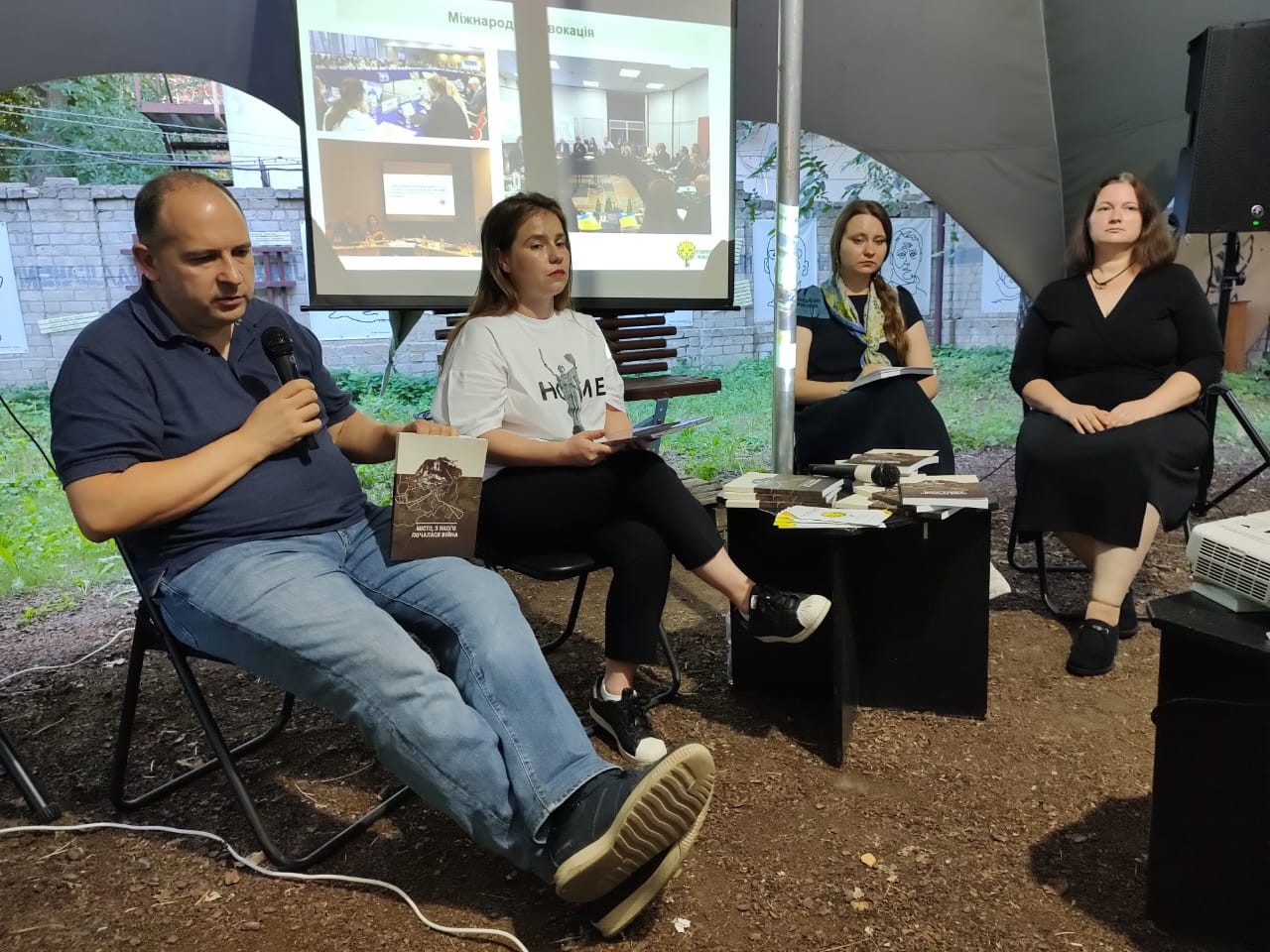
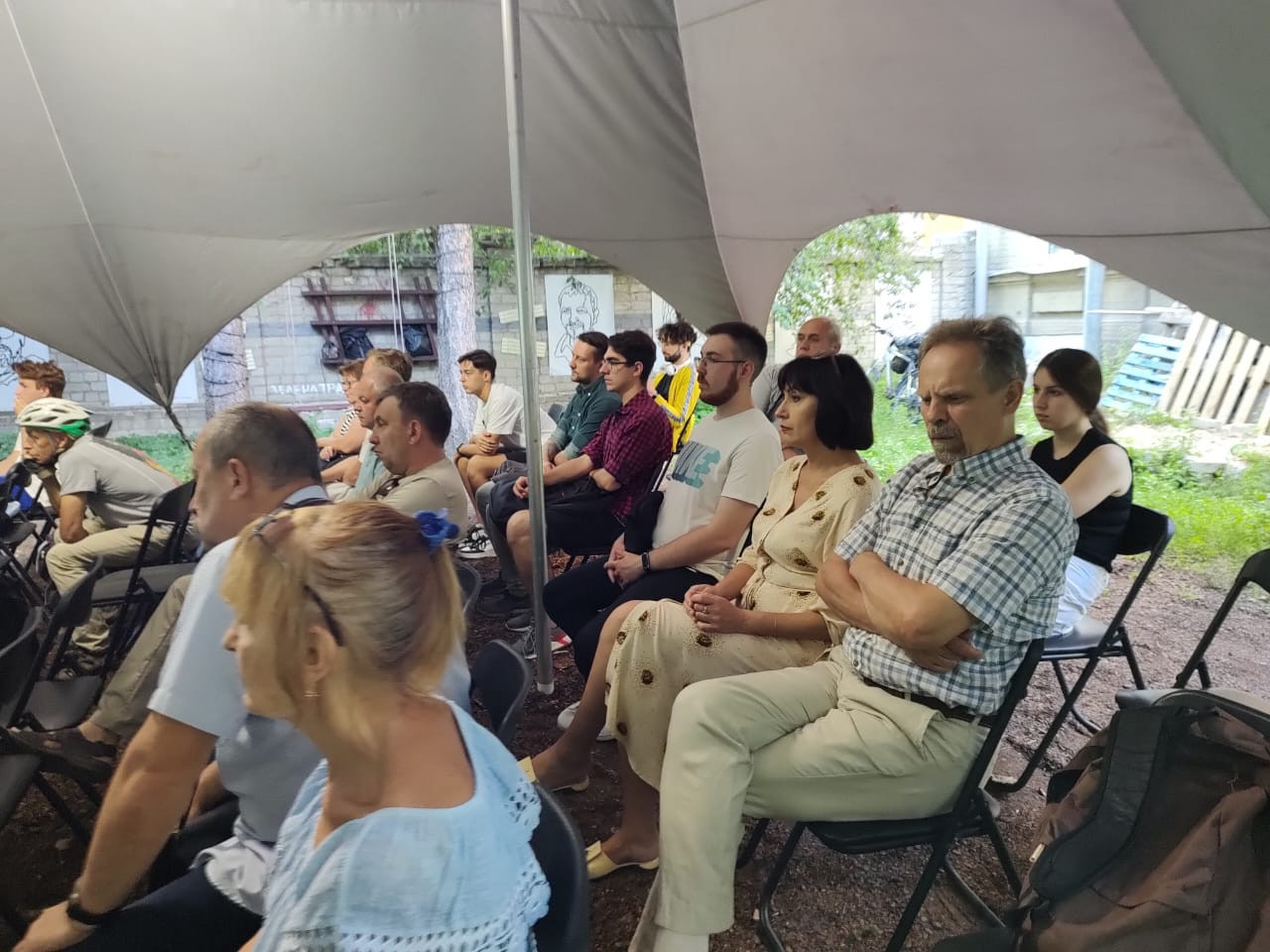
On August 17, the Kharkiv Literary Museum hosted the presentation of the book “The City Where the War Began” about the occupation of Sloviansk in 2014 made by human rights defenders from the Eastern Ukrainian Center for Civic Initiatives.
Volodymyr Shcherbachenko, head of EUCCI, noted that the book was based on real memories of people who had been in the city then, had fought for it, and had experienced those events first hand. He added that for ther book the authors had chosen subjects that traditionally didn’t get that much attention.
“We tried to take topics that are perhaps less obvious than what is usually said about the war. Traditionally, we think of war in terms of combat and military service members. It’s absolutely right, from the point of view that the events at the front line determine the lives of all of us. But war is also the lives of civilians, state and non-state institutions that exist in our cities.”
As an example, the book has separate chapters devoted to illegal places of detention, forced labor, mine placing in civilian facilities, the operations of medical institutions during the occupation. A separate chapter speaks about various ways in which children were involved in illegal armed organizations, etc.
Maria Takhtaulova, head of the North-Eastern Interregional Department of the Ukrainian Institute of National Remembrance, who was the event co-host, noted that such memories are very important. They make history more human and become platforms for sharing the experiences by different people from different regions.
During the presentation of the book, there was a discussion of the fate of other cities that had to face Russian aggression.
Residents of Kharkiv shared their thoughts on how they managed to resist the Russian occupation both in 2014 and in 2022. Some argued that in 2014 the city was able to defend itself thanks to the force method and the overwhelming power of the “Jaguar” Special Operations Regiment from Vinnytsia. As for the events of the full-scale invasion, the Armed Forces of Ukraine, local territorial defense, as well as qualitative changes in the Kharkiv residents’ mentality and their self-organization played a role here.
Luhansk was another city whose fate was mentioned in the context of the occupation. Victoria Minakova, a Luhansk native, spoke about her life in the city before its occupation. The woman shared memories of her husband Mykhailo who had launched non-violent resistance against Russian aggression in 2014 and had been imprisoned for it. In 2022, Mykhailo volunteered for the ranks of the Armed Forces of Ukraine and died in combat in the north of Luhansk Region.
“It’s sad, but volunteers from the occupied territories cannot be buried in the land they fought for now. But I know that one day I will have the opportunity to fulfill Mykhailo's last will. The Ukrainian flag will fly over Luhansk, and in Luhansk, unfortunately, there will be an alley of heroes who gave their lives for its liberation.”

The book “The City Where the War Began” was prepared by the NGO Eastern Ukrainian Center for Civic Initiatives together with several partner organizations (the "Vostok SOS" Charity Foundation, the Human Rights Center for Public Research, the NGO Young Transcarpathian Educators, and the NGO Public Committee for the Protection of Constitutional Rights and Freedoms of Citizens – all are members of the Coalition "Justice for Peace in Donbas"), with the support of the German NGO Kurve Wustrow within the framework of the "Civil Peace Service", funded by the German Federal Ministry for Economic Cooperation and Development.
