
Horror and Disgust in Luhansk. Five Minutes on the Birth of Hatred
Things around us become real when there are words for them. We had no words for what started in Eastern Ukraine in the spring of 2014, and we searched for the right words for years. Those other people (Russian occupiers) with the “Georgian ribbons” had a dictionary prepared in Moscow, well in advance: “opolchenie” (people’s militia), “Russian spring”, “Novorossiya” (New Russia), “ukropy” , “natsyki” (nationalists).
Things and phenomena finally become reality when we experience them physically. When you trip over the “porebryk” (curb), or when your jacket gets wet from the rain. For me, the “Luhansk People’s Republic” (LPR) became a real thing when in the commandant’s office I heard: “Well, what do you mean by ‘What should we do?’ To the podval, he goes.”
Even then, the brain resisted. No, it’s not about me, it’s not happening to me. What podval are you talking about? Rubbish! But the podval turned out to be quite real: under a flight of stairs, with a grate instead of a door, with two banquettes along the walls, cardboard on the concrete floor where we later slept, and a couple of dirty blankets. Yeah, this is happening to you, dude. What was the point of saying you are a journalist at the checkpoint?
Lubyanka podvaly in the “LPR government building”
“My name is Nikolay Nikolaevich. My last name is Pavlov”, he introduced himself and sat down at the head of the table.
Beginning of June 2014, they captured the regional administration building. The editors of the Luhansk newspapers wanted answers that Pavlov, the “LPR Press Secretary” did not have. Therefore, he called someone who could provide those answers. A short, stout man with oily, slicked back, black hair and a week’s stubble strode into the conference room. He put his AK gun in the corner near the door. He was wearing a black vest, camouflage pants, and fingerless gloves. He spoke with a peculiar Moscow accent. “Where am I from? I’m a local, from Luhansk.” And indeed, he had the answer:
“Well, no one cancelled ‘Lubyanka’s podvaly.’”
It was sincere. At that time, we did not know that one of these “Lubyanka’s podvaly” was located in that very building. In three months, I would have an opportunity to appreciate its hospitality.
In a few years, I managed to find out who that “Pavlov” actually was. His real name is Pavel Karpov. He turned out to be a Russian spin doctor from the orbit of Vladislav Surkov, the then adviser to the President of the Russian Federation, and a friend of Aleksandr Boroday, another puppet ruler from Moscow. At that very time, Boroday became the “Prime Minister” of the neighbouring “Donetsk People’s Republic” and later was an adviser to the “Head” of the “DPR”, Oleksandr Zakharchenko. “Lubyanka’s podvaly”, yeah right.
When, in September, we were brought from the commandant’s office to the “Government House,” we were lined up on our knees along the wall, ordered to raise our hands and place our palms against the wall. They kept us that way for… I don’t know how long—10, 15, 20 minutes? It seemed endless. It doesn’t seem difficult but try to remain like this for at least five minutes. Those who were leaning against the wall were kicked in the kidneys by drunken jailers, who didn’t even have to raise their legs too high.
By that time, the “Head of the Republic” had already changed. Valery Bolotov, the first “People’s Governor”, disappeared somewhere in the Russian Federation, and Ihor Plotnytsky, who commanded the “Zarya” battalion in the summer, became the “Head” instead. He was accompanied by a bodyguard—a regular Russian soldier. I saw this bodyguard in person when he came down to our podval.
Shelling for the sake of mobilization
July 2014 again. It was later that we learned to distinguish outgoing shelling from incoming. That night, the wooden floors of the Stalin-era building trembled, and I thought: “It would be embarrassing if the house is suddenly hit, and I would be found under the rubble in only my underwear.” However, that was outgoing shelling. They fired from my house. In the morning, the “LPR” reported that “ukropyfired at Verhunka”, a settlement in the urban strip of Luhansk.
“Let them just come. For this, I will tear them apart with my teeth”, a 50-year-old comrade told me. He came to build a checkpoint near Verhunka—I would not be surprised if he joined the militia at that time.
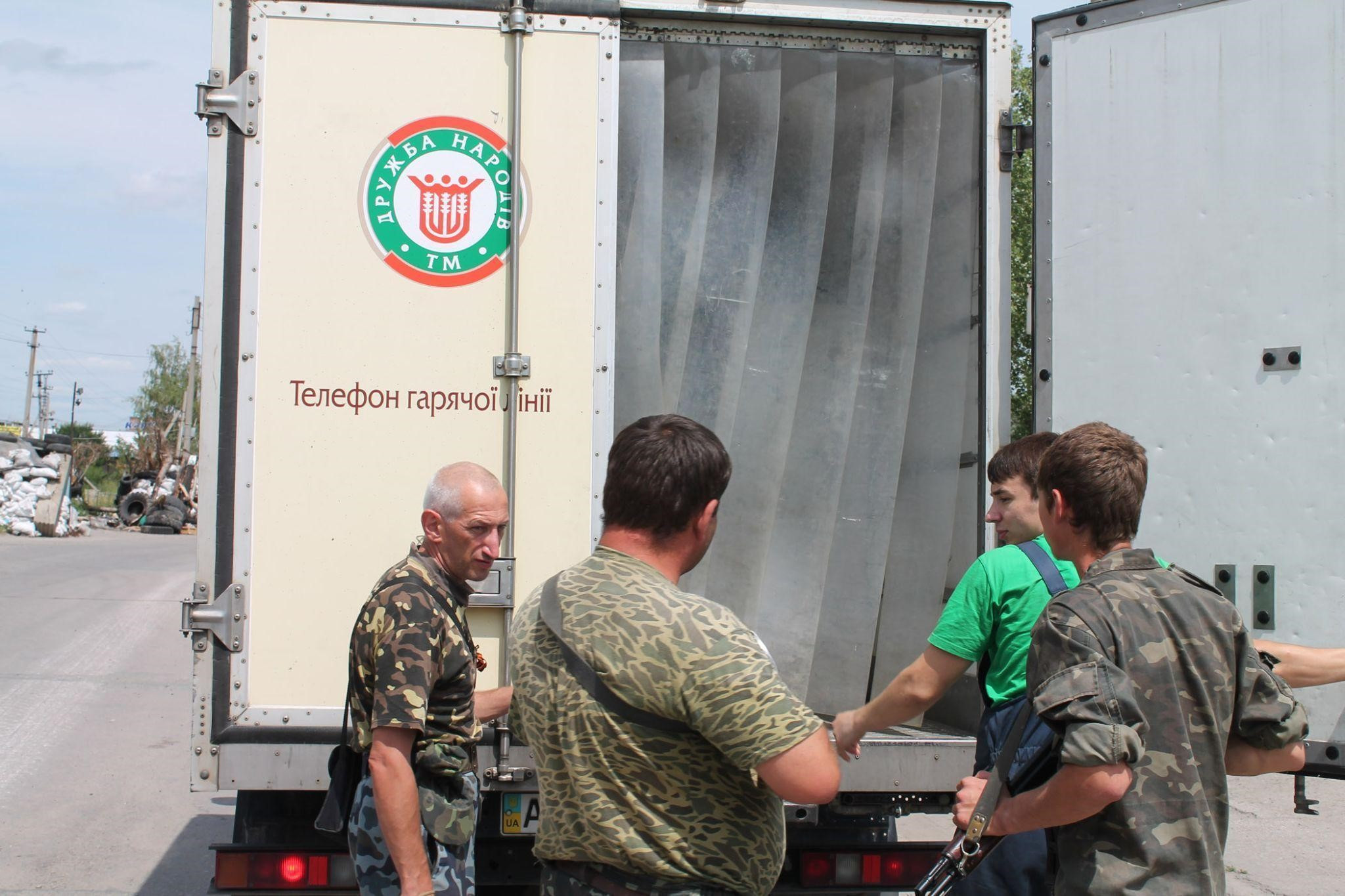
Militiamen inspect a refrigerated truck at a checkpoint in Verhunka on 4 July 2014, after night shelling. Photo: Oleksandr Bielokobylskyi
At that time, we had not yet seen the high-rise buildings which were completely destroyed. A gate cut by debris, broken windows and a damaged corner of a private house seemed like terrible consequences. The Ukrainian troops who were far from Luhansk at that time were getting the blame. I looked for funnels from mines or large-calibre shells but found only minor potholes on the asphalt. If you don’t know their origin, they could be mistaken for ordinary potholes typical for Verhunka.
These potholes are the traces left by small-calibre mortar mines. It is likely that these very mines were flying from my house. Well, where else could they aim from in the city centre, if the range of the 82-mm mortar is 4 kilometres?
In a couple of years, Bolotov, the first “LPR Head” who escaped, said in an interview that Luhansk was shelled by fighters from the Plotnytsky’s “Zarya” battalion. However, Bolotov called them Ukrainian saboteurs. But we remember Plotnytsky’s Russian officer’s bodyguard. This had nothing to do with Ukrainian hit squads.
Quirky prospects of “Novorossiya”
Some people still remember how in 2014 the “Russian Spring heroes” talked about “Novorossiya.” There was even a flag invented for it, like the one for the American Confederates, only without stars. Nevertheless, some details have been erased from memory even by the events’ participants. I am talking about the “Union of People’s Republics”. Have you heard of it?
In the spring of 2014, flags appeared online for a bunch of “People’s Republics”—Kharkiv, Odesa, Zaporizhzhia, etc. They were designed for all Ukrainian regions, for which Russian spin doctors invented a common name—the “South-East of Ukraine”. In the end, there was no need for all those rags, since events went according to the Russian plan (well, more or less) only in the Donetsk and Luhansk regions.
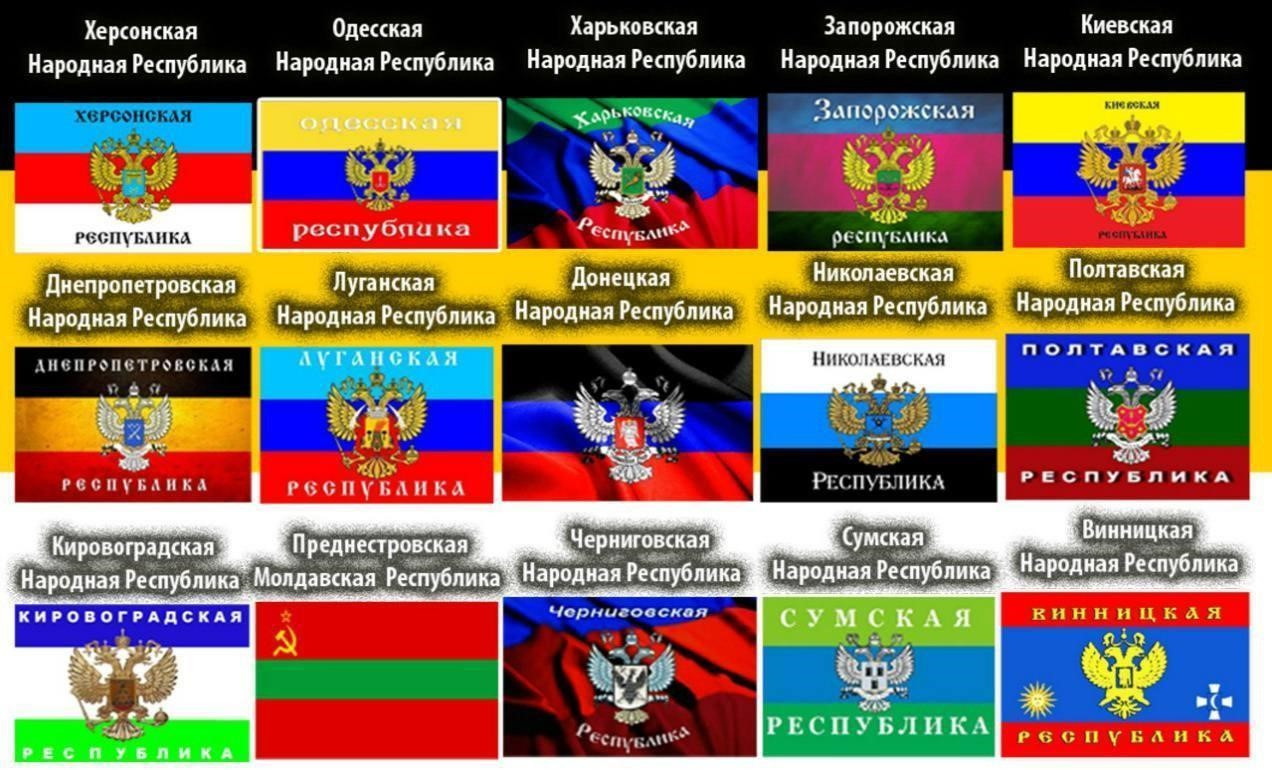
Various flags for “People’s Republics” that appeared online in 2014. Source: Detector Media: https://tinyurl.com/mry7zxh3.
So, in June of that year, the “People’s Councils” of the Luhansk and Donetsk “Republics” approved the “Constitutional Act of the Union of People’s Republics”.
The meeting of the “People’s Council of the LPR” took place in the session hall of the regional council, which I knew well. Usually, the press sat at the back, there was a special balcony with a separate entrance. At that time, places for the press were allocated in the aisle in the middle of the hall, as in the “People’s Council”—damn, who elected it, when and how?!—there were fewer “deputies” than in the Regional Council.
Old acquaintances who wrote for other Luhansk newspapers were sitting next to me. In a few months, they would work in the “LPR” propaganda system. Then we had the usual small talk. At that time, I discovered “The Year’s Best Science Fiction Anthologies” and recommended them to my old friend Andrii Kuznetsov. He was a short journalist nicknamed Batman since his student days; he was very annoyed by the nickname.
“No, I don’t like it. It’s too complicated. I’d rather re-read Golovachev”, Batman replied to me. You say, Golovachev, Andrii? By the end of 2014, he was already working for the “LPR”.
As we sat there, I skimmed a two-page printout of the “Constitutional Act of the Union of People’s Republics” that had been distributed to the press. Confederate system? A common currency? Nuclear-free status? Holy shit, are they crazy?
“The Constitutional Act is a provisional Constitution”, explained Oleg Tsarev, a former People’s deputy, and at this time, he introduced himself “as the leader of the South-East movement”.
He added that the real Constitution would be drafted later, and at that time it was important to quickly adopt that Act simultaneously in the “LPR” and “DPR” to then form a joint structure. Tsarev came with the text of this “Constitutional Act” from Moscow (don’t be surprised) and was pushing for the adoption of this document as soon as possible.
“You bastard, you bloody dog!”—my great-grandmother, from a Ukrainian village in the Belgorod region, temporarily occupied by the Russian Federation, would say.
Eventually, as in a sad anecdote, “the concept changed”. Everyone forgot about the constitutional act, and the “young republics” began to acquire the attributes of statehood on their own. Then they got closer, like Achilles and the Tortoise in the ancient Greek paradox. Until they stopped their “subject” existence and finally became part of the Russian Federation.
So once again: “Novorossiya” and all other “people’s republics” were invented in Moscow.
Why I hate Russian rock
At that time, all this seemed unreal to me. What “Republics” are you clowns talking about, for God’s sake? Hold on, now the curtain will drop, everyone will take a bow, the hall will applaud, and the audience will go home. And tomorrow everyone will go to work again—to the editorial office, to the bank, to the police station, or to the market.
But no, it was not just a performance. Because, here and there, there were signs of the Russian presence. After the storming of the Security Service of Ukraine in Donetsk and Luhansk on April 6th, 2014, the crowd sang the Russian national anthem. How many people were there in Luhansk who even knew a single line?! In June, tanks and armoured personnel carriers entered the city.
In September 2014, we were taken from the podval of the “Government House” to the base of the “Zarya” battalion. From dusty, unmarked “Ural” trucks we unloaded old, rotten boxes with grenades and large-calibre mortar mines. The Ryazan-faced drivers spoke with a peculiar accent.
A guard in the podval of the commandant’s office with the nickname “Astrakhan” shared his plans with another guard: “I’ll go home for vacation—you won’t believe me, to Astrakhan—I just have to go first to the district headquarters in Rostov to get my salary.”
Since then, I cannot listen to Russian rock. The mobile phones of the convoys were blaring it all the time—Alisa, Kino, even Letov.
Now we know the correct word
In the podval, I badly wanted to read. But there were no books. When I was transferred to the podval of the “Government House” (the seized Luhansk regional state administration), only propaganda newspapers with articles by my former colleagues were found there.
My fellow student, Natasha Maksymets, who was delicate-looking and boisterous as a student, and in recent years had turned into an obese city council deputy by the communists, wrote with enthusiasm about “the first day of the city of Luhansk in the independent republic”: “We survived!”—You are a silly goose, Natasha!
Although it nauseated me, I found out other news about the life of the “young republic”. From the same newspapers I rolled cigarettes for the whole cell. In the absence of books, I began to invent a story about the adventures of Captain Nightmare and his friends Kangaroo and Wombat. Sometimes those adventures seemed more real than the “LPR”.
In the following years, the new reality of the “republics” was imprinted in thousands of texts. It was created in the columns of local newspapers, on radio and TV, and on the websites of occupied cities and Russian news agencies. This work was carried out constantly and according to their plan. The lists of topics came to Luhansk from Moscow: what topic should one of the speakers cover on this or that date.
Thus, the temporarily occupied territory was approaching the beginning of a full-scale invasion. At the same time, we were also learning. Once, we did not have words to describe the events in east Ukraine. We went through different options: “the LPR and DPR groups”, “separatists”, “militants”, I even saw “rebels” somewhere. We heeded the advice of the tolerance teachers and used “neutral” wording: “conflict in the east of Ukraine.”
Now, we have the right words: “occupation administrations”, “occupation”, and “war”.
War. This is what it was from the very beginning in 2014. And this is what it will stay until our ultimate victory.
