
Chairs
We no longer gather together for Christmas or Easter. The empty chairs are weighing down on us. Our family, which had been like a thousand-year-old wall, had crumbled in a few years.
In 2015, the first one to go was Dima, who suffered two severe concussions. The next was Grandpa Ivan, not being able to reconcile himself with the grief, then Uncle Andriy. Later we lost Sofiyka. Maksym died in battle last summer. Recently my Aunt Alla passed away. Lusia is in hospital after having a stroke brought on when a missile hit the neighbouring building. Uncle Serhii is in a serious condition in a military hospital. As for the rest of us, the war is tearing away at our nerves.
Many of us have left. Aunt Shura and Ania are in Poland. Polina is in Slovakia. Olia is in Canada. Everyone just looking for a place to live. We’re like a string of beads that has broken and the beads have scattered into many places in the world.
At one point my sister and niece returned, because they wanted to spend some time with an aunt who was ill. It was evening and there were Shahed drones flying about. No explosions so far, only a menacing whirring sound. We had to cover my niece’s ears because she was crying and having a meltdown. In the morning, she put her pink unicorn backpack near the front door and made a determined statement.
“I have packed our things and some cookies. We are going to Slovakia”, she said.
I go through the options and try to think how we can fill these achingly empty chairs. Who can we invite?
Hm. Liudmyla is living under occupation. She cannot come to us—nor can we visit her.
I call Olenka. My timing is really bad. She says she can’t reach Pavlo, and he hasn’t called. Crying, she keeps repeating that she doesn’t want anything anymore, only that Pavlo should be alive, and that she will never forgive herself if he just dies leaving nothing behind. She and Pavlo did not have enough time to have children yet. I calm her down as best I can. At the same time, I can hear the letter that is lying in my desk drawer breathing. “I am sorry. I knew that there is a possibility that I could die. Please stay happy, for me!”
This is so hard. Perhaps I should visit Maryna? She, her mother, and her sister all live in different countries, while Grandma has remained in Ukraine. She stayed because she couldn’t leave her goats behind. And then she eventually stopped making her goat cheese, because no one ate it any more. Not because it wasn’t good, but because there was nobody left to eat it.
I went to spend New Year’s Eve with Maryna. In the evening we had wine, and there were champagne-scented candles. We were just two young girls. We ordered meal delivery from a restaurant. We had planned this evening quite a while in advance, reserving plane tickets and planning train routes. Maryna had found beautiful plates with a starry pattern and had prepared a playlist. We both wore dresses. We needed a celebration, of course we did!
“Why do you think the Russians rape our soldiers and then release them? Why don’t they just kill them?” she says.
“Hm…”
Then our conversation between two girls moved on to everyday topics.
“What I mean is, they can then testify about it in court. Why aren’t the Russians afraid of this? I can more or less see why they would release women. But even court testimonies aside, the men can then return to fight, being even angrier.”
“I don’t know. Impossible to know really. But I would say that they do it in order to traumatize society more. Applying the maximum amount of emotional horror per square metre, they try to kill us emotionally, to sap our strength, our energy, and enthusiasm for life. So that we as a people cannot develop, do not multiply, and so that we just exhaust ourselves. And an exhausted people are not capable of putting up much of a resistance.”
“Exactly! So that they won’t want to live on and have children. I have no doubts about it. Really! Look, I honestly couldn’t have sex for more than half a year. And whoever I speak to from the girls, they’re all going through similar shit. And always those images before my eyes of the shit the Russians do to us, which takes away any desire for anything” she said and blew on her hands. It’s a thing she does when she means that she’s afraid of this happening again.
“Right. And psychologists are writing about women having problems with lack of libido on a massive scale.”
“Well, OK, others. But what about me. You know, it’s nonsense.”
We laugh. It’s good that there’s still things to laugh about.
“Yes, this is complicated. Perhaps it’s not their main goal, but it is definitely one of the reasons they do this. They know how to make it wear into your brain.”
“Yes, in terms of information and psychological warfare the Russians are pretty strong. They have had experience of this, like, forever.”
We breathe out. There is silence, then we come to a conclusion.
“I know what we can do. We can give birth and raise children.”
There’s a pause.
“Fuck, I know what that sounds like! I’m totally in shock by what I just said. My feminism died just now, is turning over in its grave!”
“And what about your libido? If you don’t have any, it’s kind of difficult.”
“Don’t laugh! That’s exactly why they want to destroy it. And not having children—that’s definitely one of the results. Oh, bloody hell, everything’s gone upside down… And look at her, now she’s gone to live in a new country! And she is planning, bloody hell, to learn the language and go to university…”
And then soon after there is a call from Iryna from overseas. It’s strange. We are all very different, but despite our best efforts, our conversations are all on the same topics.
At last she has started to come out from the bottomless pit of apathy. It was rather difficult and rather expensive. It would have been easier if it had been covered by insurance, but the American psychologists could not understand her at all.
“So, how are you? What’s new with your therapist?”
“You know, it’s going well with this one. It’s not just empty, meaningless chat with some sympathetic nodding.”
“No way. Well, I’m glad!”
“We have worked through a lot and we’re getting results. I’m getting out of bed in the mornings. I brush my teeth. I’m eating normally now. And I even want to do it. That’s new.”
“Wow! Well, congrats!”
The expression on her face changed.
“What now?”
“But… there’s one ‘but’. Now I’ll tell you the real story. Ha, ha!”, and she covered her face with her hands.
Pause.
“Now I desperately want to have children. Now. Right now. To the point of having panic attacks.”
“Oh…”
“And I don’t know how this is going to… fit in.”
“That is, you’ve already decided?”
“I don’t know. I don’t know anything! You understand…”
And she cried.
“The American dream will never forgive you.”
“Forgive me! I still need to work hard for years to get anywhere. To really knuckle down! To focus on work, to the max. I have been here for a while, I didn’t arrive just a year ago. It’s a goal that I’ve been working at for a while and I need to keep to my plan! And it’s not just the wrong timing, it’s like, fucking hell the wrong time.”
I cannot find the right words of support, because I’m bothered by the same thing. Somewhere from inside my being, a deeply ingrained mantra breaks out:
“Sur-vi-val!”
It’s an animal instinct. The most basic of all basic needs has been disturbed, and that is safety. It’s not the threat of being struck, not the threat of pain or a blown off leg or a gouged-out eye. It’s the threat to a biological organism, to a species. It’s the threat of being pulled out by the roots, of being reduced to zero. A disappearance in all its forms from the list of fauna and flora and from all descriptions in ancient registers. There is a primal roar that’s breaking out from inside of me to preserve my genes, to survive at least in this way, and least partially.
“Hello there, genes! This is not the time! Have you heard of words like ambitions, dreams, and self-realization? Well yeah, hello, that’s also me!”
There are two desires that have been placed on the scales and hang in the balance. The balance has been brought to a point of tension by the war so much so that I can see beads of sweat on the scales of decision.
“Irynka, you know that you can simply continue on towards your dreams. It’s the right choice, and you have put in so much effort towards this goal! You can preserve whatever is Ukrainian in art, you can promote it. You can stimulate people towards finding out more about Ukraine. You don’t need to give birth to a Ukrainian child in order to be useful!”
“I understand all this. I understand it very well with my mind. But I can’t do anything about my feelings. It’s just…. Some sort of howling coming from inside of me… It’s a very strong feeling. I didn’t expect it and I don’t know what to do about it. Actually, due to all this shit, things are not going well… It’s consuming me.”
We talk about it. I convince her to continue working with sculpture. We talk about family, the talents and the skills which were lost due to the totalitarian Russian system.
I remember that Grandpa Ivan and his friend added some years to their date of birth in order to get into the militia school. Not that they particularly wanted to go there, but it was a way of escaping hunger and jail. In 1946, when the Russians once again took away grain from the peasants, they were caught stealing a few ears of wheat. The children were small and it was easier for them to hide in the fields, and the solidly built men, who went about beating the wheat stalks with whips to flush out any thieves, knew that. And that’s how they caught them. They were yelling with pain. On the other hand, the militia school did feed their students, and the Soviet authorities made sure of that also. They needed to bring up new solidly built men wielding whips.
I know about the tools of his life’s work carefully hidden under a pile of wood. The mill for sifting flour. The cart and its wheels, dis-assembled in order to make it inconspicuous. They found all this when Uncle Sasha was getting married and they decided to build a house. I see how Great Grandpa Stepan tried to save at least a little of his tools of the trade from the process of “dekurkulization” (dekulakization). I see how he carefully unscrewed the wheels, how he placed and repositioned each board that made a pile of wood half the size of a hut. He piled the boards in a way that no one would see it. He did it in a way that 50 years later, that cart was still sound and the wood had not rotted. It’s easy for me to imagine his love for farming. I am not allowed to despair, because he never told anybody about this buried treasure. He enlisted in the budionovtsi (Red Army). However, we heard some positive words about the Soviet rule only once in that house. And then Great grandma Tetiana quickly lashed back: “The Soviets wanted to eat you alive. Have you forgotten?”
In 1933 some man had made his way to our house. Like many others, he had been driven to despair by the artificial famine. He broke a window to get into the house, grabbed my grandfather and started to pull him out of the house. Luckily, my great grandma had returned to the house in time and managed to beat him off, barely. This was about my grandpa Mykola.
My grandfather Mykola. At the moment I am spending so much time thinking about him. He had been the oldest of the relatives that were still living in my time. He could remember the Holodomor of 1933 and the famine of 1946, the Second World War, the Soviet occupation. The empty chairs weighed very heavily in his memories.
“In our house four people died from the artificially created famine. In Baba Musia’s house, three. In Tetiana’s house, her husband and the baby wasted away. Semen and Maria were put through dekulakization and their children were put into an orphanage. In the house where Valik lives now, there used to be Grandpa’s brother with his family. The Russkies sent them to Siberia and took away all their property. Grandpa Ivan was killed in 1936 during Stalin’s time…”
10-year-old me couldn’t remember all the names, the numbers and the details. I just remembered the flat expression on his face when he told me this. Now I understand that expression. I can feel the chill wind of the “brotherly peoples” on my back as well.
Grandpa remembered how in 1941, when the Germans entered Bila Tserkva, many people greeted them with bread and salt, as one would greet liberators. And Stepan from the neighbouring street gave the soldiers a set of hand carved wooden furniture as a sign of gratitude. They were hoping to finally rid themselves of the Russians and to breathe freely, but they did not have enough resources to do it themselves. It didn’t work.
When the Red Army entered the town, they wanted to shoot my grandma Nadia. The naive child had asked them why they didn’t hand out chocolates like the Germans did, and then she spent two days hiding amongst the weeds, so that they wouldn’t get her.
At that time, they rounded up all the boys who had grown up a bit from all the houses. The other adult men had long ago been mobilized into the army or had been sent to Germany to be forced to work as so-called “ostarbeiter” (“eastern workers”). They gathered them together and sent them to be a live shield in battle at Vilshanka. Afterwards the fathers went there and collected the dead bodies of their children, so that they could at least have a proper burial. My Great-grandmother Uliana would tell my father about these and other crimes committed by the Russians each time she came for a visit to see her grandchildren. She would wake them up at night and tell the stories in whispers. She would warn them that they should not speak openly about this, because they would be sent to Siberia or killed.
All these crimes are once again being repeated on my land. And they are being committed by the same country and by the same people.
They have once again occupied our land and force people to take up their citizenship. They persecute those who resist, they torture them and rape them.
We are shouting about this to the world both day and night. We are shouting so that those crimes will not multiply.
“Can you hear us?”
Can you hear how they are forcibly mobilizing Ukrainian men in the occupied territories and sending them to the front lines to be human shields? Can you see how they are once again using hunger as a weapon against us, by destroying grain terminals, blocking seaports, shooting at poultry farms and at places where humanitarian aid is being distributed. They keep people in blockades without food and water. Can you hear how they once again are looting the fruits of our labour from our homes—cars, money, and even children’s shoes. They are stealing the harvests from farms, agricultural machinery, and metal products from steel plants. Can you see that they are destroying us, regardless of whether we are alive or dead? They desecrate the bodies of fallen soldiers. Cemeteries are being shelled. Once again there is no peace, neither for the living nor for the dead.
My Grandfather Mykola once told me how the Soviets destroyed three old cemeteries, which had held the graves of our ancestors. On top of the bones and the crypts of one cemetery they built a "Park of Glory” (a Soviet war memorial). The site of another cemetery was used to build a kindergarten. The third was built up with housing. A similar fate befell the buildings in the city centre, which had once been wealthy and beautiful houses. They had not been stolen from someone, but were built through work and talent. They destroyed them. They built high-rises and gave those apartments mostly to Party members. As for the previous owners, the lucky ones got a one-room apartment. And no one objected. It is difficult to object when you’re being marched around at gunpoint. Grandfather would tell this story and then would repeat:
“Shutting up and accepting it never helped anybody.”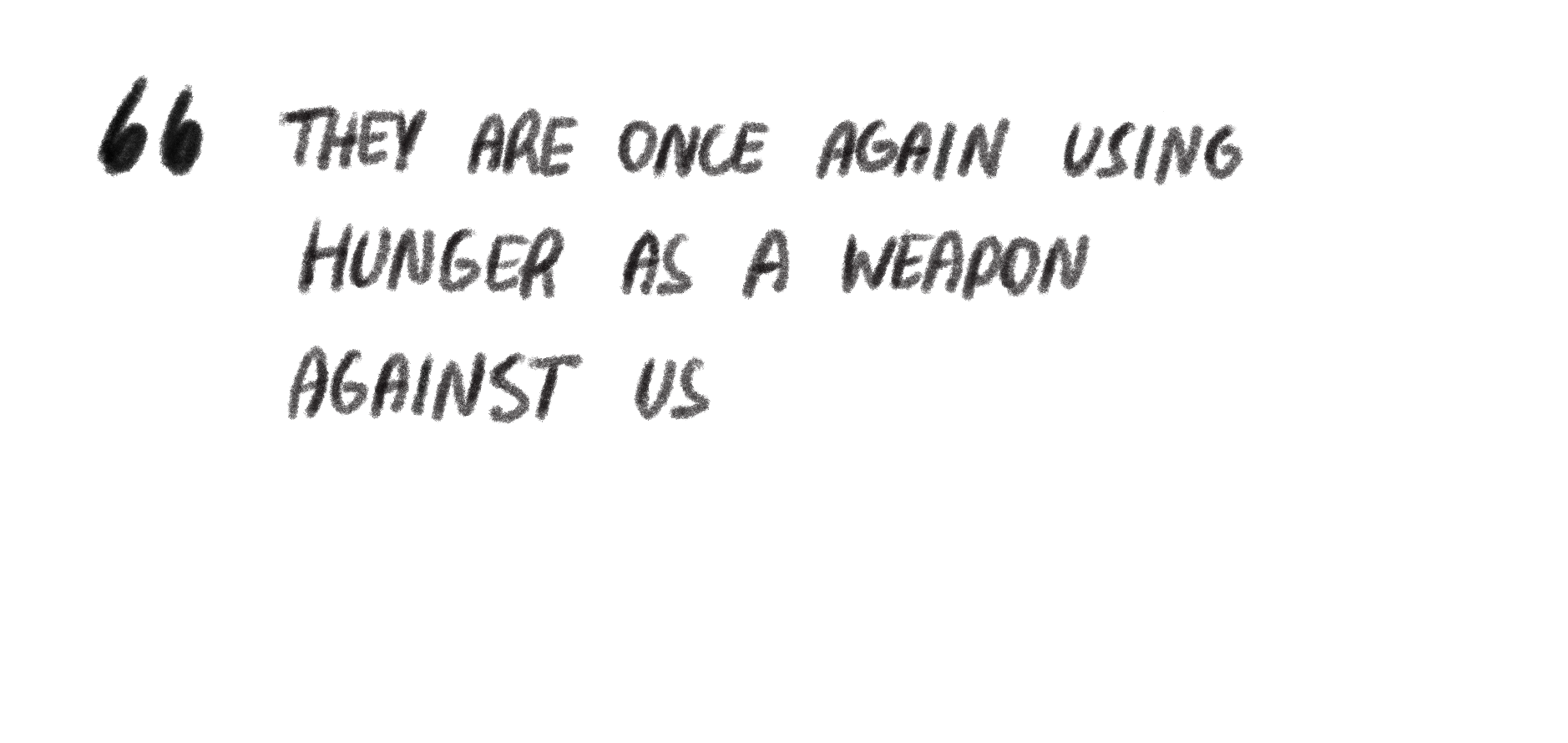
Grandpa lived to breathe freely for 13 years, which was from the renewed Declaration of Independence up till his death. I’m not sure if that was much, taking into account how old he was. But I’m glad he made it.
I’m also breathing freely, although I can’t manage to get my lungs full of air. And that is why I’m gathering strength internally to continue the battle. In a week it will be 40 days since my aunt died. I need to get people together and figure something out about those empty chairs. I’m reading emails from our international partners who are wishing me a Happy Easter.
How can I make this Easter happy?
