
War Has Settled in My House
Nine steps and you are in the safety buffer. These steps lead deep down, where there is no light, but there is hope that this dark place will one day save your life. The realisation that my new home is the basement is still absent, but the body remembers where it all began.
“Damn garbage truck! Who came up with the idea of collecting garbage at 5:00 in the morning?”
I’m still scared of that truck’s roar. It does sound like bombs dropping.
Then it took five seconds to realise that the war that had been prophesied and discussed for the past two weeks was now my reality and not empty talk.
I try to get out of bed, but my body has turned to stone. It seems to me that there is already a column of tanks with the Russian tricolour outside my window, and there are about seven seconds until the shell hits my room. As a child, I often watched films about war, so now my imagination does not spare me, generating new bloody pictures.
My hand gropes for the phone and the only news page shows me what I was so afraid to see outside the window. I cover my mouth with my hand. I don’t want my parents to hear my screams in addition to firearms.
On the same day, together with my parents, I found myself in the basement of a two-story private house of our friends. I had been there before, though I had never descended to the cellar. Nine steps underground, a small corridor, a boiler room and three more rooms of different sizes. This was the place I was supposed to call my home.
The owners of the house, Aunt Olena and Uncle Yusuf, used this enclosed space to store canned food, old and rather worn furniture and the rest of the junk that did not find a place in the house. Now, I slumber with them. Russia decided to abolish the nation, and me personally, by putting me in a cellar just because I am Ukrainian.
Now I watch how Uncle Yusuf slowly takes down the angle grinder, two metal rods of different lengths, and a toolbox. All this may be needed if the two-story building above us collapses like a house of cards. I look at it and mentally prepare myself for the most terrible events in my life.
War films practically do not show how people outside the battlefield live. It turns out that life does not stop. There is time for loud laughter, cooking delicious meals, birthday parties, and guitar songs.
For two weeks now, my mornings begin in the basement. I feel my lower back aching, and a sharp pain pierces my thigh. The body still cannot get used to sleeping on a hard-sewing table and protests with bruises on my back. At such moments, you desperately need ordinary and even strange, at first glance, things. Every night when I go to sleep on a hard table in a damp basement, I long to put my head down on my pillow. It may be old and have spots from wet hair that will never disappear, but I need it. At times, it seems that even such a banal thing can heal at least part of the wounds that bleed inside of me. Over the next five months, I would put my head on dozens of different pillows belonging to someone else; some would be new, some would be orthopaedic, but not at all like the one that lies on my assembled sofa, together with a blanket.
I can hear fragments of conversations and the clatter of the oven with metal sheets. I don’t know what time it is. I’m lying in the dark, breathing in the damp basement air. Kamila’s desperate exclamation, “Oh, no! I’m late again!”, brings me back to reality.
After getting out of the dungeon, I find myself in the kitchen. A fresh sponge cake is steaming on the table. Kamila is sitting in the corner on a stool, her cheek smeared with flour, and her unwashed hair put into a slightly dishevelled bun. Kamila is the daughter of Aunt Olena and Uncle Yusuf. On February 24, she and her husband left the apartment together: he went as a volunteer to the front, and she, grabbing a backpack and her young son, went to her parents’ private house. Today is little Artem’s birthday. The day before, I searched all the open and half-empty shops for the best gift. Even during the war, in the rare hours when the air raid sirens finally went off, I looked for a bright red fire truck for him. For a long time, Artem could not understand why he stopped going to kindergarten, why he could not play even in the yard of his grandmother’s house, and why his mom screamed at him when he did not want to go down to the damp, dark and scary basement.
We wanted to make a party for him—bake a cake, light candles, and solemnly present a gift. It probably won’t work. Kamila is sitting in a corner on a stool, hopelessly folding her flour-dusted hands and looking at the sponge cake. Today, the light went off for the third time. She miraculously managed to bake the cake but never managed to beat the cream.
Well, those are trifles. At night, after celebrating Artem’s birthday, she receives a message from her husband: “We are surrounded. Raise a decent son.” I see Kamila silently weeping.
I did not last for a long time. Every night, when I went to sleep on the wooden surface, I did not know if I would wake up in the morning. Every day lived during the war is a small life. In the morning, I lie without blinking, look at the ceiling, and go through the most terrible scenarios. During the day, I gladly eat homemade dumplings with cherries, but the last one remains on the plate. I rush headlong to the basement, forgetting how to breathe. Fighter jets scream over the house. The night allows singing quietly, almost in a whisper, a folk song, “In the cherry orchard...”.
 After twenty days of the war, I hysterically asked my mom and sister to leave the country. Dad was in tears. He quietly repeated, “Go... Go. This way, it will be even easier for me.”
Here I am, standing in my room, leaning my face against the cold wall and I cannot hold back tears. I look at how my things are arranged: there is an unfinished cup of tea on the table, in the middle of the room, there is an empty suitcase ready to hold all my belongings. I try to commit to memory everything, every detail, so that later, at least mentally, I could return to this place. I look at the windows. My father taped each glass in the shape of a cross, which is probably why they are still intact. Near the entrance to the building, the residents are cooking porridge on a bonfire. There has been no light for about a week. I cannot understand how the always-elegant woman from the ground floor has become fifteen years older in a few dozen days, even her bloodless lips look completely unusual without the eye-piercing red lipstick. A new wave of shelling brings me to my senses. I nervously open the wardrobe and throw my things in a pile. With inflexible hands, I try to fold t-shirts, sweaters, and three pairs of jeans; I don’t want to think that the main thing—my soul—will not fit into this tiny suitcase. How to fold it? In half or criss-cross? How will I go without it?
I leave it. A new thought gripped me. “What if I never come back here again?” I open an album with childhood photos and try to choose the best ones. I opt for the picture where I am on a blue horse, riding a carousel with my mom, she lightly supports me with her hand. The second photo is with my dad: we are on a sledge, flying down a steep snowy mountain, our faces are out of focus, but sincere albeit blurred smiles warm me in this cold room.
Then, there was the train station. There were more and more people every hour. It seemed that this building, known to all Kharkiv residents, would no longer be able to accommodate any living being. But the door opened again, and like a wave, a new stream of refugees was spreading through the waiting room: the frail girl was carrying two backpacks and a bulky carrier with a dog; the military men, who were trying to somehow regulate the boarding of the trains, pushed her away for the third time,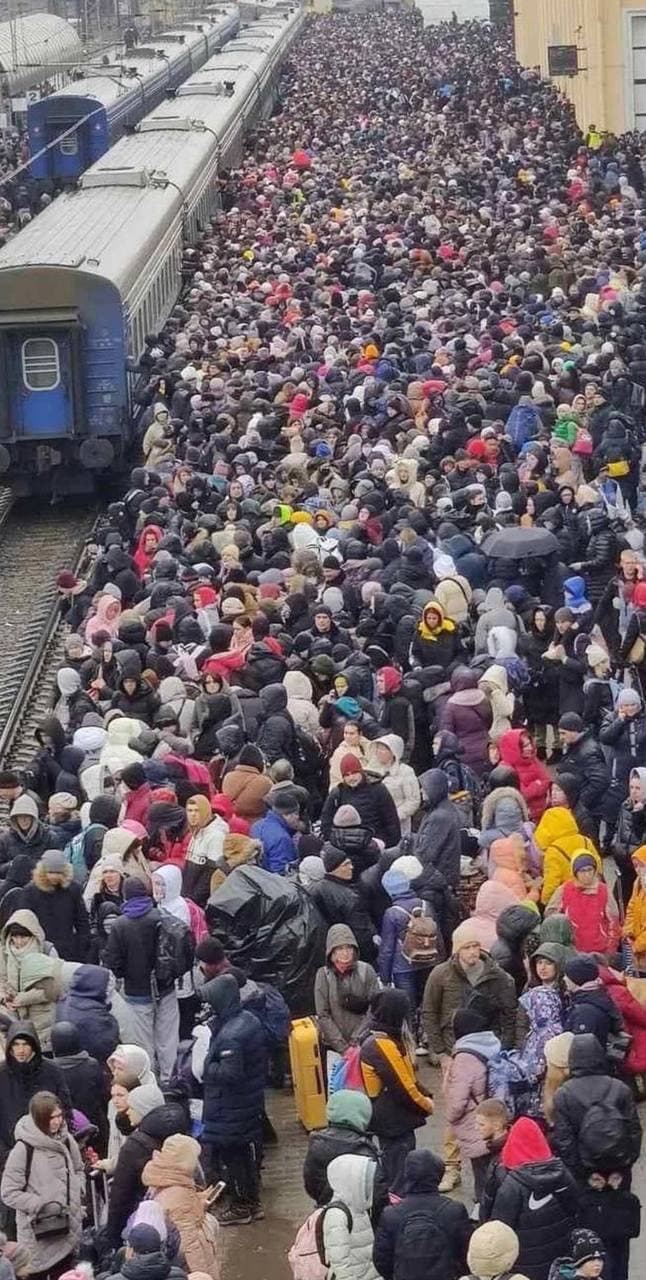
“Girl, calm down! First, women with small children, and then everyone else - and you’re getting on with your dog! There’s not enough room for all people to leave!” The refugee chewed her lips distractedly, and a shaggy dog was barking in the carrier, eager to fly at the throats of everyone in this hall. I had already been standing in a growing line for eight hours and I understood that dog like no one else. I could no longer feel my legs, I was surrounded by a mass of people, and it felt like I was being squeezed by pliers. I saw only the main door, which was an unattainable goal for me. It periodically opened, people rolled out, and I remained in place. I never managed to leave Kharkiv that day.
The second attempt was successful. Here I am, standing by the stained glass window and watching my native Kharkiv fading away. The train is taking me away from Ukraine, I don’t even know where. The words echo in my head, “My house can be taken away, my city and even my country can be taken away from me, but they will never take me away from me. I have to act. I have to live.”
You cannot compare Ukrainians who chose to leave their home and those who decided to stay. You cannot judge for whom it was more difficult, who experienced more grief, and which decision was the right one. In this task, there is only a given, there is no correct answer.
This road was difficult not only physically, but also emotionally. I saw so much grief, tears, separation, and absent looks. At times, I was surrounded by just the bodies; those people moved automatically, dragged their bags, and called all the numbers from their phone books, but there was an emptiness inside them, and their vacant stares gave it away.
Texts became my medicine. I sat on a beautiful veranda in a small house in Slovakia and started writing. I did not see the beauty. Over some time, I began to forget life before the war. All my dreams and plans fell apart and turned into a single desire—to live. Everything that I had built around my whole life fell apart in a second and became an unnecessary pile of junk. I felt that there was only now, the future was so illusory that it was ridiculous to even think about it. Everything you need can fit into one suitcase, and if you wish, even into a backpack. Only the soul never got in, no matter how hard I pushed it. So here I am, sitting in quiet and peaceful Slovakia: above my head, there are airplanes trails, on the horizon. Mountains spread out, fields are covered with greenery, but I don’t need all this.
I want to go home! I had so many goals, ideas, and dreams, but as it turned out, they do not translate into another language. And the land for their successful planting and growing can only be fertile Ukrainian soil.
Kharkiv. Railway station. February 2024.
Photo: Andriy Tsaplienko. Source: UNIAN, https://tinyurl.com/3wjrp3cn
