
From the Sea to Nowhere
On February 27, at two thirty p.m., an event occurred that split my life and those of other residents, into “before” and “after”: the city was captured by Russian troops. A convoy of URAL military trucks, Buk artillery systems, BMPs (infantry fighting vehicles), BTRs (armoured personnel carriers), and other equipment with the “Z” marking drove into the Pearl of the Azov Region unhindered. There were no barricades, or trenches, or dugouts on the approaches to Berdiansk. Late in the evening, the first blood was spilled: one Berdiansk Harvester Factory security guard was killed and another was wounded, because they were dressed in camouflage and because they refused to give the invaders their phones so that they could call home. On the same day, the enemy took control of city hall, the police building, and the TV tower. The next day, the residents held the first protest rally that the invaders failed to disperse with automatic rifle fire and a salvo from heavy artillery across the bay's water area. It became clear that peaceful life had left Berdiansk for good. An oppressive sense of danger hung over the city, and time seemed to stand still.
Survival
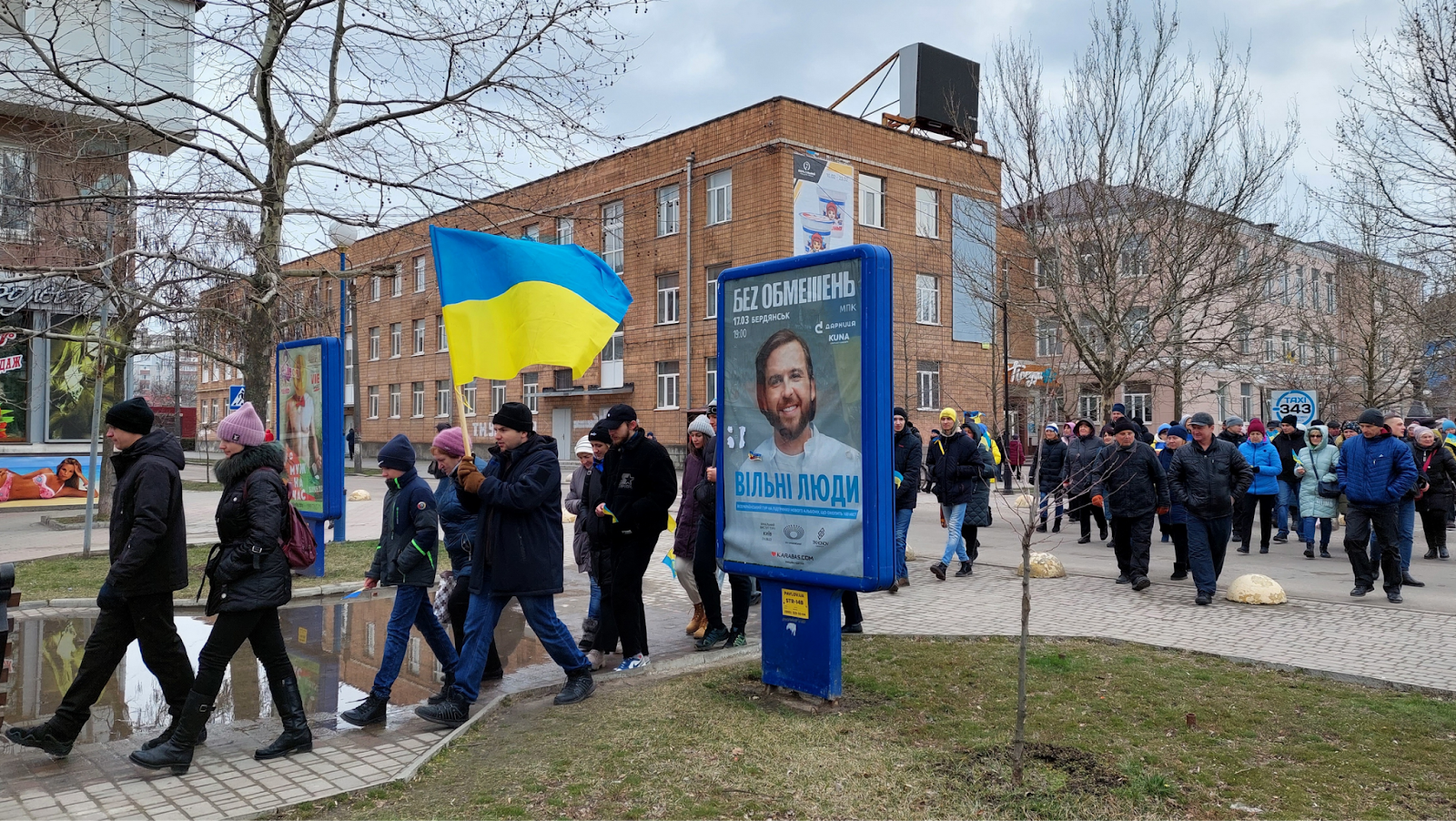
Life was reduced to endless line-ups at shops and pharmacies, with almost empty shelves during the day and deserted streets at night. There were Rashist checkpoints and patrols, pro-Ukrainian rallies and news about tortured activists. We were subjected to the roar of URAL trucks and other military vehicles moving around the city twenty-four hours a day, the absolute loss of a sense of security and confidence in the future—that is what our life became like under the occupation.
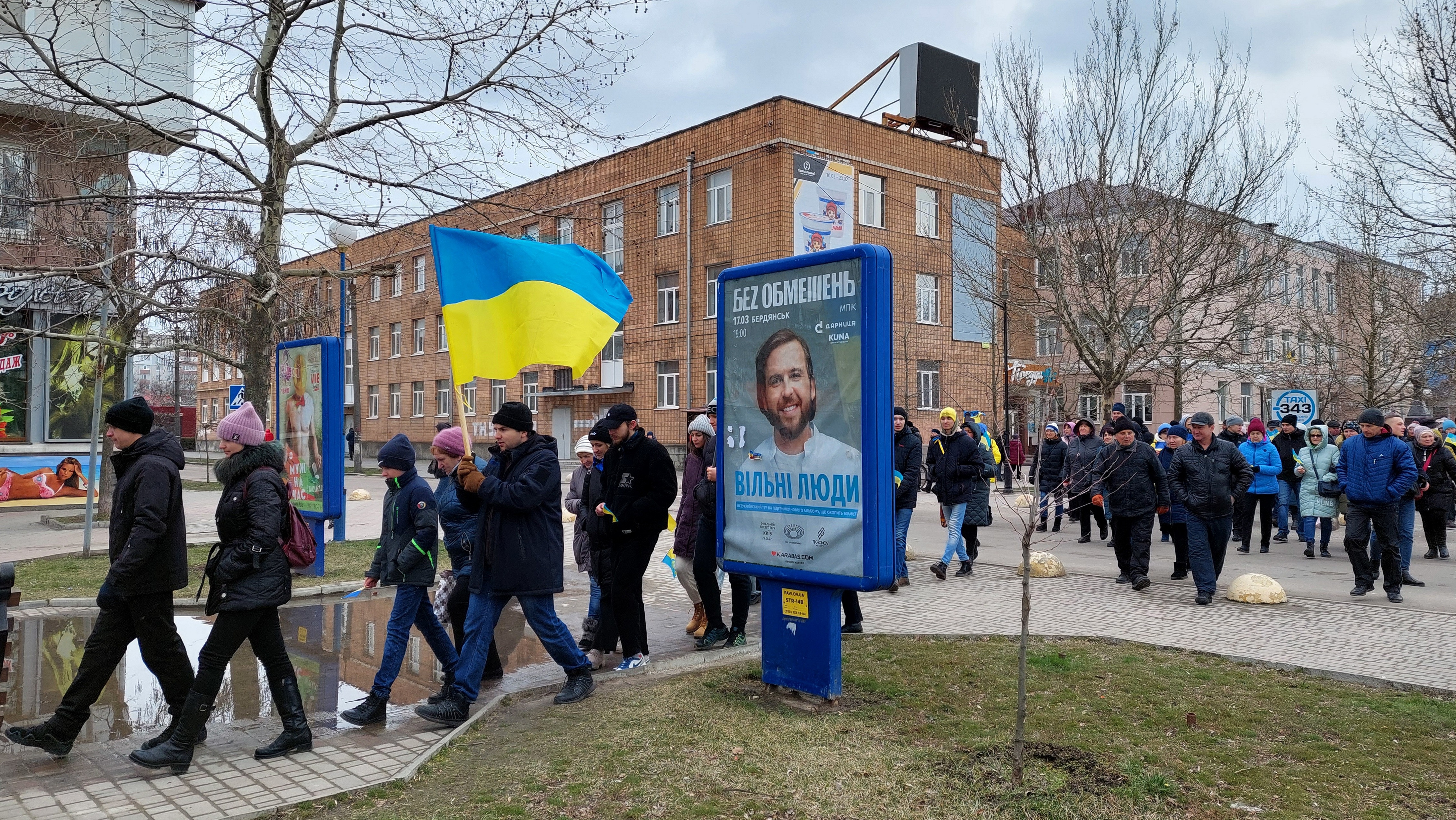
A pro-Ukrainian rally in temporarily occupied Berdiansk, 07.03.2022.
Photo: Oleksandr Pylypenko
Communication problems began practically from the first day. To prevent residents from handing over the coordinates and other important information about the Rashists to the Ukrainian security forces, their phone communication and internet were cut off. Sometimes it lasted for five days in a row. We were cut off from each other, and Berdiansk was isolated from the outside world. The only exceptions were the Ukrtelecom land lines, Wi-Fi that one could access in the Central Market, near the Raiffeisen Bank branch, and several other locations. Dozens of people started flocking there at the same time. Due to network overload, sending one text message could take up to half an hour, but the understanding that there was no hurry and the desire to send a message to your loved ones made you wait.
The city blockade caused a shortage of food supplies, hygiene products and medicines. All the large chain stores and numerous small shops were closed, and prices sky-rocketed, creating all the necessary conditions for a humanitarian crisis. On March 7, due to the fighting near Mariupol, the main gas line was damaged and the supply to Berdiansk was cut (not to be restored until October). As a result, the power grid was overloaded, which led to blackouts. The city was left without electricity, heat and hot meals.
The absence of the internet made it almost impossible for us to make payments through bank terminals. ATMs had not been working from the first day, and we were running out of cash. One day, I happened to find a way to solve this problem. There was a huge line of displaced people from Mariupol in the clothing store with a working bank terminal. They paid in cash, so I walked up to the counter and offered to pay for them by a credit card. The refugees didn’t mind, and so in a few minutes I got several thousand Hryvnias in paper banknotes, but they didn’t last long, because the prices in the city were sky-high. A few days later, I had to repeat the same trick. But soon, the people from Mariupol either ran out of money or moved on, while the cash deficit had increased.
Relocation
On April 1, I saw the Russian tricolour appear on city hall. It was the 31st day of the occupation of Berdiansk and the 31st day of decision-making, whether or not I would be able to stay in the city. All this time there was hope that the enemy troops might leave, and it would be possible to return to a more or less normal life. I understood that I was losing the opportunity to engage in journalism, because there was no freedom of speech under occupation. My NGO was cut off from the outside world and all partners. I couldn’t be myself, I couldn’t do my social work anymore. That rag on the city hall was a clear signal that the horror would drag on for a long time, and it was time to make a decision.
My wife and I decided to leave by evacuation buses that occasionally arrived in Berdiansk from Zaporizhzhia. To do this, we had to get to the large traffic circle outside the city, where the invaders had set up the first checkpoint, as early as possible, and join the line. We took a backpack and a travel bag with us—exactly as much as we could carry. We said goodbye to our parents, our cats, the shepherd dog named “Dick”, and left home.
It was six in the morning. We found a taxi, paid 500 Hryvnias (ten times more than it cost before the war) and arrived at the place. But it was in vain—the bus convoy hadn’t arrived yet—the invaders didn’t let the convoy pass the demarcation line in Vasylivka. We returned home.
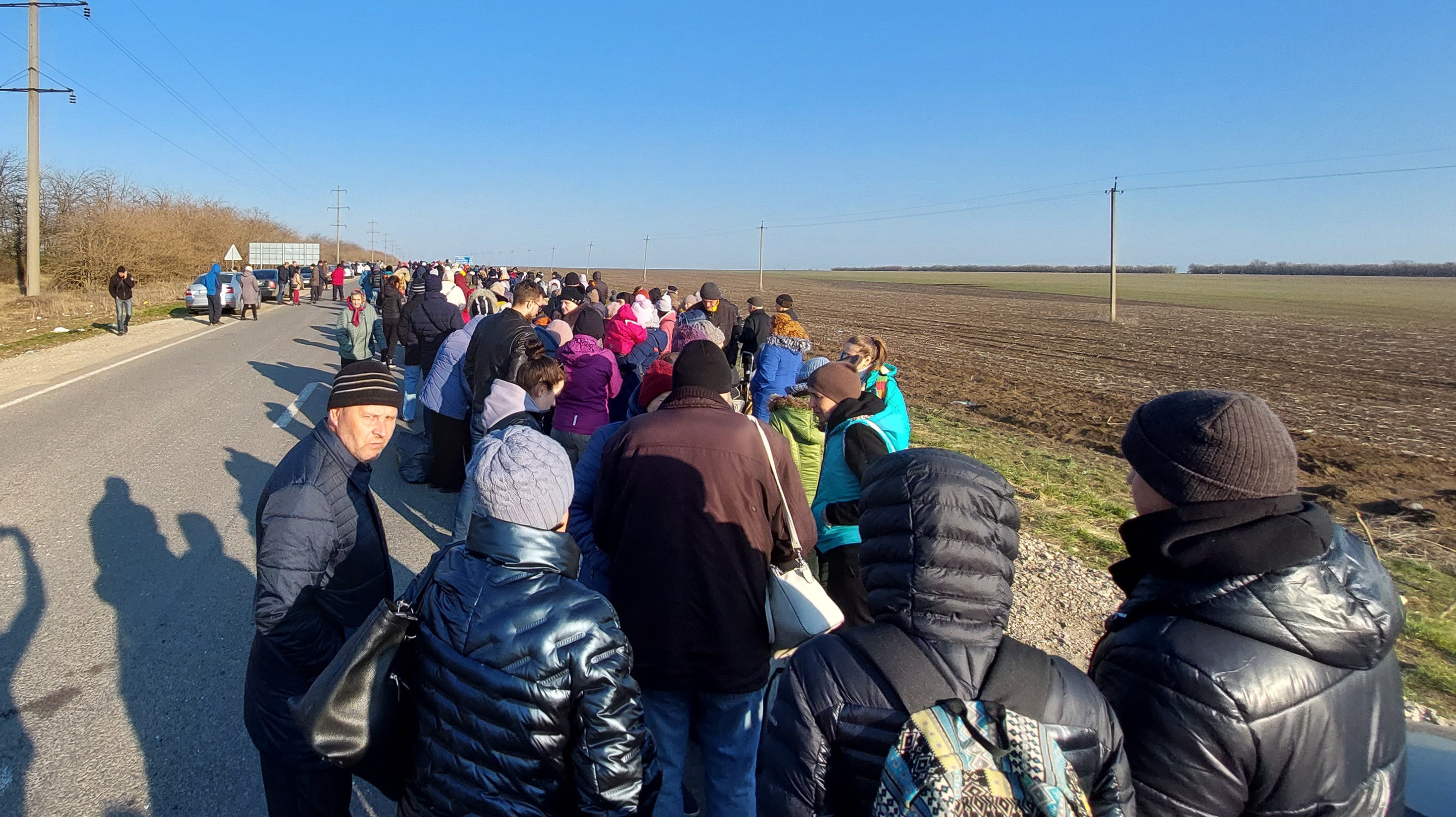
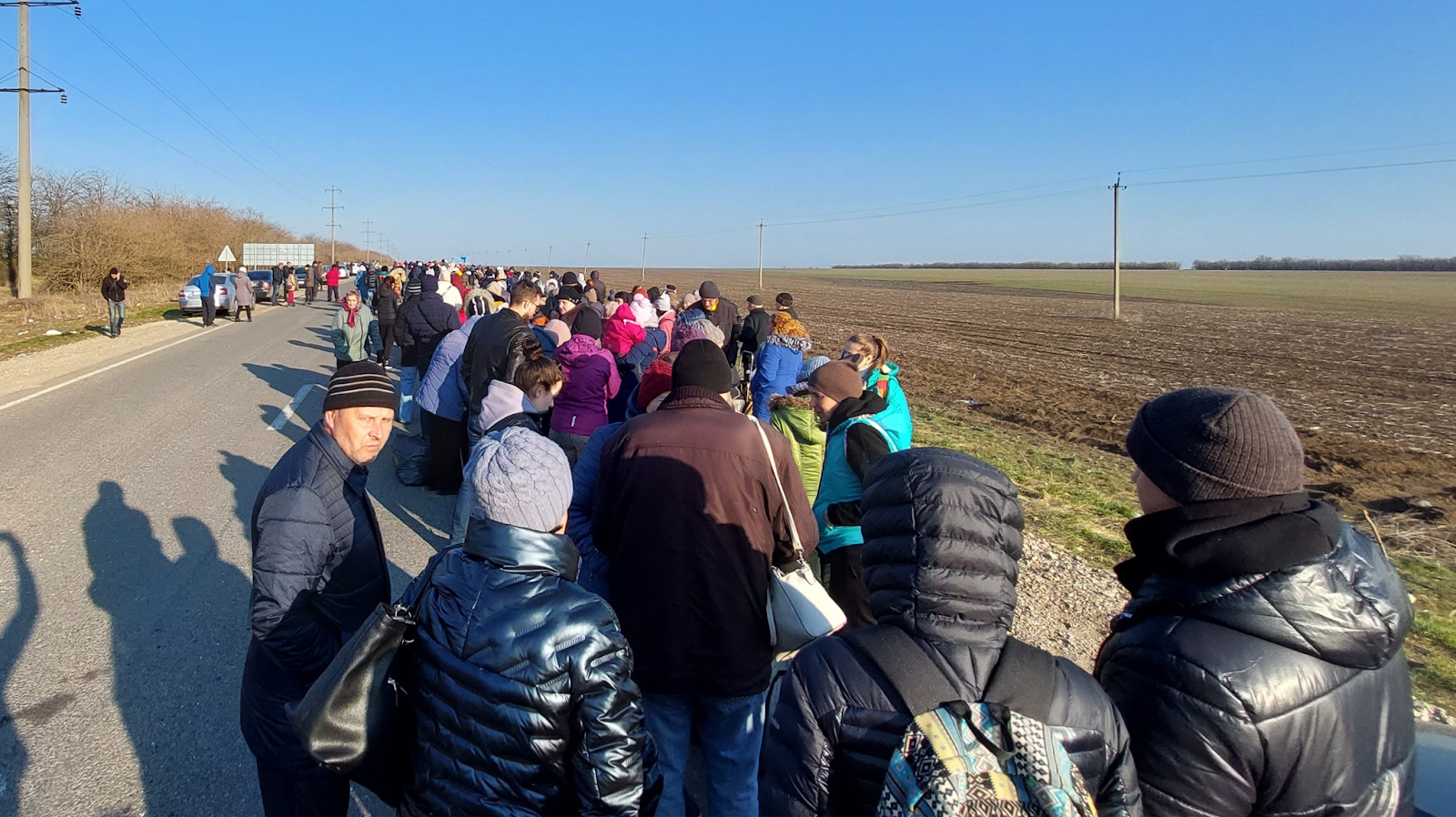
People waiting for evacuation vehicles near Berdiansk, 05.04.2022.
Photo: Oleksandr Pylypenko
The next morning, we did it all again. Again, there were no buses, although it was already 10 a.m., and the line of several hundred people was starting to thin out. By around 11 a.m. the line was shorter by half. My wife and I decided to keep waiting. Finally, a vehicle convoy showed up, but from a different direction—that of Mariupol. Those were the five Red Cross buses. They were denied entry to Mariupol and decided to try to take people from Berdiansk. It took the Pakistani volunteers quite a while to negotiate evacuation with the invaders, but they finally agreed.
The line dissolved into chaos because everyone wanted to get on the buses. A Russian soldier with a Georgian accent announced loudly that women and children would go first, and then it was up to everyone’s luck. All bags were carefully inspected; it was a stampede. My wife and I were let through quickly, and we even got seats next to each other. In the end, all four hundred people wishing to leave managed to get on the buses, although many had to sit in the aisles or on the steps. There were no empty seats at all—everything was filled with bags, backpacks, and packages.
The driver warned us that the buses would stop only at the checkpoints, and it would be possible to get out only if demanded by the military. We were to answer their questions briefly and not to react to provocations, otherwise one could be left standing on the road, as this had already happened during previous trips. Stepping away to the shoulder of the road was not allowed either, because of mines. We set off.
We expected the trip to be difficult, but not by that much. It took us more than a day, instead of the usual three hours. Near the demarcation line, the invaders stopped the convoy and made everyone spend the night at a bombed-out gas station. The air temperature outside the bus windows, as well as in the cabin, fell below freezing; explosions could be heard somewhere nearby. However, all was worth it. The realisation that the free Ukrainian territory was just around the corner warmed us better than anything else.
We drove away from powerlessness and hopelessness, because our city had turned into a grey area where there are no human rights, laws or justice; they were replaced with the eradication of Ukrainian identity. We relocated to preserve our national identity and to be able to fight for the restoration of peaceful life under the yellow and blue flag.