
The War That Changed Me
I’ve always been afraid of dark basements. I’ve always thought that someone was sitting there and watching me. And now I live in the basement. I sleep on rotten shelves where my grandmother's preserves used to sit. I remember the delicious strawberry jam we used to eat with bread at the dinner table. Warm memories are silenced by pain. The shelves painfully pierce into my back.
“Darling, no need to worry, but our airfield has been shelled, something is starting... Come back home.” The call came at six in the morning. Damn it. I remember how in the ninth grade, during the health basics lessons, we were always told not to panic and keep a cool head in difficult moments. I remembered that rule so well, as if I knew that I would definitely need it someday. “OK, mom, I'll be there soon.” The call made me feel cold, so I reached under the bed for the heater. A black mushroom cloud from an explosion was already visible outside the window. It was so close that it seemed as if I could reach it with my hand. The downtown was being shelled.
I packed my suitcases. Every item is a precious memory of mine. Great-grandmother Anna had embroidered this dress for her daughter Yaroslava. It was passed down from generation to generation, because in our family, embroidered traditional Ukrainian clothes are, I quote: “an attribute of high Ukrainian fashion.” I took out my favourite sweatshirt. I wore it every time we got together as a family to play bingo. These memories warmed my heart, but I forced myself back into reality. The suitcases were packed, and the car was waiting. I left my cosy apartment in a restless city. People were running around in search of ATMs from which to withdraw cash. The city was engulfed in traffic jams. Rumours and whispers were in the air. Gas stations were out of fuel and gas. There was a bitter aftertaste of chaos in my mouth. My Kherson, I will miss you! I will definitely return someday, because we still have so many moments to look forward to, together.
Loud explosions were heard. I ran to the car and with my trembling hands gave the driver my suitcases. A few minutes later we were driving through the city, and I was watching Kherson residents. Some ran through the streets, some stood in line for medicine at the pharmacy, others rushed to work, pretending that everything was as usual. We stood in a traffic jam for a good hour. My phone was overwhelmed with messages: “How are you there? Are you alright?” And then my sister sent me a video and said, “Watch it and calm down.” In the video, a Ukrainian military service member stated that the Ukrainian Defence Forces had been informed about possible provocations from the neighbouring country and knew that it all would begin at four a.m. I understood then that the shelling was temporary intimidation on the part of Russia, and also that the Ukrainian Defence Forces were already in their positions in any case. I was relieved. I believed that this horror was short-lived. Well, who knew, who knew.
We got out of the city, out of that human Armageddon, and I felt a little better. The sun was shining, the wind stirred the treetops. It felt like a dream. Just a silly dream, or maybe a movie that's about to end. A huge haze of black smoke stretched to the sky, the fire it came from was devouring everything around—the Chornobayivka airfield was burning. Soon we ran out of fuel, and the nearest gas station was two or three kilometres away. At that moment silly thoughts started to cross my mind. My brain told me: “No one will help you, if you don’t make it to the gas station in three minutes—you will be hit by a rocket. You will die on this highway, because very soon Russian tanks will be driving on it.” I didn't know what panic attacks were, but at that moment I realized that I’d just had my first one.
When we got to the gas station, I somehow pulled myself together. And then I was home. How nice it felt to be in my native village, quiet and peaceful. I believed that I was totally safe here. My walls of the house were my guardian angels. Mom wasn’t there, she had gone shopping. My younger brother hugged me and started crying. “I was so scared! It’s good that you came,” he said. Together we unpacked my things and made up emergency bags. Until the last, we didn’t believe that we would need them. But there was no choice. Mom came back with bags full of groceries and medicine and we immediately took everything down to the basement. To that same damp, dark basement that became my protective dome.
We decided to spend the night in the shelter. There wasn’t much space there anymore, as everything was covered with stuff. There was a shovel and an axe near the door, in case we were buried under the stone walls that could collapse from the explosion. We moved the jars of preserves and pickles from the shelves to the garage so that there would be a place to sleep. The first night was relatively quiet, so we returned to the house. We blacked out the windows with towels and sheets and sat at home by candlelight. We slept with our clothes on, in order to quickly go down to the basement, in case the shelling started. My body itched from the clothing. I was so done with it. I wasn’t used to living like this. “Stupid ambitions of the Russian dictator”, I thought, making a cup of hot coffee. I felt a need for frosty fresh air, so without hesitation I went outside. I went to the vegetable garden, where my grandmother and I planted potatoes and watermelons when I was a child. I remember how she said: “Let’s plant a few more rows and then you can go and get yourself some ice cream.” The blue sky from my childhood memories was replaced by a red sky. Mykolaiv was being shelled. Russian scum fired rockets at military barracks, gas stations, and residential areas. The city was on fire, drowning in tears and covered in blood. Tears fell from my eyes into my drink. What’s it like, salty coffee? I don't know, because the cup fell from my hands when I heard a loud noise in the sky. It was a Russian fighter jet that was aiming at the bridge on the way from my village of Shevchenkove to the Kherson Region. But it missed. An aerial bomb fell on a farm field where wheat was supposed to grow.
“The larger part of the Kherson Region is no longer under the Ukrainian forces’ control,” the Telegram news channel wrote. The invaders entered Kherson. Around one p. m., I was sitting in the kitchen eating a cherry pie when I heard a loud roar. My mom and I looked out the door and saw a tank convoy. The convoy was going to Mykolaiv. It was difficult to understand whose tanks they were. “One hundred percent ours,” mom said. I thought so too, until I saw the Russian flag on the last one. Another panic attack. My mom and I ran to the basement. Intuition told us to hide.
Automatic gunfire, explosions. The Territorial Defence Forces and the Defence Forces were fighting the invaders. Russian tank fire struck a house on a nearby street. The roof caved in, the windows shattered, and a wall had collapsed. My mom and I called our neighbours, because we knew that a family lived in that house. The boy and his parents were unharmed because they were in the basement at the time. The fight continued and it was so hot that the air burned my skin. Russian tanks were fleeing. They were backing off, returning to where they came from. The first small victory. The defence of Mykolaiv was successful.
Sensing defeat, the invaders began to enter some of the more remote, rural villages, those located very far from the main highway. It was through those villages that one could access the bypass road to Mykolaiv. When the Russian troops entered the villages of Novohryhorivka, Myrne and the town of Luch, all hell broke out. Shevchenkove was surrounded on three sides. We could no longer sleep in the house, and the shelling never stopped. My twelve-year-old brother had learned to tell the difference between the shells. “That’s Grad artillery system rockets flying to Mykolaiv,” he said. “Oh, cluster munitions are being used nearby.” I was impressed by how fast he learned new information and also taught us. Moreover, he could tell when the aggressors were firing and when our troops were fighting back.
The Russians destroyed everything. No longer was there a hospital in the village, because a Smerch multiple rocket launcher struck nearby. No longer was there a pharmacy, because an aerial bomb hit its centre. No longer was there a semi-finished products factory, because an S-300 missile destroyed it. Store shelves were empty. Sometimes a car came to deliver bread to the villagers. But then the invaders also destroyed the bread factory. I became more aggressive with each day, because I couldn’t counter the actions of Russian criminals.
For some reason, it seemed to me that it was much safer to hide in the village than in the city. But even here, death was constantly catching up with people. Aunt Zhenia, my physics teacher’s mother, was the first. Aunt Zhenia was on the terrace of her own house when the Russian army opened artillery fire. After receiving shrapnel wounds, she died from blood loss. Antonina Stepanivna, her daughter and my teacher, said that on the morning of March 18, she talked to her mother on the phone. “Mom blessed us for the rest of the journey, and by lunchtime she was gone.” Sometimes they say that death doesn’t choose. The war makes its adjustments. And it happens sometimes that your death may await you under your own roof.
The nights were so black that it seemed as if I had lost my sight. It was difficult to find the way from the basement to the house door, although they were only a few steps apart. You want to turn on the flashlight for a few seconds, but then paranoia instantly kicks in. You think that an aircraft might fly into the light, because it will think that it’s another target mark.
Even nature helped us in this terrible war. As if it knew that the Russians didn’t belong here. Winters in the south of Ukraine are usually warm. Typically, snow barely touches the streets and tree branches and it melts very quickly. But that winter, I came out of the basement early one morning to have a cup of coffee. Finally, I had a few hours of sweet silence. I pushed on the door, but could not open it. I pushed with all my might and then saw snow. And the snow was knee-deep! The last time I saw so much snow was the previous year, when I was vacationing in the Carpathian Mountains. But was it a coincidence? I don’t think so. Nature also has feelings and seeks justice.
My dad had always been a positive person. He was often called the “life and soul of the party”, because of his charisma and funny jokes. With the beginning of the war, he seemed to have lost his zest. His voice was barely recognizable on the phone. My dad was no longer the same as in my pre-war memories. Instead, he turned into a harsh, rude man who had neither feelings, nor any warmth in his heart. He had completely changed. We were no longer who we once were or who we hoped to become. We were driven by anger against our common enemy now.
Dad came home from the capital at the time when our highway was controlled by the invaders. A few days before his arrival, on that very highway, the Russians destroyed an ambulance and killed the driver, a nurse and a wounded soldier. A few days before that, the murderers shot a convoy of civilians leaving the hot zones. How dad got home safe and sound is still a miracle for us. We hugged for a long time, because we thought that we would never be together again. Memories of how my dad taught me to ride a bicycle as a child and how to drive a car as a teenager came to my mind. How I won my first chess game, also thanks to my dad. He taught me almost everything he knew himself.
There was silence in the basement when dad made a desperate decision to teach us how to make Molotov cocktails. First, we learned the theory, and the practice started the next day. We practiced in my grandfather's workshop. We prepared everything necessary and began. Surprisingly, I got it right the first time. Dad then said: “I didn’t think that my gentle, fragile girl was actually such a commando.” I myself didn’t know that I could be like that. I simply had no choice. While my dad taught me the art of war, looters and collaborators were regularly detained in our village. They, like vile rats, hid in abandoned houses and also in basements, but they were found anyway. Looters were tied to poles for public condemnation, and collaborators were handed over to law enforcement authorities for questioning. I never thought that supporters of the “Russian world” would be found out in my native village, named after the fierce Ukrainian and talented writer Taras Shevchenko. The war unmasked everyone, and everyone got what they deserved.
Dad could no longer bear to see my brother and me flinching at every shell that flew over our heads. Our nervous systems had completely failed. Therefore, my mom, my brother and I went to a more peaceful place. Each of us had a backpack where we kept the essentials. The volunteers picked us up at six in the morning. We said a long and painful goodbye to dad, grandmother and grandfather, and then, under fire, we went to the railway station. My dad, like most brave Ukrainians, is serving in the Ukrainian Defence Forces now and defends our right to exist.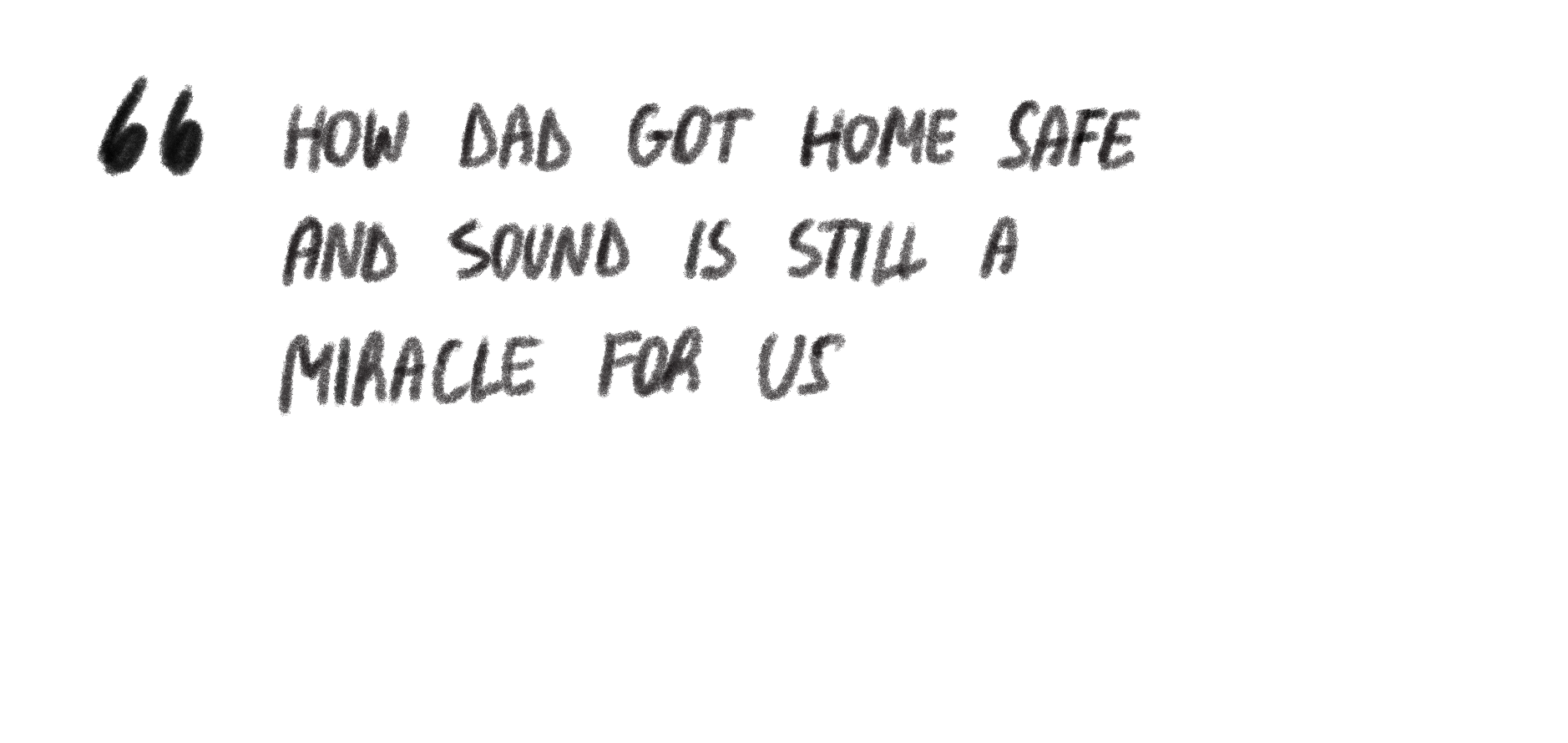
With tears in my eyes, I returned to my native village on November 23, 2022, when I read the news about the liberation of Kherson. It was raining, and a little foggy. There was a blackout all over Ukraine, due to large-scale shelling by the Russian invaders. Although there was no power, I decided to walk the streets of the village. Every other house was destroyed. Was there a military base or did Nazis live there? My heart aches when I see what seems to be footage from a movie about the apocalypse. Just give a terrorist country an excuse and it will destroy everything.
Every evening I hear the Ukrainian air defence at work, but I am no longer afraid, because I know that I am protected. My nervous system has adapted to this reality. It’s 2023 and the invaders are still terrorising Ukrainians, who, like me, have great gifts inherited from our ancestors: indomitable spirit, combativeness, and faith. Our belief is that good always triumphs over evil, and our unity will definitely overcome the evil that has come to our land. We believe that it will happen very soon.
