
The City to Which I Shall Not Return
For me, the morning when all of Ukraine awoke together began with a lesson in my 6th grade literature class. Before meeting my pupils online, I sat in the kitchen, thinking that for the first time I had nothing to say to them. The coffee my husband made for me had gone cold long before. I held the cold cup in my hands, and for the first time I was not ready to face my class. Probably none of my fellow teachers were, and so we simply did what we usually did. The zoom session began, and screens vibrating with scared voices appeared.
“Yaroslav, turn on your camera. Zhenia, microphone—I don’t hear what you’re saying.”
The children are bewildered and ask a lot of questions, responding to each one themselves, interrupting one another. My pupil Vika has her little brother with her on the screen; as usual, they’re home alone, their parents off at work.
We were discussing Charles Dickens and his “Christmas Carol,” the text and its meanings. Right now, none of us sees any meaning in anything. But I force myself to keep smiling, so as to keep up my pupils’ spirits. I glimpse a rocket flash by. If I turn the microphone off fast, maybe the children won’t hear it. Please, at least not at us—at least, not at us.
Every one of my kids has heard the missile. In their room, Vika’s little brother cries out. The next lesson is cancelled. From February 24 to March 1, I don’t conduct any lessons at all.
The first missile attack reached us that evening. In the vestibule, together with our neighbours, we kept to the rule of two walls—we made that rule our own that first day: if there are two walls protecting you from the outside, you are more or less safe. That whole night, in chatrooms across my city, rumours spread about its capitulation. We knew that Berdiansk would not defend itself, since no local defence force had been organized. We knew that the doors of the military commissariat had closed, and saw Ukrainian military convoys leaving our city and moving out to defend Mariupol and Zaporizhzhia. We knew all of this, and because of that we began to organize our own resistance effort. Boys, girls, men, and women squinted with distrust at each other; nonetheless, we acted in unison.
Three days after the full-scale invasion began, Berdiansk was occupied. I met the reality of the city’s capture outside the doors of the student residence of the pedagogical university. There were many of us, but in comparison with the kilometres-long line of Russian tanks, we were nothing at all. From above our heads came the sound of a plane.
“They’re tracking us from the air! They might start shelling us!” shouted a fellow in the crowd.
People rushed to the residence doors, but I stood still. Most of my friends and my husband stood still too—we were too far away to get to the doors.
“I am not going to die. Not today.” The thought went through my mind as I looked at the shadow of the plane. We had to get home. Young guys began shouting about gasoline and alcohol to make Molotov cocktails. That day two of them were made and were thrown, not by the guys, but by a young woman from her car. The line of Russian APTs halted, but they didn’t catch fire. The young woman managed to get away and post a video of her deed in the city’s online chats.
I witnessed the next cavalcade of infantry and tanks from the grounds of our high-rise. Russian had been heard around our building before, but now for the first time it sounded close. We were standing on the balcony, taking a video on our smartphones and feeling an anger unlike any we’d ever felt before. We were not afraid. The anger was coming out from under our skin.
**** **** ****
On the first of March, contact with the nearest villages was lost. I wondered whether those villages were still whole, whether people were still living there. Landline internet service vanished, but there was still cell phone service. That day I first saw a video of shelled cars on the road and photos of dead bodies. My mind imagined disturbing village scenes that I couldn’t shake. Many people had gone to the village, thinking it would be safer there. They were mistaken. The villages were shot at and plundered. Frightened people hid in their basements and listened as military vehicles roared by outside. That night I couldn’t sleep at all. Wearing jeans and a sweater, under two comforters, I lay in bed and froze. Our dog Nilson wiggled in under one of the comforters too, something he’d never done before. For my husband and me, he was our 38-degree heater. Central heating was gone, because the furnace had been blown apart several days before. It was between 16 and 12 degrees in the apartment. We were freezing.
Outdoors it was minus 7. The spring would prove to be as chilly as February was. My husband and I hunted for another comforter; we couldn’t turn on the heat because that could overload the electricity system. Some parts of the city were already experiencing blackouts. Darkness, cold, occupation, and fear—but Lyosha and I resolved not to turn on a heater; that was only for people with small children. Ukrainian Berdyansk’s city administration was still operating, but not in its municipal building, for it had been chased out by the Russians. Online and with great difficulty, city officials coordinated humanitarian aid and communal services, striving to stand up to the occupiers, even under death threats. All that the city officials were asking of us now was not to turn on our heaters. And so we didn’t, out of understanding and respect. We didn’t, nor did our neighbours, friends, or acquaintances, or just about anyone else, because there was already no gas in the city and we wanted to keep the lights on, at least.
**** **** ****
Evenings, nobody now thinks about what day it is. In the city, pro-Ukrainian chatrooms multiply, calls to action sound louder, as collaborators figure things out from two or three messages. In one closed chatroom which still exists, Yulia writes: “We have put together a leaflet. Who can print it and put it up?”
We print 25 leaflets giving the Russians’ losses in the first week and calling on them to withdraw. We go out into the night. My building and the military area the Russians have taken over are separated by a square. I freeze going out there.
“If they catch us, they’ll kill us right off.”
“More likely, they’ll put us in a cellar”, my husband interjects jauntily.
My hands are shaking. The bag with the leaflets seems to glow in the darkness.
“I can’t do this. This would be a stupid death—it won’t make any difference.”
“Tania, you go back. I can do this myself.”
“You can’t! No! Nilson will die without us! Please, let’s go home—it’s not too late. Please.”
We stand there. In the military area machinery has begun to move, and we see two red lights—signal flares.
“Please…”, I have begun to tremble from the cold and fear.
My husband takes me under his arm and begins to pull me toward home; I myself can barely walk.
During the night I lie sleepless, making sure Lyosha doesn’t go out himself to hang up those accursed leaflets.
In the next few days, leaflets and appeals to the occupiers to go home begin to appear throughout the city. People come out in protest, waving Ukrainian flags and crying “Go home while you still can!” Lyosha and I go and cry out too; our two small flags, hardly bigger than palm-size, were among a hundred other blue-yellow ones, but we all understood that this couldn’t go on forever. The occupying army knew that too, and it was probably strongly affected by the videos of pro-Ukrainian demonstrations in occupied Berdyansk. Cellphone service stopped. We were in a news vacuum now, but we were ready for it. Pro-Ukrainian demonstrations continued to gather by City Hall every day at noon, as planned from the very start.
Every day at noon the protests continued, until the Russian army started to fire above the heads of pro-Ukrainian demonstrators. A couple of days before that began, the Russians had seized two “organizers” of the demonstrations. They may not have been organizers at all, just a man and woman who took the microphone more often than others, shouted out slogans more often than others, and then endured torture in the cellars of their native city from those who were foreign there. The woman, also а Tetiana, was “in the cellars” twice. She managed to get out of the occupation zone to speak about the beatings, electric currents, and physical and psychological violence inflicted on her, a wife and mother. I, who was never struck as a child, was stunned and shocked by such violence.
The same treatment could have awaited me: even during the occupation, I made pro-Ukrainian posts on Instagram, volunteered at school, and distributed from Ukrainian humanitarian sources medicines to the elderly. I did not lead any partisan activity, but I was warned that even volunteer work like I was doing could lead to being “in the cellar.” For taking part in pro-Ukrainian chats or having amiable contact with Ukrainian military personnel, there was the threat I might be killed in my own home.
The question of leaving hung over my husband and me like a cloud, but there was then no place to go. I loved my city so much that I had not even imagined life outside it. My mother had been living in Kyiv for twelve years, and I could have gone to live with her long before; we had a warm and exceptionally close relationship, even though for her Berdiansk had been too small and provincial a place, and once, long before, that had separated us.
**** **** ****
When my birthday came around, there hadn’t been any contact with the outside world for four or five days, but then we heard from a neighbour that a supermarket nearby had internet access. My husband has never liked going into shops, and once the full-scale invasion began that dislike just became deeper, yet he was the first to say:
“We have to go right away! We’ve got to call our family.”
Since the occupation began, we had only ventured out of the house together, so we both hurriedly got ready and ran out the door. The supermarket was packed with people, everyone quickly and intensely writing texts or making calls, one or two people managing to smile. A very large man with silver-grey temples caught my attention: crying and standing against a wall, he kept looking at his phone, and I saw tears streaming down his cheeks.
“Mom, everything’s okay! We’re alive, we’ve got electricity,” I say into the phone, “Yes, we’ve got water too, but for gas and heat we’ll have to wait until at least summer. Thanks, Mom—don’t cry. And so what, that it’s my birthday? Everything’s good, we’re alive. How are you? It’s Kyiv that getting rocket fire every day, here it’s quiet. That’s right, here there’s no shooting, no rocket attacks. Yes—I don’t know about Mariupol. Nilson has gotten very thin, there’s hardly any of his food in the stores. What do you mean, buckwheat? He’s been living on millet for the past two weeks. Lyosha’s okay, he’s talking with his dad…”
The conversation is short—greetings, tears, pleas, and again tears.
“Ma, everything’ll be okay, phone service will come back, some people are even getting landline internet. I love you too. We’ll do some shopping now and go home.”
And that’s how we lived. Lines to get into stores, home, reading books aloud to one another, and, once a day, a short walk with the dog.
**** **** ****
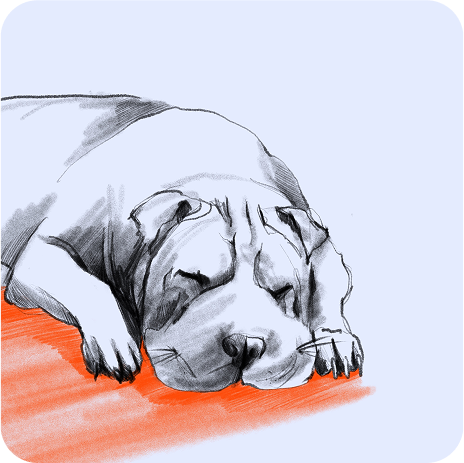
Nilson, my Shar Pei. He was three years old, and until the start of the Russo-Ukrainian war he had never heard an explosion. The sound of thunder had sometimes frightened him, but, remarkably, he took the explosions of that February morning calmly. Now he is four and a half and he trembles at every alarm, whether it comes when he’s on a pillow or in the corridor.
My fingertips stroke his fur to comfort him, and I’m glad to feel that he’s trembling, for that means he’s alive. And where once he was fearful only outdoors, now he’s scared at home, as well. I am scared too. Scared because my husband and I have soberly talked about killing our dog, as something that might have to happen, or maybe even be unavoidable. My husband lived through the occupation of Donetsk in 2014, and he knows all too well what filtration camps are.
One evening Lyosha began to talk about how we must flee, even if it has to be on foot, for the fate of a teacher of Ukrainian language and an instructor of Ukrainian history under the occupation is well known. Our colleagues are already being pressured to cooperate. Our refusal to do that and its consequences are only a matter of time.
“Without Nilson, I’m not going anywhere.”
“God grant that he makes the trip.”
The next day, we bought dog tranquilizer. For people, the only tranquilizers left came in glass bottles or tin cans.
Every night we downed our “tranquilizers,” so as not to dream. We went to bed in our clothes, not out of fear of being shelled but for purely practical reasons.
If they came for us at night, at least we’d be dressed.
We exchanged house keys with our neighbour and agreed, just in case, that she wouldn’t abandon our dog and we, if needed, would take her cat.
In truth, what scared us most was the unbroken silence and expectation of some or any kind of action. Some sign, at least, that Ukraine had not forgotten us, that it needed us. That sign came in the form of the Russian ship blown up in our port. That day, the people of Berdiansk walked the streets smiling at each other, because the Russian landing ship Saratov had gone down to the bottom of the Azov Sea, and nearly all its crew were lost, too. While just about everyone went about smiling, my husband and I were getting ready to provide refuge, if needed, to students and colleagues in our home.
The windows of the pedagogical university in Berdiansk opened out onto the port where the ship stood, so the occupiers lost no time in breaking down the doors to student rooms. They drove the students out, using their combat boots and rubber batons, and the students had no right to return.
“We actually got away easy”, says one woman I know, whose blue coat bears the mark of a Russian footprint. “Sasha has hematomas all over his body, Ihor got blows to the head and probably has a concussion.”
I convey this information to friends in Ukrainian controlled territory. “Please— tell the world about this. As everybody is celebrating the destroying of the ship, our university students are being interrogated in the assembly hall. They’ve taken away their phones and told them not to go to the hospital.”
**** **** ****
Phone service would go down and then come up again. Every time the line went down, my mother became more and more anxious.
“My dear, the Russian Army has left the Kyiv region. Come here, to us. The shops are open, there’s plenty of food—and we are Ukraine!”
My husband and I begin to search out evacuation routes and stand in line to join the columns getting out from Mariupol. It seemed that the contents of our one-room apartment, and the more than twenty years we had each lived there, fit into a bag and a knapsack.
“Nilson has become so thin”, says Lyosha. “It’ll be easier for us to carry him, if need be.” He sighs sadly.
Seven kilos lost in a month and a half. Our dog looks like a skeleton wrapped in skin and reddish fur. We had lost weight too, but not such a critical amount. Hunger and thirst had been a part of our life for a month and a half. Although we had money in our accounts, since it’s not in cash, it was worthless. I remembered my grandmother and her advice to always have cash on hand and regretted my imprudence. They knew something, those grandmothers. They knew life.
Sadly, I look at the keepsakes on our shelves, our large library, and the renovation Lyosha and I had recently done. All this is my life, and I am leaving it. My father and two grandmothers are buried here, I won’t even be able to go visit their graves before we leave. The occupying authorities weren’t letting the living go to the cemetery.
**** **** ****
“You know what they call this road? The road of life,” says Pasha, a former police officer who left two days ago and has now called me.
“The road of life.” He laughed a small nervous laugh. “I nearly died there. My ribs broken, maybe my nose too, hematomas all over my body. They found deleted photos of some equipment on my phone. I’m lucky they didn’t kill me; some guys didn’t make it to the Ukrainian roadblocks. What happened to them nobody knows—maybe they’re down in the cellars, maybe already in the ground.”
I chew my fingers nervously.
“They have lists. I don’t know whose names are on them, but mine wasn’t, and so I got through,” Pasha goes on. “Delete everything—they check.”
We had looked through our smartphones and deleted everything a few days ago, but now we check our conversations with family once again and delete any mention of our national stand.
During the night, a message pops up: “Disappeared.” Then another: “I don’t believe it.” And another: “That can’t be.” These messages seem to tear my insides to bits. I don’t believe it either, but this is war. I know that anything can happen.
In the morning, we get on an evacuation bus. Nilson lies down at our feet. Tranquilizers are at work in all three of us: for the road my aunt gave me half a pill, for Lyosha and me both.
A trip that used to take three hours took eleven hours that day, four of them under fire.
We passed through seventeen Russian checkpoints. Men were stripped down to their underwear and examined for “extremist” tattoos. Women and children waited in the buses. One use of the toilet was allowed, no one got out to smoke.
At the checkpoints, they looked through documents and bags. Our nerves were stretched as tight as the barriers along either side of the road. They grumble, wish us a good trip—and then start shooting again, behind us.
As our bus enters the grey zone between the checkpoints of the temporarily occupied zone and Ukraine, we catch sight of a civilian vehicle suspended from a tree. It was thrown there after going over an anti-tank mine. A little further on, we see two totally burned-up tanks, bodies already gone.
Ten to fifteen minutes before the Ukrainian checkpoint, shelling from the Russian side begins.
“They don’t let anybody leave alive”—that’s the thought that runs through my head.
I see smoke and hear gunfire. With one hand I grip Lyosha’s palm as the other keeps stroking the dog. Our column of buses halts, but not for long.
“We’re going to make a run for it”, says our driver.
“Today I’m going to die”, I think. “Mom won’t forgive herself, she’ll blame herself for telling us to come.”
I am not sorry, I tell myself. I tried to get out of the occupied zone, but just wasn’t able to do it. I’ve had a good life, joyous and happy. I had love and dreams. If we could all just die at once, I don’t want to suffer. Nilson might get away, but he won’t survive on his own—for the second time since the full-scale invasion, I am crying.
I hear a whistle, and the bus makes a turn.
“Glory to Ukraine!” Before us, a blue and yellow banner and the smiling faces of Ukrainian soldiers.
“Welcome home! You got through! Men, get out and take your documents with you. Gals, you wait a bit.” A Ukrainian soldier smoking a cigarette passes apples out to the kids. “What do you mean? Of course, we’ll move out—but we’ve got to wait out the gunfire first. You can get out, have a smoke.”
We get out and breathe in the sweet smoke of freedom. I hear bursts of gunfire very close by and whisper, “What happens now?”
**** **** ****
I think about the trinkets in my apartment. For each of us, they aren’t just things. Can we get back that particular book or postcard that a friend sent from another country? Can we find the same bracelet that I wove with a friend at summer camp? Is it possible to again have beside me in bed that toy without which I couldn’t sleep in childhood? Will Granny again knit us warm and colourful sweaters?
My fingers come upon the keys lying in the bottom of my bag, and I ask myself the question: “Will they ever again open the doors to my own, native home?”
Our “trinkets” will stay in memory and remain there on the shelves of life. But the city to which I will return, my Berdiansk, will never again be the same.
