
My Truth: The War We Cannot Be Silent About
Do not read my story: ignore the post, scroll down the page, skip this confession, but instead name at least one person who has managed to escape the truth…
I learned about the war when I was 4 years old. No, not about a full-scale invasion, but about the definition as such. The image of war often appeared in family stories. My great-grandfather Mykola lost his youth in a German concentration camp, and after returning home, he was awarded the beloved Soviet label “traitor”. My neighbour—old Kateryna—told how she hid in the cellar and ate shepherd’s purse during the fascist occupation; my great-grandfather Kote made a long journey from Georgia to Orikhiv in the ranks of the Soviet army. But most of all, I loved the story of my great-grandfather Petro, who, barely alive after execution by a firing squad, was saved by my great-grandmother Dunia, who hid him from the fascists in her basement.
But that war was a legend; it happened a long time ago. It’s just yellowed photos of fallen military relatives and laying flowers at the Tomb of the Unknown Soldier on May 8th. Or is it not?
I was good at history in school, diligently writing down the causes and consequences of armed conflict. The deeper I got into it, the more I was frightened by the thought: “Well, we haven’t had a war for a long time!” If you open textbooks on the history of Ukraine, you will see how long our nation has defended its independence. The blue and yellow flag reminds us that the glorious spirit of Ukraine shines and lives forever. No matter how cynical it sounds, the attack of the “brotherly” (sarcasm) people was expected. But even the internal logic denied this truth...
Indeed, the war started in 2014. However, I did not feel it at that time. Everything changed in February 2022. But even then, it seemed like an artificial idiocy, a deception.
For four nights in a row, I went down to the basement, hearing the sounds of artillery shelling nearby, reading the news about the occupation of neighbouring villages, and struggling to believe it. Could this happen to me? I did not choose to be the heroine of a movie about war! But the truth is not about scripts.
Almost immediately after the start of the Russian full-scale invasion 2022, Orikhiv was flooded with military personnel. The city centre and the military commissariat were flooded with armoured personnel carriers (APCs). Checkpoints were opened on the roads. This was the first time a tank drove down my street, which had been repaired a month earlier. The school bus took me along this road, I drove a car there for the first time. And now, damn it, a tank!
During breaks in shelling, I studied Russian weapons to accurately identify every type of tank. Acquainting myself with all possible varieties of enemy equipment, their dimensions, range and sounds of shots. Not a common activity for a 19-year-old woman. However, I googled and read extensively because I realised that the enemy was close. And I needed to know what they wanted to kill me with.
Most of the stores in Orikhiv closed almost immediately. People snapped up everything—even lollipops, which had been lying on the cash register for ages. Food deliveries occurred twice a week. Those dates were circled in red on the calendar because I had never looked forward to going to the store as much as I did then. It was a chance to escape from the four walls or the basement.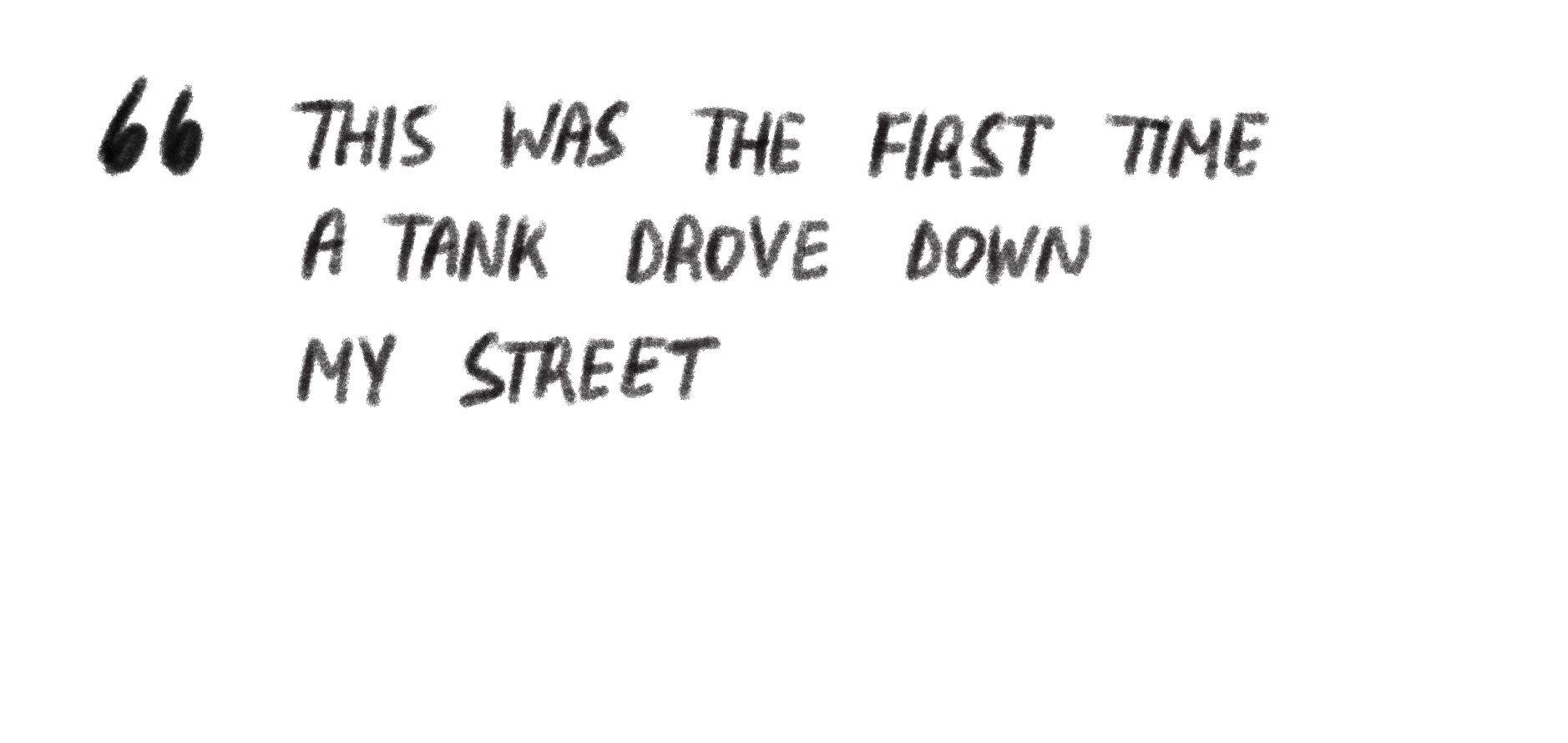
On the 19th day of the full-scale invasion, I went to the store for condensed milk. I never liked it, and considered it a relic of the Soviet system. But now, my cat Serhii Kuzmych and I, the 19-year-old Daria, wanted condensed milk.
However, I couldn’t find any condensed milk! It was not there. “It’s not an essential product!”, Larysa, the saleswoman from the nearest store, told me. I was already thinking about making the damned stuff, from regular milk. It was only in Zaporizhzhia that I had experienced the nauseating, too-sweet taste of condensed milk. The can of milky happiness cost UAH 57. However, during that time in Kharkiv, the electricity was only on for three or four hours every day when there was a break in the shelling. Cooking milk was far from a priority on my to-do list.
When the war started, I fled from Kharkiv to my native hometown Orikhiv. I didn’t think anyone would care about a small town like mine. But I was very wrong. Every evening in my hometown’s online group chats, I read the phrase: “They will capture Orikhiv today!”. This “today” has been going on for 411 days, yet the invaders have failed to take my “fortress”. The nearest occupied settlement is only 12 kilometres away.
I tried hard to convince myself that Zaporizhzhia would be better. When I got there, there was dissonance in my head: people were walking in the park, drinking coffee on the terraces, singing karaoke, while 50 kilometres away, in my native Orikhiv, people were dying. Daily.
Grandpa and Grandma struggled the most with the move. They simply didn’t understand how they could leave everything behind. Grandfather had laid the brick facade of our house with his own hands. Grandmother had spent 40 minutes choosing saffron curtains, which I never liked, for the tiny kitchen. They loved their home. It was their personal secret place that gave them a sense of peace—full of folk songs sung at the evening family gatherings, and memories of straw amulets, decorated with orange marigolds which I wove as a child. But after one bombing, our house was left without windows and glass doors in the bedrooms of my grandfather and my younger sister.
“The thing is that I don’t have a home...”—oddly enough, I began to remember lines of a song that popped into my head. But my truth is not about a damaged house…
During this time of war, I changed apartments four times, but none of these places gave me comfort. I missed the comforting taste of my grandma’s mushroom pies, the smell of my grandpa’s freshly caught fish from the Kinska River, and a warm cup of coffee from my favourite mug with cats. Yes, an ordinary mug with cats has become very special for me. Do you think I’m crazy because I miss it? Do you know how many such crazy people are scattered around the world today?
Later, my entire big family moved to Zaporizhzhia. Then I felt better. When I first saw Grandpa after the large-scale invasion, I was a little scared. He had aged significantly.
Grandpa is a typical village angler. In his wardrobe, you can find two old check shirts and three pairs of worn-out pants, because it is pointless going to our swampy Kinska in normal clothes.
But in the last eight months of war, he changed a lot. My younger sister couldn’t even count the wrinkles on his face. His grey hair had grown a lot and was below his shoulders, like mine. It was the first time I saw him with a beard. He did not shave all those weeks, because it was almost impossible to find the necessary hygiene products in Orikhiv during the war. I remember neither his look nor the clothes he was wearing when we first met in Zaporizhzhia. I only remember how dad said, “Phew, I already thought that the old man had forgotten how to smile.” Grandfather was smiling, but what was there, behind his smile?
On October 6th, he was very scared for me. That day, a vacancy emerged on the map of Zaporizhzhia, marking the location of a now non-existent five-story building that once served as the centre of life for several families. Their days were cut short by Russian S-300s. It’s a fluke that they missed me. I was in the next entrance. My apartment was “scarred”, a bit: the windows and panes on the balcony were broken; the kitchen door was smashed by debris. That day I couldn’t let go of the thought, “I could have been in that place.” A single wall became the border between death and life.
After that incident, I felt a lot of support. Many people reached out to ask, “How are you?” I realised that these three simple words had taken on a new meaning for all of us. “How are you = I love you”, a new semantic born out of the war.
When the communication services were jammed in Orikhiv, I climbed an old cherry tree and wrote “How are you?” to Olia who was staying in a Kharkiv dormitory, to Katia who suffered from depression in Vilniansk, and to Alina who was living under occupation in Melitopol. All of our conversations ended with the words: “Take care of yourself!”
The war has changed me and continues to do so every day. I have re-assessed my priorities and plans for the future. With all my heart I do not want to leave the borders of my Motherland. I am sure that the moment will come soon when all of us in a free Ukraine will recall this time and share our truth. The war demands us to be unbreakable, confident and united, and we, Ukrainians, are like that.
I live in strange times, terrible times. “Tulips” and “Peonies” have become death for some people, military operations have acquired the status of “sacred”, and someone’s sons turn into impiously stolen fur coats.[1] That’s what my truth is. Well, you see, I warned you: do not read.
[1] Tyulpan (“tulip”) and Pion (“peony”) are self-propelled Soviet weapons systems that Russia is using in its military aggression against Ukraine.
The war, which is termed a "special military operation" in Russia, receives divine blessing from Russian clergymen.
The looting of the civilian population by Russian soldiers (household items such as washing machines, clothing such as fur coats etc.) is widespread in Russia's war against Ukraine.
