
Born Again
Chapter 1: Preface and the conscious Ukrainians of Stakhanov
For me, the war didn’t start in 2022. It began with the annexation of Crimea and the Anti-Terrorist Operation in the east of Ukraine. My home town of Stakhanov—the birthplace of the Soviet myth about the Stakhanov movement and mining glory—has been occupied by the Russian Federation for more than ten years now.
After the collapse of the Soviet Union, most of Donbass needed economic help. Additional state funding was needed to survive, and the lack of this led to the closure of mines. The Stakhanov Vuhillia Coal Mining Association was closed. Suddenly, 25,000 people, most of whom were men, lost their jobs. Unfortunately, the government didn’t offer any alternative. Those men felt that they were not needed. Many of them went to look for a job in Russia, in the big cities of Moscow and Rostov-on-Don. And they thought that the high standard of living they saw in those cities was the same throughout the Russian Federation.
Local politicians of Donetsk and Luhansk Regions added fuel to the fire and spread the myth that Donbas was feeding the whole of Ukraine and that Russian-speakers would soon face oppression.
Added to that was Russian propaganda: about the loss of the Soviet Union that used to be feared by the whole world, about how strong a leader Vladimir Putin was because he lifted Russia from its knees, and how wrong the “brother nation of Ukraine” was to have taken the path towards Europe. Therefore, the events of the “Russian Spring” (a number of pro-Russian and separatist events in eastern Ukraine in 2014) were developing incredibly fast. At the time, I wasn’t able to assess the scale of the threat and couldn’t imagine the things awaiting me.
In February 2014, I went abroad for the first time. It was an educational training trip for those who studied the Polish language and culture. I visited Zielona Gora and Wroclaw in Poland. And on the way back, my teammates and I visited Prague, the capital of the Czech Republic. As it turned out later, I arrived from Golden Prague straight to captivity in the so-called Luhansk People’s Republic.
I returned in March, but my hometown had already become difficult to recognize. It was “grey” and hostile. As if out of nowhere, crowds of women and men I had never seen before flooded the city. Most of them were marginal in appearance. Each of them was ready to rally for any random thing: some for the restoration of the Soviet Union; some wanted to become part of Russia, and some wanted to have “big” Russian pensions. All of them were angry and dull. And all of them were united by hatred of Ukraine.
Of course, there were Russian flags and red flags there. And everyone frantically shouted: “Russia! Russia! Russia.” I still remember it like a terrible dream. I remember, going through the photos of these rallies and noticing some very strange people in them. They were unusually dressed, wearing some kind of military uniform, without any insignia. Those people with an air of military bearing about them stood at a distance from the main events and watched them with a self-confident smile. Like puppeteers who controlled their puppets. They were the Russian instigators who set off the hybrid war in Stakhanov.
Soon the most aggressive rallyists formed a “people's guard.” They dressed in military uniform and tied a red cloth around their right hand. Then they set up a tent in the centre of the city and “protected public order” there twenty-four hours a day. At the same time, the Ukrainian flags were removed and the flags of Russia, Belarus and the city of Stakhanov were put up in their place. The “people’s guard” placed their trust in Russian propaganda that was broadcast daily: “Buses with right-wing radicals from the Right Sector are moving to the east of Ukraine. They are going to destroy the monuments of the Soviet era.”
But the Right Sector never came to the city. And the “people’s guardsmen” received weapons from “Brother Russia” and formed a militia that stood against common sense and the modern world. They created complete anarchy in the city. Only the law of force applied.
When I returned from abroad, I saw a young man with a Ukrainian flag come to a pro-Russian rally. I have never witnessed that much hatred and aggression from pro-Russian demonstrators. They all shouted in unison: “Traitor! Provocateur!” The man was almost torn apart on the spot because of our yellow and blue flag. He was pushed out of the square until he disappeared.
Everything in the town had changed. It was a weird thing to comprehend: there still seemed to be legitimate government authorities, but at the same time some armed people set up roadblocks in the town. They started checking IDs, extorting money and cars. Whoever had more guns was the master of life. The search for “enemies of the people” began.
It was incredibly difficult to be in such an environment. It was as if all of them suddenly turned into zombies, who started speaking the language of Russian propaganda, saying that Ukraine no longer existed, foreign rule had been established, a coup d'état had taken place in the country, and so on. I started searching for like-minded people. And I found them on a social network. It was the underground association called The Conscious Ukrainians of Stakhanov. Those people were a true breath of freedom for me.
We started meeting secretly. And we even found a place for our secret meetings: a room in the offices of the tram and trolleybus administration. The room wasn’t in the best condition, with old Soviet furniture and a hole in the floor. But there was something unusual about it, we felt like a secret resistance group.
Different people, of different ages, from schoolchildren to the elderly, attended our meetings. We didn’t want to be part of Russia, we didn’t want war, and the main thing that united us was love for our country.
Chapter 1.1: Shevchenko readings
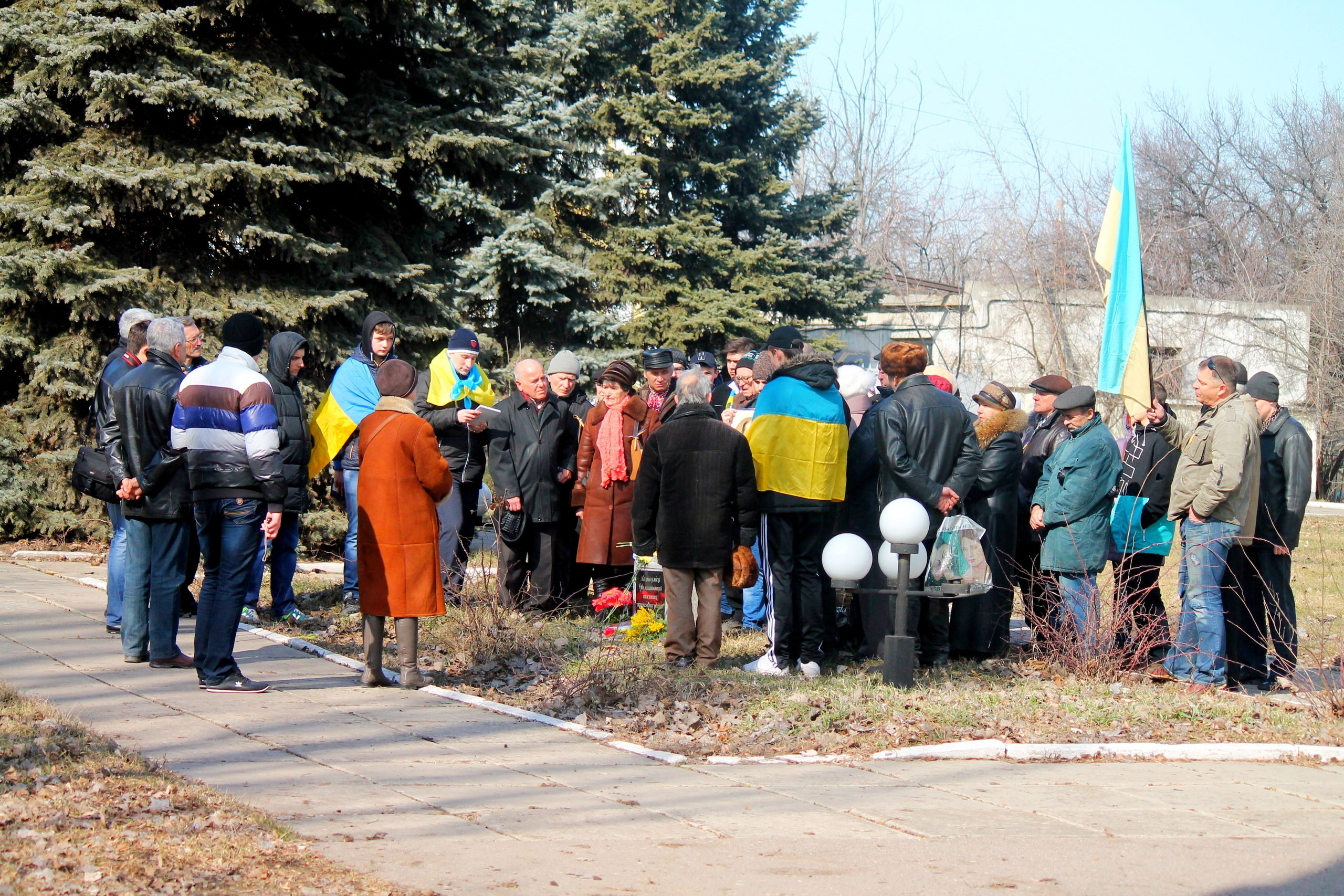
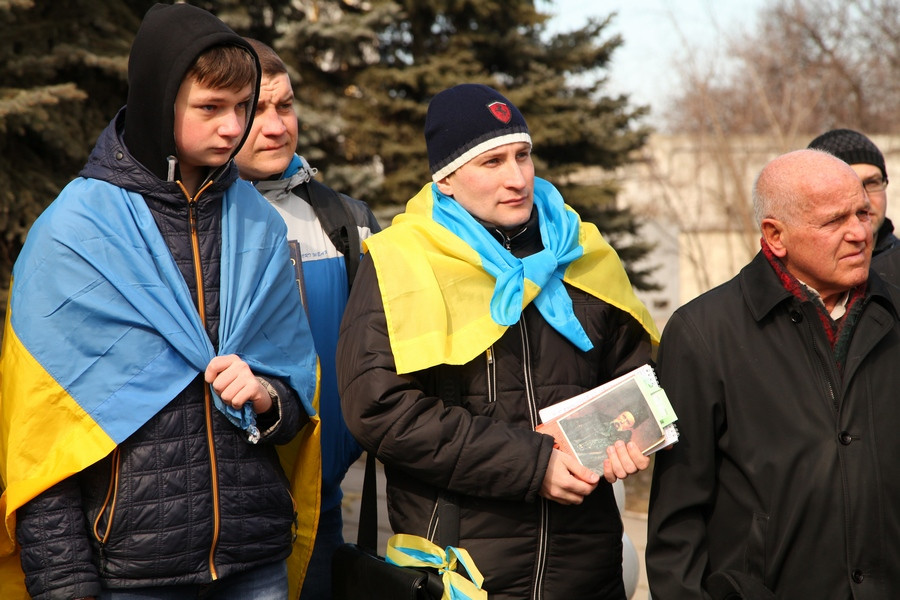 On March 5, I received a message from Oleksandr Hail, my acquaintance from the university. He proposed to hold readings of Shevchenko’s works in Stakhanov, on the occasion of Taras Shevchenko's birthday. I agreed, and we quickly created an event online and invited all the subscribers of the Conscious Ukrainians of Stakhanov page. Before that, I learned at work that the Enlightenment City Association was also planning a similar event. I called Nina Semenivna, the head of the “Enlighteners”, and we agreed to conduct a joint event.
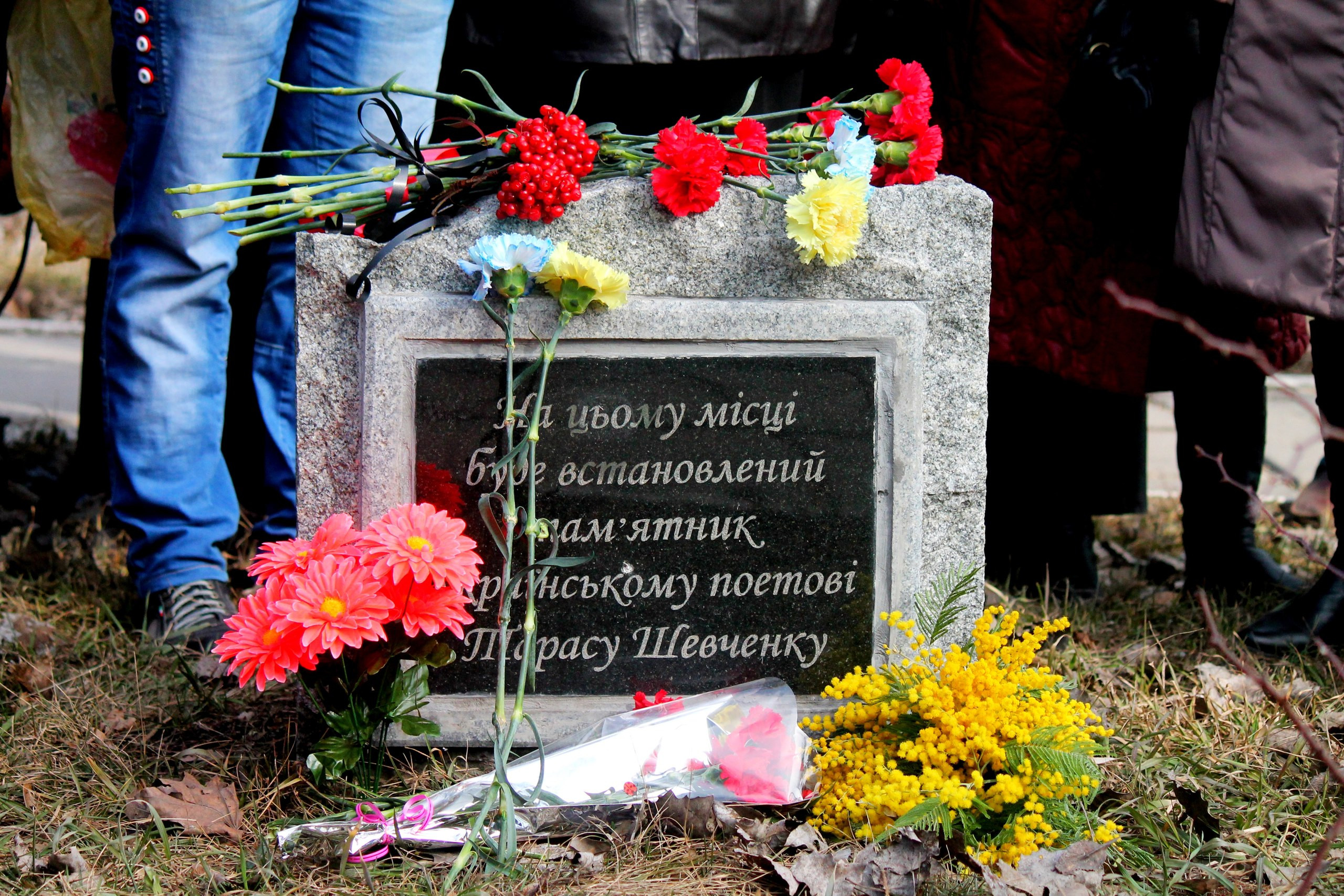
Our meeting place was on Lenin Street, opposite the Peremoha stadium, at a memorial sign where a Taras Shevchenko monument was to be erected. Unfortunately, back in 2011, some vandals stole Shevchenko's bust and the town was left without Kobzar (Shevchenko’s nickname, meaning a person who plays a string instrument called kobza). Our readings turned out to be very intimate. Young people and the Enlightenment members of a more respectable age read poems, everyone was full of optimism and believed that the separatist nightmare would be over soon. We spent a few hours in the company of like-minded people.
 On the same day and time, the Ukrainian People's Town Hall Meeting took place in Luhansk and was attended by many patriotic people who cared about Ukraine. An enraged crowd with Russian flags broke into the square where the meeting was held. There were plenty of them, several thousand people, they pushed and beat people with yellow and blue insignia, even children. There was a lot of blood and fear.
The separatists quickly pushed back the town hall participants and occupied the square around the Shevchenko’s monument, then they threw away the flowers laid at the monument. After that, shouting “Russia! Russia!”, they began storming the Regional Government Administration. The police didn’t interfere. The crowd broke into the office of the Regional Government Administration’s Chief and forced him to write a resignation letter. A Russian flag and a red flag were installed on the Government Administration building.
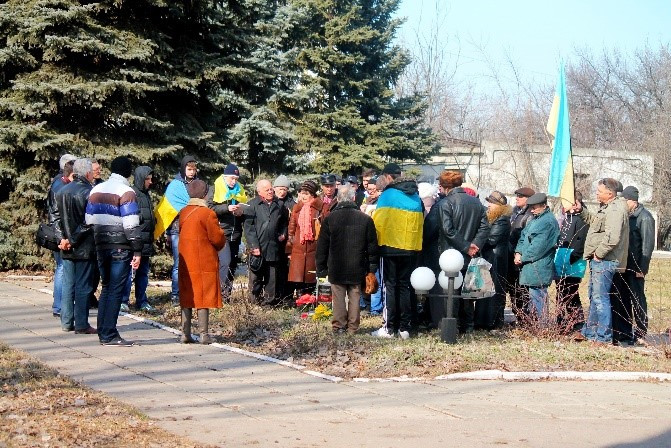
Local residents organized Shevchenko readings for the 200th anniversary of the poet in Stakhanov on March 9, 2014. Photo from the personal archive of Yevhen Shlyakhtin.
Chapter 1.2: “Luhansk Region is Ukraine” leaflets
Svitlana Yevseyeva, a Conscious Ukrainians activist, reported in one of our meetings that her friends had sent her a thousand leaflets with the text “Luhansk Region is Ukraine.”
Five people volunteered to distribute them. They loaded a ladder, glue and tape into the car. Around seven p.m. they started posting the leaflets on lamp posts on the central streets – Lenin and Karl Liebknecht. Everything was going well until someone called the police. Our boys and girls were forced into a police car and taken to the city police station. They were held there for several hours, and each of them was interrogated. They managed to inform me in time, and I started calling lawyers, Euromaidan SOS human rights defenders and other representatives of the public sector. Many people called the police and asked what were the reasons for the detention. The flurry of phone calls worked, and everyone was let go without a single fine.
Organizing and participating in those patriotic events was the most genuine thing that has happened in my life. But, God, how naive we were and how couldn’t we see the real threat. We even tried to communicate with the organizers of pro-Russian events. We asked them: “What are you doing? Do you understand that you are bringing war into your hometown?” And they answered: “Everything will be fine. Everything will be like it was in Crimea, and we will become part of the Russian Federation.”
Chapter 2: March 30, 2014
It was a sunny Sunday. I enjoyed my day off to the fullest, reading in the morning and planning to go to the movie theatre with friends in the afternoon. But a phone call from Svitlana Yevseyeva ruined it all.
Svitlana (or Sveta) was a journalist for the regional publication “Telegazeta”, and we often crossed paths with her at work. But since 2014, we had become friends because we supported the Revolution of Dignity[6] and a united Ukraine.
.JPG)
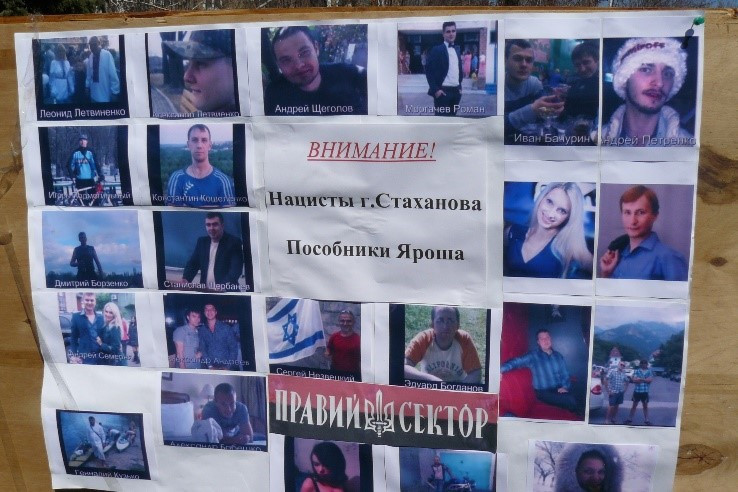
Collaborators put up a stand with opponents of the "Russian World" with trumped-up accusations in Stakhanov on March 30, 2014. Photo from the personal archive of Yevhen Shlyakhtin.
The call was very emotional: “Come quickly to the rally! They set up a “Nazis” of Stakhanov stand with your photo on it in the central square.” I quickly pulled myself together and ran to the rally. Angry people were going crazy with excitement after the speeches made by Communist Party members, and were chanting “Russia! Russia! Russia!”
Looking around, I found the stand, my photo was in the right corner at the bottom. I saw several more familiar faces on it: Stas, my former classmate; Sashka with whom I worked during the election campaign, Kostya who almost got killed later for his patriotic stance. There were pictures of the Lytvynenko family, real Stakhanov nationalists, on the stand as well.
While I examined the stand and called the police for help, the collaborators began to look at each other in confusion after seeing me, a “Nazi” in the flesh. The Chief of the Stakhanov Police Public Order Protection Division walked up to me, and I asked him to remove the stand. I told him: “What Nazis? You and I attend the same meetings at the city council. Remove this disgrace immediately.” He examined the photo and ordered the organizers to get rid of the stand. As soon as he left, they hastily installed it again. We went back and forth like this several times. Eventually, my temper kicked in, I tore down my photo from the stand and went home.
Chapter 3: The Conscious Ukrainians of Stakhanov’s last rally
On April 26, 2014, the Conscious Ukrainians of Stakhanov organized the United Ukraine car rally (through the towns of Stakhanov-Kirovsk-Irmino-Bryanka). I was energized by the real freedom and the people’s earnestness. Then I started getting calls from the police: “Have you received any messages announcing a car rally?” – “No, I haven’t.” Although I organized it myself and was in the convoy that very moment. The police got worried after seeing us drive by the town police station.
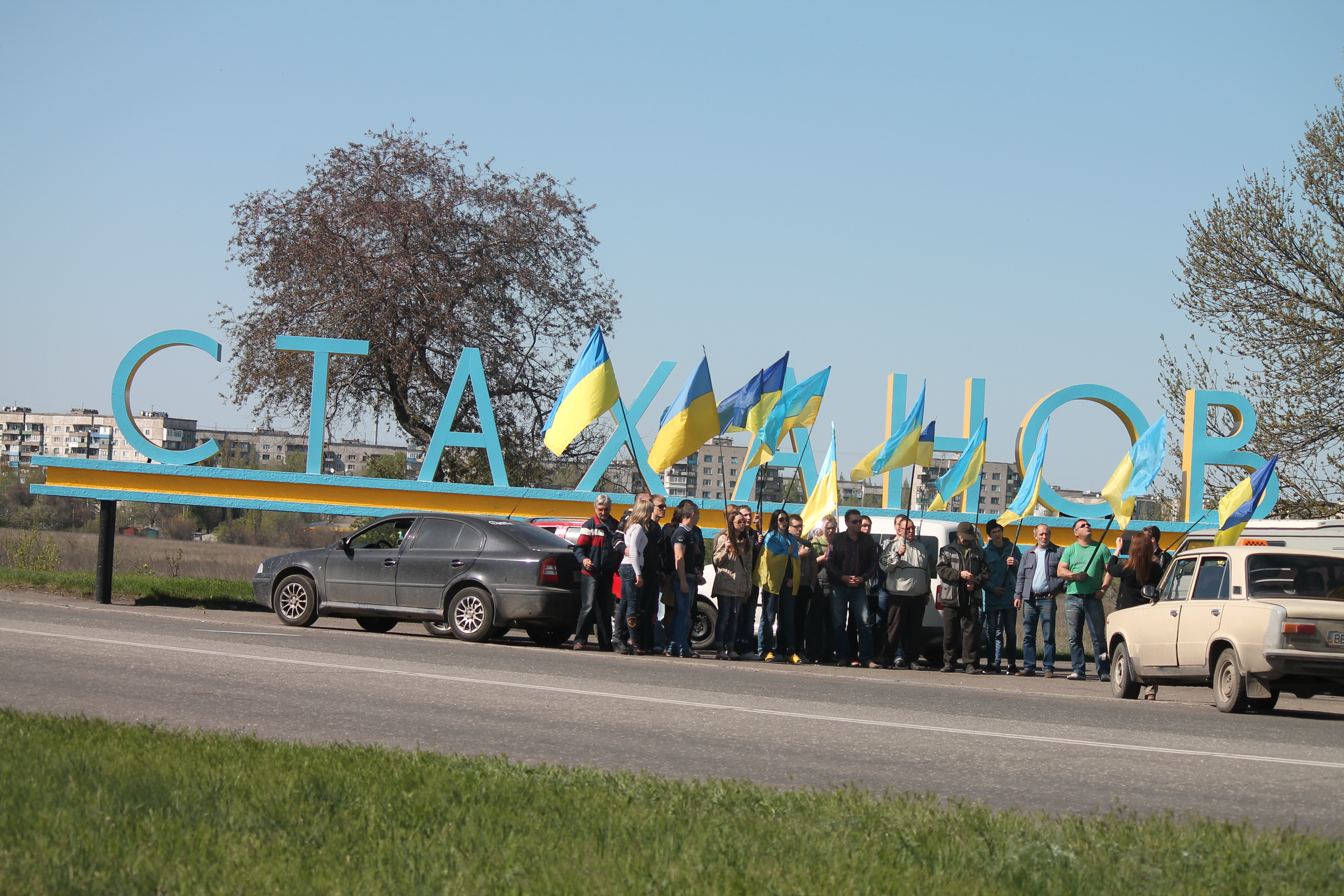
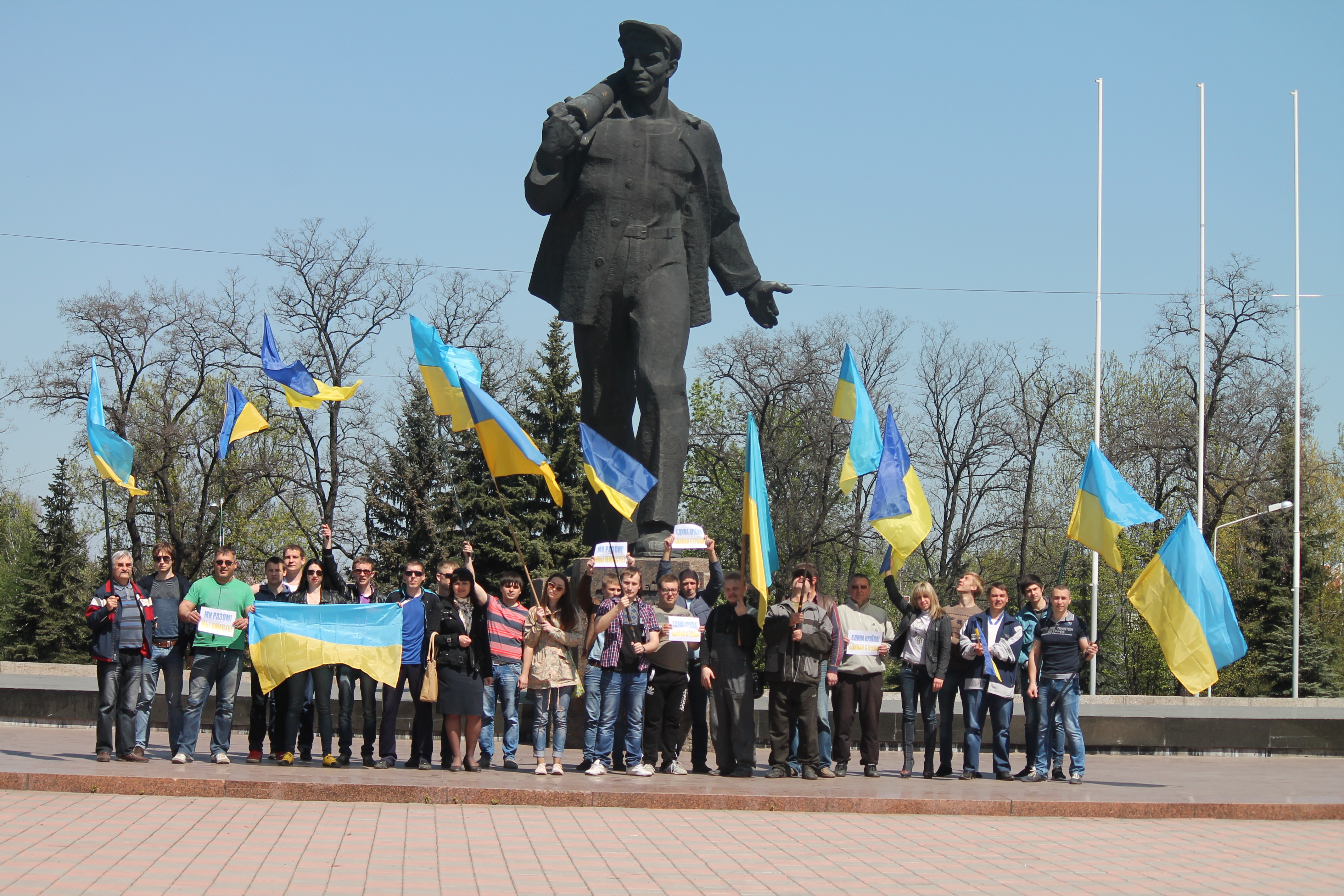
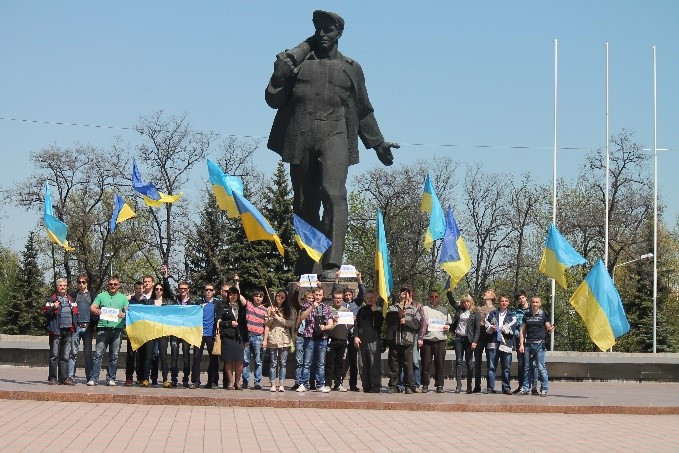
Patriotic rally in Stakhanov, Kirovsk, Irmino and Bryanka. April 26, 2014. Photo from the personal archive of Yevhen Shlyakhtin
But our happiness didn’t last long. Four hours later, forty armed collaborators from the Luhansk office of the Ukraine Security Service arrived in the town. The first takeovers of administrative buildings began; they seized the town hall and the Gorky Concert Hall, and started to put up barricades downtown. Before that, there had been attempts to seize the police station, and the event was filmed by Russian propagandist TV channels. And the police, in order to stop the crowd, took down the Ukrainian flag and put up the red flag of the Soviet Union.
The situation escalated dangerously and grew like a snowball. One of the motor rally participants was threatened with a gun, but miraculously, he survived. Conscious Ukrainian teenagers, Bohdan and Volodymyr, put up the Ukrainian flag on a pile of coal refuse. The militiamen started shooting at them. The police didn’t help to find the culprits, and the teenagers themselves were taken to the police station. But the most terrible thing that happened was Volodymyr Popov’s murder. He was shot. He argued with all collaborators and very openly supported Ukraine.
Chapter 4: May 9, 2014
I will remember May 9, 2014 for the rest of my life. I could have been stabbed to death.
The city council had planned festivities to commemorate the Victory in the Second World War. I was tasked with filming any provocations that might happen during the event.
The separatists distributed Colorado ribbons, their symbol, to everyone near the town hall. And everyone was happy to wear them close to their hearts. They gave me one as well. I put it into my pocket.
All of a sudden, Oleksandr Klimanov, my neighbour, who was also standing in the square with everyone, pointed his finger at me. “He is with the Right Sector,” he shouted frantically. “Dmytro Yarosh’s henchman! Remember? And he was in Poland, in the Right Sector training camp.”
They twisted my arm behind my back and started beating me. The bloodthirsty crowd surrounded me. There was hatred in the air, everyone wanted to push and hit me. I was very scared. I don't remember how long the beating lasted, but it seemed like an eternity. I said: “Check my pocket, there is a city council employee ID in it!” The beating stopped, separatist Oleksandr Kashparenko looked at the ID card and tore it... Throwing it away together with the Colorado ribbon.
And then Kashparenko took out a knife and swung it at my stomach. The knife cut through clothes, my leather belt and trousers in an instant, but left just a scratch on my body. I was that close to being killed. Exhausted, I was dragged to a Soviet made Niva car. My two colleagues, Vladyslav Shapovalov and Serhiy Stroev, tried to save me but were not successful. I was taken to the militants’ headquarters that they set up at the Stakhanov Police Unit for Combating Organized Crime.
I was escorted into the building. They took my IDs, money and work equipment. They took me out to the backyard and locked me in an iron garage. I thought it was the end. In an hour and a half or so, they took me out of the garage, gave me back all my belongings, apologized and said they made a mistake. My boss Volodymyr was waiting for me in the car in the yard. He took me to the town hall and called a doctor to examine me... Then I was taken home.
Chapter 5: Work
I continued to work in the town hall. The town was under dual power, split between the legitimate government and armed separatists. I thought to myself that I would keep working until they start forcing me to swear allegiance to the separatist organization called Luhansk People's Republic. Because you pledge allegiance only once.
The situation inside the town hall was difficult: one third supported the separatists, ten per cent remained faithful to the oath, and the rest of the employees were waiting to see what happens next.
My “circle of trust” included Volodymyr, my department chief; Maksym, the legal department chief; Mariana, the deputy chief of the youth and sports department; and Ella, the mayor's secretary. A different fate awaited each of us. Volodymyr went to fight the separatists with weapons in his hands, Maxym was captured, Mariana and Ella and their families left for the free part of Ukraine.
On July 21-22, 2014, Stakhanov was fully occupied. At that time, the Ukrainian Armed Forces successfully liberated the cities of Rubizhne, Severodonetsk and Lysychansk and already reached the city of Pervomaisk, which is eight kilometers away from my hometown. The separatists retreated. At night, a convoy of heavy military vehicles drove along the Stakhanov bypass: there were artillery systems, Grad multiple-launch rocket systems, armored personnel carriers and tanks.
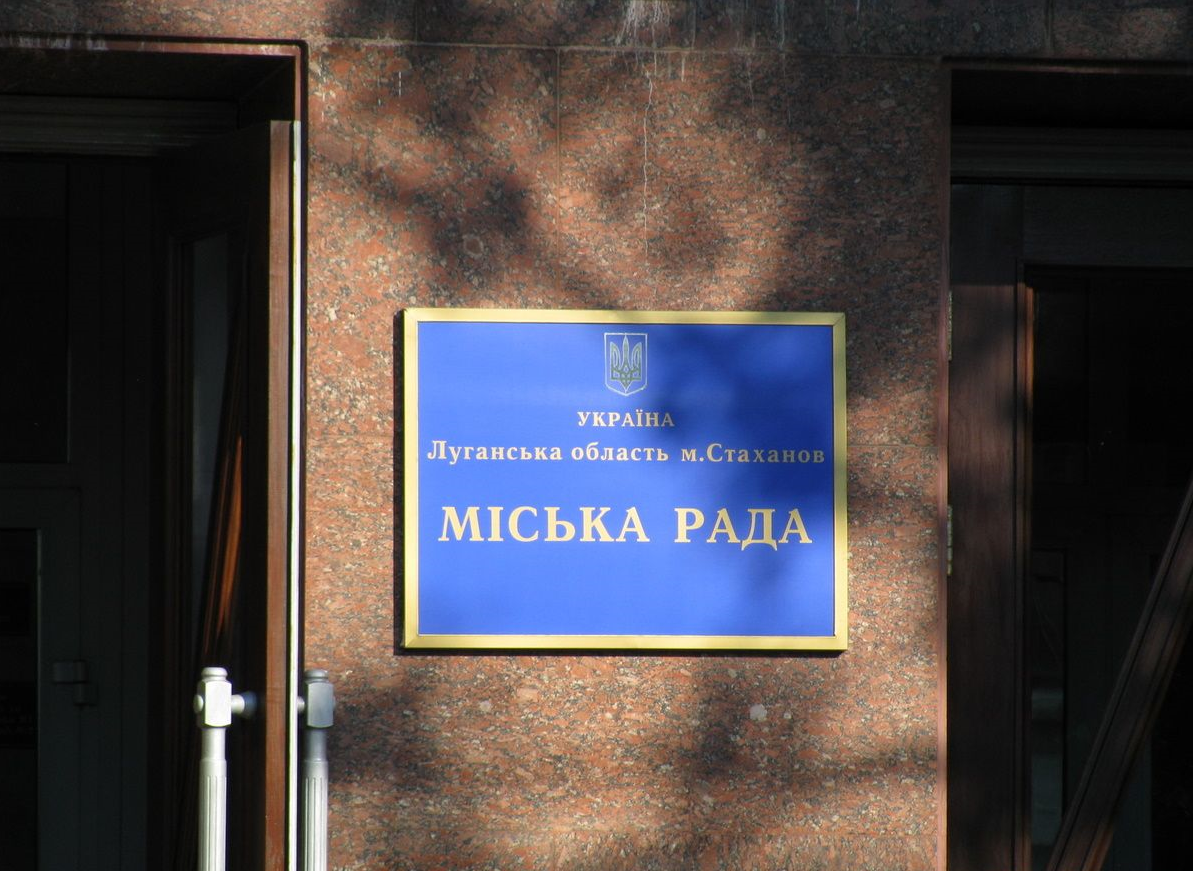
Entrance to the Stakhanov City Council before its capture by illegal armed groups. Until March 2014 - Photo from the Internet. Photographer is unknown.
And in the morning, a real horde passed through all the central streets of the town: an endless convoy of separatists and mercenaries from Russia. Cars, buses and trucks. All the personnel were in camouflage, with machine guns, grenade launchers and mortars. They were covered from head to toe in patches and flags of Russia, Novorossiya, the “Luhansk People’s Republic”, red flags of the Soviet Union, the separatist Ghost Battalion flags, and the Russian Don Cossacks flags.
As a result of the active combat actions, the water pipeline was damaged and the town of Stakhanov started experiencing problems with water supply. Utility services delivered potable water according to a predetermined schedule. Having taken time off from work for the first half of the day, I went out to replenish the household supplies.
My father and I took a garden wheelbarrow and an extra barrel and drove to the yard of the Military Mountain Rescue Unit. There was supposed to be a water delivery to that location from nine to twelve a.m. After standing in line with fifty other people, we replenished our water supply.
I got changed and went to work. Halfway there I met my dreadful neighbour Klimanov. Three weeks had passed since our quarrel. He said with a disgusting smile: “Are you still alive?” I wasn’t surprised, I replied: “More alive than all the living.”
At work, the boss gave me the task of posting several messages on the city council official website, so I returned to my office. I turned on the computer and the electric kettle. Just then, five to six armed separatists broke into the office. All of them wore camouflage. They addressed each other exclusively by their callsigns. I remember: “Samara”, “Bars”, “Radical”. And one of them had a badge that said “Sergey Cherezov. Assistant commandant of the town of Stakhanov”. They all had insignia with the flags of Russia, Novorossiya and the Platov Don Cossack Regiment.
They shouted, “Are you Shliakhtin?” “Yes,” I answered, feeling doomed. I was instantly hit in the stomach with the stock of an automatic rifle. Sweat flowed like a river, I thought about how to save myself. I could not bounce back, more blows followed – to my body and my head. They took my phone, checked my messages and recent calls. They found a Ukrainian flag in my office, they took away cameras, video cameras and computer hard drives.
My colleague and I were escorted out of the premises. Colleagues from other departments watched all this, they looked away because they couldn’t do anything. Finally, the separatists draped the Ukrainian flag, they had found, over my shoulders. They ordered us to get into the car and drove us in an unknown direction.
They brought us to the militants’ headquarters, the same place where I was held on May 9. There were tire barricades at the entrance, and there were a hundred times more separatists and Russian mercenaries now. The former Police Department for Combating Organized Crime has been turned into a major centre of crime.
My colleague Maksym and I were taken to a room. Before the seizure of the police department, this had been a relaxation room for employees. There was a pool table in the middle of this large room. Now, instead of pool balls, there were instruments of torture on the table: batons, pliers, knives and scalpels. And in the corner of the room there was a chair with a rusty iron chain. There were traces of blood everywhere.
We stopped in the middle of the room, near the table. Several militants began to beat us with police batons on our hands and feet. They beat us on soft tissues, thighs and forearms. I was ordered to take off my pants and shirt and wrap myself in the Ukrainian flag. And they started beating me even harder. The executioners changed, and the beating continued. Insane fear was accompanied by intolerable pain. Another camouflaged man entered the torture chamber. He was healthy, and under two meters tall. He took the iron chain, wound it around my neck and began to strangle me. My whole life seemed to flash before my eyes at that moment. There wasn’t enough air, I started to suffocate. My executioner threw me on his back and continued his torture. My spine cracked, my eyes rolled from the pain. When I was thrown to the floor, I began to gasp for air. At this time, Yevhen Tymofeyev, an acquaintance of mine, was brought into the room. His head was smashed and his green T-shirt was covered in crimson blood stains. This didn’t give me optimism.
After such a “warm welcome”, the three of us were taken to the garage in the yard. I felt a shock of realization that that the enemy could destroy me from the inside. I was numb with fear. What scared me even more was what I saw inside – a place absolutely unsuitable for keeping people. The garage was made of steel, and the air in it warmed up like in a sauna. Dirt and dust. Broken chairs, rags, some kind of mattress and cardboard boxes were scattered on the concrete floor. There were people among all this garbage.
First, I saw a woman in her 60s. She was exhausted, and when she turned around I noticed her right arm, completely blue from the beatings. When they brought us in and threw my things and the flag inside, she immediately grabbed the flag and hid it in some kind of bag. “Do you want us all to be killed?!” she exclaimed.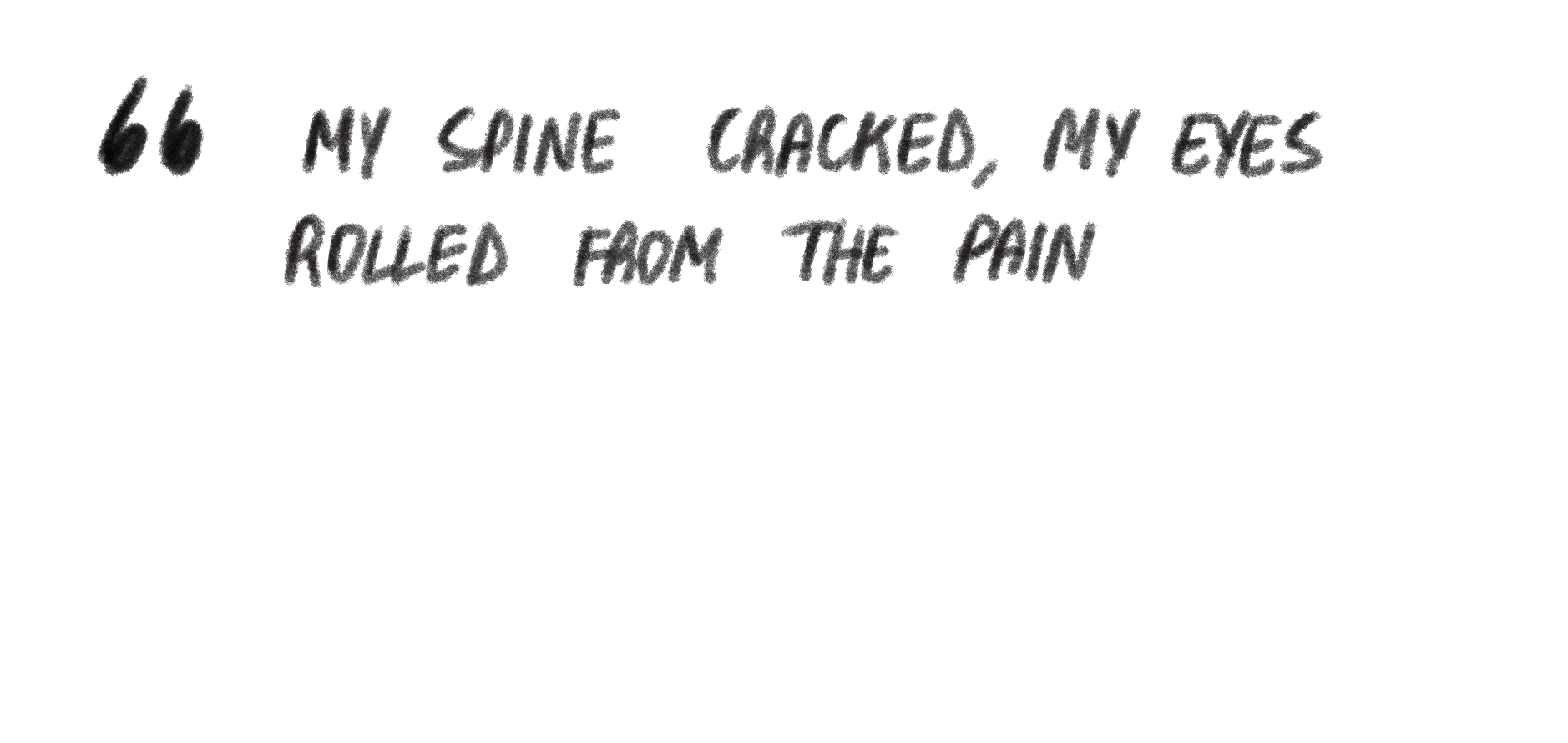
Another girl shouted after the militants: “When are we going to be fed? Even the dog in the yard is fed!” There were several other men in the same garage, but I was in total prostration and didn’t know what to do. I was in a state of complete stupor caused by hopelessness. After putting on my pants, I silently sat down on some rags near the wall.
I had barely come back to my senses, when I was summoned again for questioning. Armed guards took me to a small room. There were three men in camouflage uniforms there. Two of them with pistols were sitting at the table, and one, with a baton, was standing in the corner of the room. The vilest one began the interrogation: “We are the LPR counter-intelligence. You trespassed against the Republic’s constitutional system! And you're probably an artillery observer. Give a statement. What Ukrainian secret services do you work for?” I answered: “I have never worked for any secret services. Yes, I organized rallies against the war and in support of Ukraine in Stakhanov.” I immediately received several baton blows on my shoulder. I screamed in pain.
“Think until tomorrow. Tymofeyev has already started telling us everything,” added “Consul”. “Saint” nodded to “Big Face” and he started hitting me on my arms and legs again. Then I was locked in the garage again.
My thoughts about the possibility of my life ending in such a pathetic way were interrupted by the guards. “Ukrops, come out and unload the shells!” As it turned out, the garage consisted of two parts: one used to hold civilian prisoners, and the other half was a warehouse filled to the brim with artillery shells. We walked up to the truck and unloaded two dozen boxes of shells and anti-tank guided missiles.
When Ukrainian military aircrafts showed up in the sky a few days later, I had a certain feeling of dissonance. On the one hand, there was hope that an offensive was coming and Stakhanov would soon be liberated, and on the other hand, if rockets were to strike the separatist headquarters now, there would be nothing left of us. Meanwhile, the prisoners began to hide, some under door panels, some in the car inspection pit. And I froze as if in a living picture. I remained there, on the dirty floor, not looking for any shelter.
After unloading the munitions, I was taken to wash the car of separatist leader Pavlo Dryomov. Loud music was playing in the yard, “Get up, Donbas. Mother Russia is with you.” The car was parked at the entrance to the headquarters. It was there that I saw my frightened parents. They asked the separatists in charge to let me go. But the separatists yelled at them and ordered the guards to immediately take me out of their sight. I just managed to shout: “Bring food.” We were no longer allowed to communicate with our relatives. It was a deliberate system, whereby the “conscious” were demonstratively taken away from home and work so that everyone could see and fear that the same could happen to them. In this way, the separatists tried to contain any anti-Russian resistance.
A few hours later, we were handed two packages of food. “Shliakhtin. Tymofeyev. Take it away.” Before the doors had closed, a separatist named “Consul” rushed in: “Ukrops, outside! What the hell are you doing! Special treatment and individual meals?! You are not at a resort here!” I couldn't stand it and answered: “Ask the people who have been here for a while, they don't feed us here.” He cursed and gave permission to bring us food.
But I had yet to experience the first night in captivity. The prisoners, who had been in the garage for a long time, warned: “It’s going to begin now.” And so it happened. The shutter creaked. Drunk militants started entering the cell “to have fun”.
A militant with the call sign “Colonel” ordered all of us to line up. They smelled of recently consumed vodka. They began “morale building exercises”. They were rumored to have come straight from the front line where they were defending Donbas from the “Kyiv junta”, as the separatists called the legitimate Ukrainian Government. If it weren't for them, all Russian speakers would have been killed. They said that when the militias retreated from Slovyansk, the Ukrainian National Guard “punishers” crucified a little boy there. And there was a lot of other Russian propaganda, which could be summed up in one word: sheer nonsense.
The “Colonel” started yelling: “Why are you here? What are your crimes?”. Everyone started in turn: “I broke the curfew”, “arrested drunk”.
“Which of you are the fucking Ukrops? Step forward” shouted the militant again.
Max, Tymofeyev and myself took steps forward. And he immediately started threatening us: “We will send you to the minefields! You will collect corpses!” Then they beat us with batons and fists. The same bruiser who strangled me earlier with an iron chain approached me again. “So, whoever doesn't jump is a Moskal?” he asked. I stood in silence. “Jump, I said!” he roared. And he hit me with a baton with all his might. He beat me purposefully, on the head. I tried to protect myself with my hands, the beating didn’t stop. He shouted something, but I could no longer hear him. I fell down from the pain and passed out.
I regained consciousness because of terrible pain. My head and the whole body hurt. I had two swollen bruised claws instead of hands. My fingers wouldn’t bend. Later I found out that I had six fractures in my arms. The executioners left. Exhausted and stressed, I fell asleep on a rag strewn in the middle of the concrete floor. I woke up from terrible pain and from the news that our numbers grew. New people arrived in the prison. Every time the door opened all the prisoners had to line up.
The morning began with the guards taking everyone out into the courtyard. Riflemen stood around the perimeter and watched us. The yard felt like “heaven on earth”, because the iron garage was heated to the temperature of a sauna. It was as if we were boiling inside, and the stench was terrible. We couldn’t breathe, and the dust on the floor added to that, causing everyone to start coughing sooner or later. The temperature inside was so high that some of the prisoners were shivering from the cold when they got outside even though the outdoor air temperature was about 27 degrees Celsius.
After the morning routine, the “Ukrops” were called in for interrogation. They “talked” with each of us for about an hour. I was brought in and saw the same line-up again. “Consul” began: “Write a confession. Say you are an artillery spotter and work for the Security Service of Ukraine.” I refused: “It's not true. I won’t write it.” “Saint” gave the go-ahead to “Bruiser” yet again, and he started beating me with a baton. He hit my head, my body, my broken arms. The pain was unbearable, and I passed out. And then, like in a Hollywood blockbuster, they poured a bucket of cold water over me, so that I would come to my senses. Then, the beating began again.
Eventually, under force, I “confessed” to everything. Because if you don't do what they need, they continue the torture. Somehow, I managed to write the text they dictated. And writing with broken hands is quite a challenge.
While I was writing, “Consul” noticed my hands: “What happened?” I said “Fell over at night.” I was sent to see a nurse. A young girl greeted me with a shout: “Our boys don't have enough medicine! And I have to help the enemy here!” But it could barely count as help. She rubbed my hands with a warming gel and bandaged my hands. And finally she gave me two pain-relief tablets blister packs. That was all the medical care I received during my entire time in captivity.
We spent ten days in the garage. During this time, they also imprisoned Serhiy Potiomkin (they came to pick him up at home). Oleksandr Hailo joined us. Oleksandr (Sasha) tried to hide, but they still found him. Because he is an ultra of Zorya Luhansk Football Club, they beat him on one hand only. That is why it turned the colour of a ripe plum.
At the peak of this persecution, there were fifty people in the garage. The prisoners had to take turns sitting and standing, because there was not enough room for everyone. Each new prisoner was a carrier of information from the free world. And we tried to find out the news, to understand the real situation. Because according to the militiamen and their counterintelligence, their forces were practically on the outskirts of Kyiv already.
My interrogations and torture continued every day. When you pass the “three day” mark, you are in such a state of shock that you cannot even talk. Having accepted the reality, the “political” prisoners started to talk to each other in whisper. We agreed upon what each of us would say during interrogations so that we wouldn’t be beaten. “Tomorrow I will talk about the rallies in Luhansk. You're talking about the motor rally. And most importantly, we will be talking about rally participants who have already left the city,” I suggested. Everyone agreed. This tactic proved to be effective, and the number of beatings decreased. It was as if we were giving them some real information during the interrogations.
When the number of beatings decreased, I began to comfort the new cellmates so that they would “adjust” more easily. I explained the routine in the cell and how not to get on the guards’ nerves. But one can’t possibly predict the behaviour of sadists and maniacs. Militants constantly came into the garage and threatened us. Once, the one who strangled me with a chain and who hated my colleague Maksym because he had a higher education and held a senior position in the city council, fired several single shots at Max's feet inside the garage.
A big man with the call sign “Bars” came to see me: “I liberated Crimea, now I’m here, in Donbas. Do you know what I'm going to do to you? I will drug you and cut your skin to pieces. I will do this until you die.” “Samara” told me about the history of the Russian Empire and the role of the Ukrainian people. He told me about his three terms served in prison. And at the end he said that he would shoot me or send me to the minefields.
But the most terrible thing that happened there was the murder, of course. On August 6, 2014, new prisoners were brought to the garage—Mykola Zaglada and his son. He was a former police officer. In April, while resisting the militants’ attempt to capture the police station, Mykola was severely beaten. Then he left the town for a while, but later he came back to Stakhanov.
And as soon as he returned, he and his son were caught and their house was searched. They interrogated father and son separately. During the search, the militants found Zaglada Sr.’s flash drive with some information, and he was badly beaten again. They made his son clean the interrogation room, and wipe up his father's blood. One time, after the torture, they brought Zaglad Sr. to the garage, blue from the beatings. His hands were tied and already blue, and his ribs were probably broken. He was chained to the garage door, and the other inmates were warned that if any of them came near him, they would be treated the same. Zaglada was in a very bad condition, he moaned for a long time, he rattled his chain because of the excruciating pain. And then he was taken out of our garage into the yard and chained to an iron pipe. He was silent for a moment. The militants said later that he was allegedly taken to the doctor... However, no one has seen him since.
Chapter 6: Orphan boarding school
On the tenth day, the established routine changed. The guards were saying nothing. After lunch, they ordered the main “enemies of the people of the LPR” to gather: the “conscious”, the “artillery spotters,” the religious and the “terrorists.” I was considering two options in my mind: they could relocate us to the former police station (because I saw them hanging out there), or shoot us.
At gunpoint, we were loaded into a minibus. I could see that they were not taking us to the police station, as we passed by the pond. That’s it. They were taking us to the quarry where they would kill us. My whole life flashed before my eyes yet again. Looking at the faces of those around me, I realized that I was not the only one with such thoughts. All of a sudden, the representative of an evangelical church began to speak: “Brothers, don’t be sad, because the soul is eternal! And if we die now...” Before he could finish, we all shouted in unison: “Shut up!” It seems funny now, but back then it was very scary. Those two religious men would be freed. But before that, during an interrogation, their heads would be smashed and their bodies cut with knives.
We were brought to the orphan boarding school on the Matrosov street. There the separatists had military barracks, counter-intelligence and a hospital. And then we were sent to the basement.
The conditions were terrible. A silence fell among us. Everyone was lost in their thoughts. Half an hour later, the old separatist man started telling jokes and funny stories. That cheered us all up a bit. But not for long, because I had to sleep on the damp earthen floor. Some of us were lucky enough to sleep on wooden boards, doors or table covers, or some old mattresses. A lamp that was always on produced a dim beam. There was no daylight. In place of the unbearable heat came terrible humidity. After a short time, most of us began to cough.
The interrogations continued. The worst thing about it was that the torture chamber was nearby, right behind the wall. And every time someone was taken away for interrogation, we heard terrible screams and moans of pain. Butt strokes and screams every time. So when the door opened, we had mixed feelings. On the one hand, it brought hope that you could get the so much desired freedom, and on the other hand, it could mean that you would be taken back for interrogation where they would mutilate you or the person sitting next to you. Constant fear. And I am still not sure what is scarier, to be beaten or to hear the screams of another person.
We were taken to the bathroom once or twice a day. When guards came, everyone had to move away from the door. Then the door opened and the prisoner had from seven to ten minutes to get out of the basement, go up to the first floor, and run 50 meters along the corridor, where we had an unappealing choice: either use the latrine, wash up, fill water bottles with water or pour urine out of the bottles. We ran this entire route under the muzzles of the guards’ automatic rifles, guns and pistols. Even in the restroom, there were always militants with weapons standing nearby and rushing us.
Our prisoners’ line was formed the following way: first, those who needed to take a crap, and then, those who would pour out urine and fill the empty bottles with water. Smokers were the last to go, because whoever went last had to clean the toilets, and was given a few cigarettes afterwards.
I remember the first time we ran like that and I saw a purple sunset, I noticed it almost by chance, with my side vision, when I was running on the ground floor. I had only a few seconds to admire it. But that sunset will stay in my memory for the rest of my life.
After the transfer, we thought we would run out of food. However, we started receiving our parcels. One day I found a piece of paper at the bottom of the package. I recognized the handwriting of my mom, Olena Vasylivna. The note consisted of just a few words: “Love and kisses! Mom and Dad.” It was incredibly difficult to read those lines. I read them again and started crying. I sobbed uncontrollably. There was complete silence in the basement. Nothing had made me feel the emotions that note evoked, neither my fingers being broken (I screamed in pain, but I didn’t cry), nor the beating during interrogations until I passed out.
By the third week, there were fewer beatings, but they tried to break the “political” prisoners psychologically. They would tell us: “We will not shoot you, but you have seen too much, so you will be here until the end of the war.”
Chapter 7: My second birth
On August 28, Pavlo Dryomov, the local commander of the Don Cossacks, came to visit the LPR counter-intelligence unit. The “political” prisoners were transferred to a separate cell, many times smaller than all the previous ones. At most, it could accommodate up to ten prisoners.
They began to hastily summon the prisoners. I remember very well the commotion, the slamming of the doors of the first, second, and third cells, the quick steps of the prisoners on the first floor. About forty people were released that evening. And the total of over 200 people went through the “basement”. And there wasn’t a single military man among them.
They came to us too. They took Max. He came back to collect his kitchenware. I nodded to him and asked in a whisper:
“Did they let you go?”
He nodded affirmatively in response.
“Leave it here for us.” I point to his watch. Max heard me and quickly put it back in its place. The electronic watch was a real treasure for us. Because with it, and with no daylight, we had some notion of time.
That night was the happiest for “political” prisoners. We hoped that one day we too would be free. Maybe in a week, a month, six months, but we would get out of the prison. We spent half a night talking in whispers about how our lives would change when we were released.
On the morning of August 29, Shliakhtin, Potiomkin, Tymofeyev, Vozniuk, and Hailo were summoned one by one. The “Consul” took out a gun from his holster: “You don't have any complaints against us, do you? Write a statement: ‘I am such and such, while being detained by the counterintelligence, I have no complaints about the conditions of detention. No physical force was used against me.’” After the “formal part” they gave me back my passport and my empty wallet.
All the guards, investigators and other militants instantly became so friendly that it made me sick. As if there were no murders, constant psychological pressure, torture and abuse during interrogations.
The five of us were released.
Outside the prison, I ran into my mom first: she was carrying a bag of groceries to be delivered to me. At home, I found my father, whom I’ve never before seen in such an emotional state.
August 29, 2014, was my second birth. Thirty days of hell were behind me. I had a whole life ahead of me. Life after captivity.