
The Tale of a Small Motherland, a Lost Library, and a Golden Sunset
A flight from the occupied territory through the parched steppe
It was July 14, 2014 when I set off on a journey that has been going on for 11 years. Luhansk was already in the hands of the separatists that day. I packed two large chequered bags and a backpack. I took only as much as I could carry by myself. I quickly said goodbye to my house. I took a photo of its empty rooms, and for the first time in my life, I took a selfie in the bathroom mirror.
The house dates from 1913. It has crown moulding, a cellar with a limestone arched vault, and a tiled stove covered in thick black paint, with shiny bronze doors. There was also a huge, old apple tree by the porch. It was covered with white and pink flowers every year and brought forth large sweet and sour yellow apples. I lived here for only a few years, made some major repairs to the building, and fell in love with the view of the road, where I could watch the big orange sun setting over the hot Luhansk summer.
Those evening moments reminded me of my childhood, when my father and I went up to the roof of our nine-storey building and watched the same sunset from there. Quite often, on windy days, the evening sky turned dramatically bright, and those evening minutes were imprinted in my mind as a symbol of the beauty of my native land.
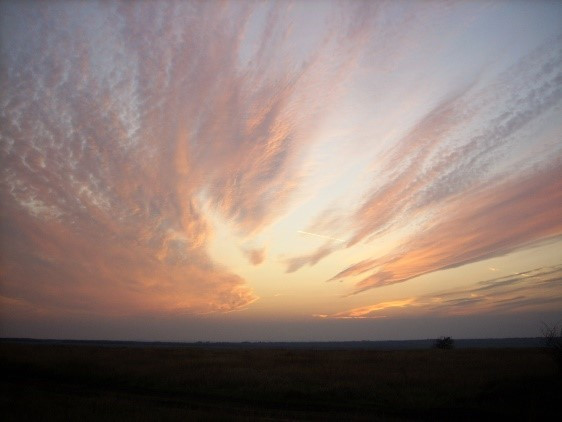
Sunset in the steppe in Luhansk oblast, Lutuhine region, 2007.
Photo from the personal archive of Volodymyr Shcherbachenko
I will never return to my last house in Luhansk.
I asked a distant relative to take the keys. That kind woman was part of the family, and we had never discussed politics with her. I heard from my relatives that she voted for the pro-Russian “Party of Regions”. Along with the house keys, I left her a note with the contacts of those who needed to be called in case of my detention. I did not explain to her in detail whose phone numbers they were and why I was leaving them, but she seemed to understand.
I prepared to close the door for the last time. There was an unpacked box with an electric generator in the corridor. I bought it in the Epicentre store back in January 2014, in anticipation of the war. Back then, I imagined the war differently. Hostilities on the border with Russia, perhaps, somewhere near Krasnodon. I thought there might be missile attacks and power cuts in Ukrainian Luhansk. The reality turned out to be completely different. The occupation ate away at the city from the inside within a few months, with no real resistance from the authorities and virtually no armed resistance from the security forces. Perhaps the only heroes to openly offer armed resistance from the outset were the Luhansk Border Guard Detachment. The generator has remained unpacked.
I walked to the railway station through the backyards, since I didn’t want to be seen by the wrong people. The station was patrolled, so the next goal was to quickly cross the station square and jump into the carriage. I did this successfully.
I had to travel in a carriage with reserved seats, but even getting such a ticket in those days was difficult. There were more people in the carriage than seats. The shelves were crammed with bundles and suitcases. I was enveloped in a stuffiness that made it difficult to breathe, and in a few minutes my t-shirt was already unpleasantly sticking to my sweating body. The train started moving, accompanied by the sound of shelling. I had no feeling of irreversibility yet, so I silently sighed with relief. Later I found out that it was the second to the last train from Luhansk to free Ukraine.
I still have my ticket for that train. Every year, in early summer, some of my friends make posts on social media with memories of the same tickets. Why have we been keeping these sad electronic mementos of our escape from our small motherland for so many years, although we cannot return with these tickets? Perhaps, for us, it is symbolic proof that this land is ours, and we have the right to get it back.
Railway Ticket Boarding Pass
|
TERMINAL No. 61 |
Railway Ticket Boarding Pass |
000В38С3-4311-В5Е9-0001 |
PN: 215793826073 FN: 2659023176 ZN: 3T00000002 FK: 2396394 |
|||||||
|
SE “Main Information and Computing Centre Ukrainian Railways” 21 I. Franka Str., Kyiv |
#Ф9У-Е1-3310157-1307 |
|||||||||
|
IPS |
Railway Ticket Boarding Pass is the grounds for travelling |
13.07.2014 |
20:52 |
|||||||
|
Name, surname |
Shcherbachenko, Volodymyr |
Train |
134 D NET |
|||||||
|
Departure |
2214200 |
LUHANSK |
Carriage |
16 WITH REGISTERED SEATS |
||||||
|
Destination |
2200001 |
KYIV PASSENGER |
Seat |
025 Full |
||||||
|
Departure date and time |
14.07.2014 19:55 |
Service |
BIL |
|||||||
|
Arrival date and time |
133* |
15.07.2014 12:20 |
|
|
||||||
|
PRICE=UAH 117.85 (TICKET: UAH 49.18+SEAT: UAH 23.53+SLEEPING PLACE: UAH 15.00+VAT: UAH 19.47+INSURANCE: UAH 1.09+FEE: UAH 9.58) #ACCIDENT INSURANCE: 6,000 TAX-EXEMPT MIN. PJSC “UKRAINSKYI STRAKHOVYI DIM”, 3 SPORTYVNA SQ., KYIV, T. 0442388081 DEPARTURE TIME: KYIV TIME |
||||||||||
|
/QR-code/ |
This Railway Ticket Boarding Pass allows travelling by train without obtaining a physical ticket at the ticket office. It is the proof of payment. This Pass can be returned before the departure. |
|||||||||
The train picked up pace, and the landscapes of my native Donbas began to drift by. Dozens of trips turned those landscapes into a film for me, which I can easily recall in detail even now. How much I would like to see this film live again from the train window...
The suburbs of Luhansk, the Olkhovka River, the steppe, a penal colony, the Alchevsk Iron and Steel Works, and piles of coal refuse. That time, the steppe was on fire from shelling, burning out at dusk in ugly black spots.
The train stopped for several hours, and we spent several anxious hours near Horlivka at night waiting. The battle was going on. Finally, the train started moving again. I felt a sense of relief in the tense atmosphere of the carriage, and fell asleep.
I woke up the next day close to Kyiv. Ten years of my next life began. Ten years of documenting crimes and helping those whom the war destroyed especially cruelly. Ten years full of human pain, suffering, injuries, deaths, forced disappearances, abandoned and destroyed homes, unrecovered families, unborn children, and unfulfilled hugs.
Anticipating the occupation
There is a question in my working questionnaire for those affected by the war: “When did the war begin for you?”. I sometimes ask this question not only to others, but also to myself.
The first time the war knocked lightly on the door of my house was on December 29, 2013. It was evening, and I got a message from friends from the Maidan protest movement in Luhansk: “Some Party of Region’s supporters came with a sign about you! Come!”
It was intriguing. I quickly got dressed and went out. My adrenaline level was higher than usual, and I was feeling a mixture of curiosity and slight danger.
Young men with posters were hovering about Shevchenko monument in the centre of the city. “Shcherbachenko is a U.S. Department of State’s agent”, one of them read in large letters. Hah! About me? Really” The names of three other colleagues from friendly NGOs were on other picket signs. Kostiantyn Reutskyi was accused of travelling abroad for long periods of time (was that a new sin?), and all the “civil society activists” were accused of sodomy. I shook my head at the absurdity of that.
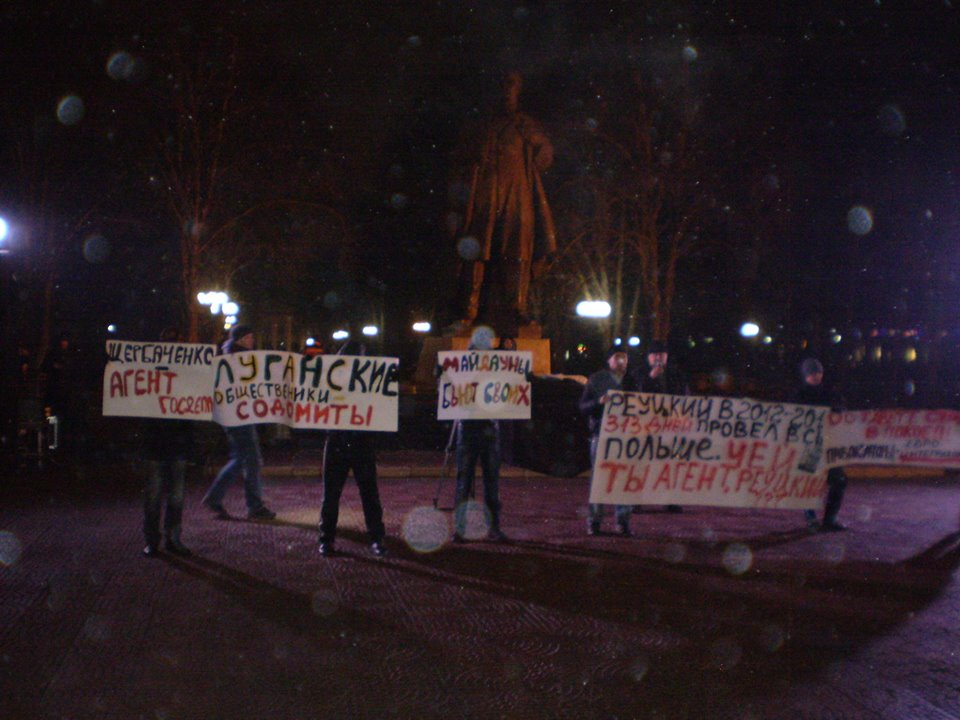
Anti-Maidan protesters in Luhansk attacking civil society activists, 29.12.2013.
Photo from the personal archive of Volodymyr Shcherbachenko
Young men held picket signs so that they covered their faces. Oleksandr Kharytonov, one of the leaders of the local anti-Maidan movement, shouted slogans into a megaphone. An insolent headman and his assistant managed sign-bearers. These two were not hiding and were handing out leaflets. The leaflets contain our coloured photos and the amount of donations our organisations received from charitable foundations.
For those who are interested in more detail, anti-Maidan activists offer a lengthy article by local “journalist” Viacheslav Husakov, “Young Cockerels of the Third Sector”, published in the newspaper of the Luhansk Oblast Council. It was prepared in the first half of 2013. The propagandist reflected in the article on whether our NGOs were dealing with the right topics and whether we were spending money on the right projects. It was not surprising that the names of the organisations in Mr Husakov’s article and those on the anti-Maidan sign were the same. Mr Husakov did not avoid the topic of grants even after 2014. After fleeing Luhansk, he actively participated as a journalist in various grant projects of NGOs in the Kherson oblast. It turned out that grant money smells bad for a propagandist only when it is not in his hands.
I was uncomfortable when I realized that information was being manipulated, and they wanted to make us the object of unjustified envy and attacks. Actually, all information about our organisations’ funding was open. We wrote about it in our reports and talked about it in our speeches. The money went to benefit people in this city and region. I had nothing to be ashamed of, and this thought brought me back to balance.
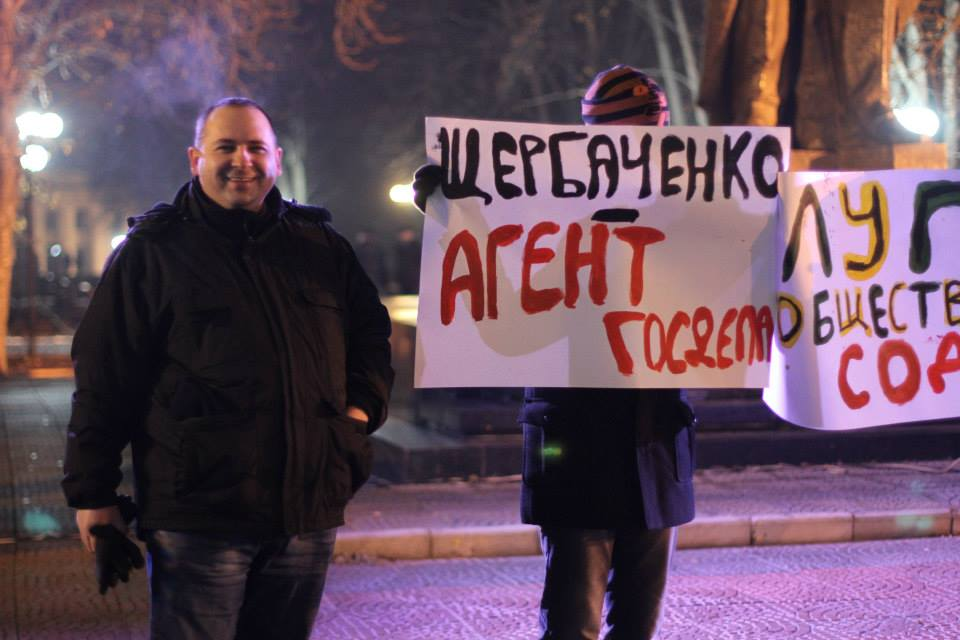
The Anti-Maidan picket sign still looks ridiculous. Luhansk, 29.12.2013.
Photo from the personal archive of Volodymyr Shcherbachenko
The fear shown by my opponents with picket signs made me more courageous, and I felt empowered to take a few photos with the sign bearing my name. I tried to strike up a conversation with the sign-bearers. I wondered what motivated them to come out to the square on a winter night. I was trying to see their faces, but they were hiding them. In response to my questions, they mumbled something senseless. Their leader hurried to help his protegés, but we did not manage to have a meaningful conversation either. I heard only threats and irrelevant answers. My interest in the young Party of Regions members faded, and I joined the Euromaidan protesters who were holding a multi-meter-long Ukrainian flag along the main street and shouting pro-European slogans.
After ten years of war, the excitement I felt that evening seems like an absolute trifle, but for me, irreversible changes began with that evening’s event.
In a couple of months, the signs that caused such thrills would be replaced by phone calls and letters with threats and suggestions that I should leave my home city. Our office phone would be disrupted for hours by silent callers. Friends would be followed by annoying stalkers, and leaflets accusing them of sexual perversion would be put into their neighbours’ mailboxes. The first illegal prisons would appear in the city in April and May. They would be accompanied by kidnappings, public humiliation of opponents, torture in its most savage, medieval forms, slave labour, sexual violence, and even extrajudicial executions. I would learn about all that in the summer. And at that moment, the “Russian Spring” was pouring into the city like a small but noticeable stream of sewage. This muddy stream was being stirred up by people who at first seemed just weird.
Weird characters
Several images of those weird people have been living in my memory since the spring of 2014. Let me introduce them.
March 2014. Luhansk was officially still a Ukrainian city. State institutions were still functioning, but the streets were already partially controlled by the pro-Russian followers. Massive old men wearing sagging trousers with Don Cossack stripes, loud teenagers armed with sticks and rods, pseudo-workers and their girlfriends with boozy faces and missing teeth.
It is easy to distance yourself from them in ordinary life: you can just walk the length of a specific street or block, move to another bench, or simply look away. However, I didn’t have that opportunity in Luhansk in the spring of 2014. Such characters had taken over public spaces where you would never expect to see them. They became key figures in the central streets, squares, public gardens, as well as entrances to government and law enforcement agencies.
I remember a stout young man in sweatpants with a baseball bat. With his legs spread wide, he stood at an imaginary post in the middle of the street at the main entrance to the oblast state administration. The man was passing the bat from hand to hand and exuding self-confidence. It was unclear what exactly he was doing in the middle of the road on the main street of the city. But he exuded a sickening threat and a sense that the official authorities no longer controlled the city. Now, the power was in the hands of that man in a tracksuit with a heavy stick.
“Russian spring” begins hunting for opponents
March 5. One of the last rallies in support of state unity was held: about a hundred or two pro-Ukrainian citizens with picket signs, flags, and ribbons gathered in the park opposite the regional office of the SSU and the “Children’s World” store. There were songs, chants, shouts, and the atmosphere was tense but generally positive. The event took place along the main street. Some drivers honked their horns in encouragement. But the situation suddenly changed. The police secretly warned the organisers: “Clear the place! Your opponents will disperse the rally by force in a few minutes”. My brain refused to accept the situation. How would they disperse us? Why wouldn’t the police protect our peaceful event? Was the law still in force? But there was no one there to answer such questions. We needed to solve the issue quickly because people were leaving in a hurry.
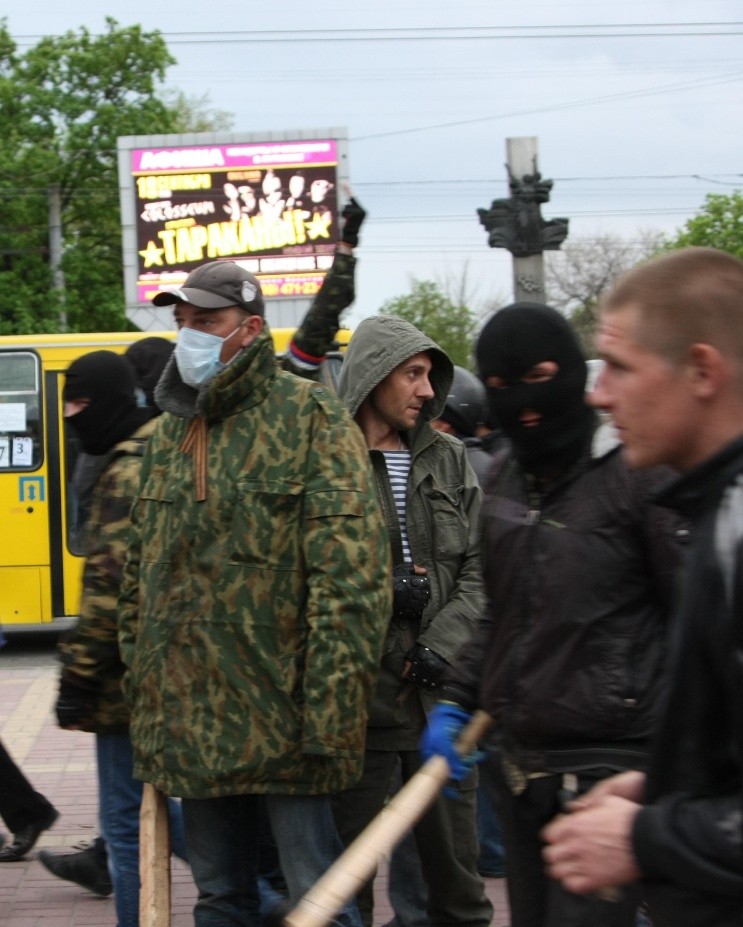
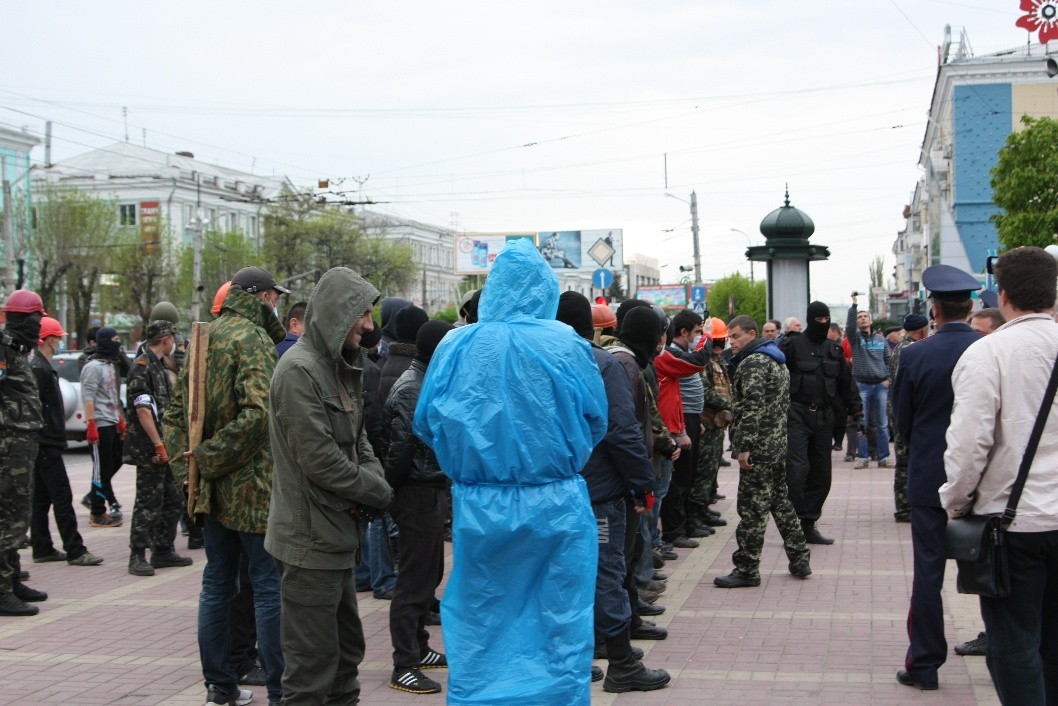
A group of supporters of the "Russian Spring" armed with sticks preparing for a provocation. The group was led by Dmitry Pindyurin (in the photo on the right in a green camouflage suit). Pindyurin would later head the illegal armed formation "Bryanka-USSR", whose members committed robberies, illegally apprehended, tortured and killed civilians and military personnel. Luhansk, Heroes of the Great Patriotic War Square, May 28, 2014. Photo: Oleksandr Volchansky.
I left the park through an alley. There was a central department store nearby. With no peculiar plan, I entered one of the boutiques on the ground floor. Less than a minute later, a couple of young men rushed into the store. One of them was holding a huge shovel handle at the ready. They stopped in the doorway and looked around attentively. Apparently, they were searching for people with Ukrainian symbols. I felt like a chameleon. My whole body was tense, but I pretended to be a calm, ordinary customer, so I was thoughtfully looking at the shop-window while watching those “goblins” out of the corner of my eye. The tense seconds passed surprisingly quickly. The “goblins” disappeared, but the possibility of being hit with a shovel handle right in the hall of a central department store plunged me unpleasantly into a new reality.
Lumpen picnic
I love a little excitement. About a month and a half after the events in the store described above, I decided to visit the same park opposite the SSU building again. At that time, the Special Service Building had been captured by Russian proxies, and the main street was blocked with sandbags. A round-the-clock anti-Maidan “festival” was taking place in the park.
At that time, people were already being held and tortured in the building of the seized regional office of the Security Service of Ukraine, but I did not know this yet. The entrance to the park for the anti-Maidan “festival” was still free, but some tents were already covered with barbed wire around the perimeter. By a miracle, I persuaded a friend, who had almost lost a tooth during the dispersal of a pro-Ukrainian rally on March 9 (Shevchenko’s birthday), to accompany me on my excursion to the park. A half-hour visit to the anti-Maidan camp was enough to confirm our impression of its participants.
I was a little upset to see some cleanly dressed Luhansk residents carrying boxes of cookies and marshmallows for the local “campers”. I can only guess at the reasons that motivated these people to support those events. Otherwise, the camp was a massive and poorly organised gathering of mostly the lumpen proletariat and their cronies.
Some of them were engaged in activities that we could not understand, while others were socialising, listening to music and drinking alcohol. Even for me, a person who grew up in industrial Luhansk, a few places where people were drinking strong alcohol in the Central Park seemed too revolutionary. I had seen something like this only once in my life, during a night walk in Antratsit, where locals were drinking horilka (Ukrainian hard liquor) while sitting on the curb of one of the city’s main streets. But it was midday here, and small groups of pro-Russian protesters were grouping around dirty newspapers spread out on the dusty park ground. Their typical meal consisted of a bottle of horilka, a couple of crushed boiled eggs, a withered pickled cucumber, and a few slices of bread. Staying in a park full of such characters boded no good, so we decided it would be wise to leave the “festival”.
A little later, I saw a couple of my acquaintances among the participants of the camp established near the seized SSU office in the photographs. One of them was the leader of the Luhansk Komsomol, Ihor Humeniuk, and the other one was my university mate, a newspaper man and local political scientist who simultaneously tried to be friends with people of two different political views. My relationship with the latter ended a few years before the war when he undertook to publish a book for our foundation, but did such a poor job that we had to recoup his wages through a lawsuit.
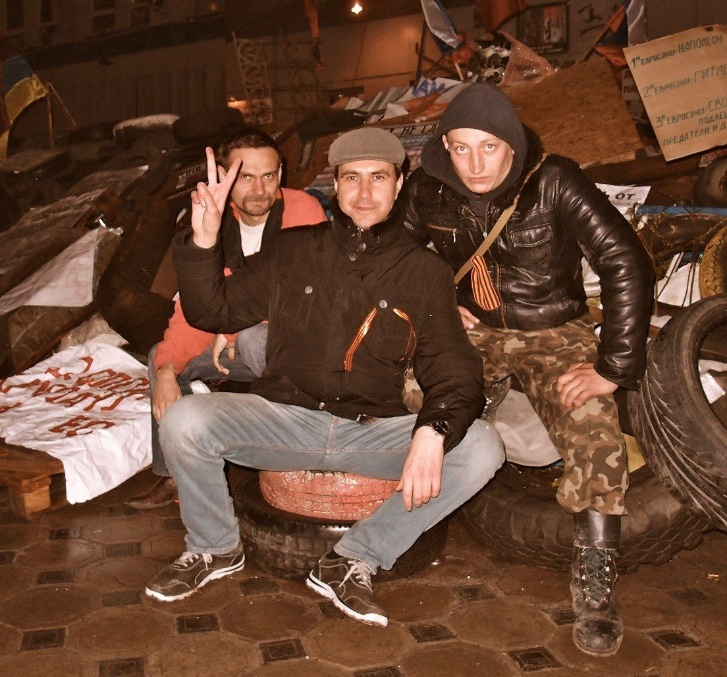
Supporters of the “Russian Spring” near the seized building of the Luhansk regional SSU office, Luhansk, spring 2014.
Photo: the author is unknown /Ihor Humeniuk’s social media page in Odnoklassniki, social networking service primarily in Russia.
This man’s desire to be friends with everyone ended up badly for him. The gang of “Batman” (field commander Oleksandr Biednov) did not appreciate this multi-vector approach. They first expropriated his old “Volga” car, and then put him in a basement torture chamber in the East Ukrainian National University for almost six months. There, they broke the man’s arm, and his wife was forced to earn his right to freedom working as a nurse’s aide and cleaner in the hospital of the same gang. Both of them still prefer not to talk about this sad experience. In general, everything happened according to the classics of the genre: a Russian-inspired riot devoured (or rather crippled) an enthusiastic supporter and his family.
Thoughtless supporters of war
The story of this couple is similar to those of tens of thousands, maybe hundreds of thousands, of people who thoughtlessly tolerated the “Russian Spring” and later became its victims. In the spring of 2014, I still had the opportunity to closely communicate with such people. One of the portals to their world for me was found on the trains that still connected Luhansk and other Ukrainian cities in the spring of 2014.
On my way back from one of my business trips from Kyiv to Luhansk, I shared the compartment with three recently retired miners. They had just completed a preventive course of treatment for pulmonary silicosis in a Kyiv hospital and were returning to Donbas. The friendly men treated me to a delicious dinner and poured me a glass of horilka. The conversation naturally turned to political topics, and they shared their intention to go to the checkpoints to “defend Donbas” from the nationalist government as soon as they returned from their trip to the capital. They spoke Surzhyk, the dinner they had was not poor, their pension payments were VERY decent, and in general they seemed happy with their lives. However, Russian propaganda had convinced them that life was unbearable. I encouraged them to look at reality and realize that they needed to question more of what the Russian propagandists were saying. Unfortunately, my arguments did not work for them.
It is unlikely that I will ever see these men again, but I am sure that the following years of the war they so eagerly supported did not bring anything good to their lives. Have their homes remained intact? Are their relatives alive and thriving under the conditions of war? Do they continue to receive large pensions and necessary medical treatment? It is more than certain that the programme for their happy old age has failed in one way or another.
“Miners and tractor drivers” were not the only brainwashed victims of the war
The monster of Russian propaganda was eating not only the brains of the working class but was successful in influencing educated people, as well. Returning from another trip, I found myself in a compartment with a young music teacher. She was a nice and refined woman on her way from a visit with friends in Kyiv. At their invitation, she had stayed in the capital for a couple of weeks. Her friends invited her to relieve the stress of the first weeks of the ATO and to see for herself that Russian speakers were not being dismembered in the capital. She had a positive impression of her trip. She seemed calm, and her judgements about social and political life were balanced and rational. However, as we approached Luhansk, it was as if someone had turned a switch in her head. Absolutely seriously, she started telling me a story about a “Right Sector” unit walking around Kamianyi Brid (one of the oldest districts of Luhansk), wearing black uniforms and holding knives. She allegedly saw them with her own eyes. Having been familiar with the nationalist milieu in Luhansk for many years, I knew perfectly well that there were no such crazy nationalists in the city who would openly walk around the city at night with unsheathed knives, especially at the peak of the “Russian Spring”.
The fantastical nature of the woman’s story and her inability to accept reality stunned me so much that I was completely at a loss for a while. Our train was fast approaching Luhansk, and I was never able to find out how and why she had invented this story.
I heard many such unbelievable stories. The people who told them did not question the absurdity of the figures and “facts” on which they were based.
One of the classic stories that I personally heard was that about 40 buses with “Right Sector” members were allegedly on their way to seize the centre of Luhansk. The number of buses, their destination cities, and their goals changed from story to story. The only thing that never appeared in them was a critical assessment of the “Right Sectors’” ability to mobilise and bring so many people to the east.
Another tale that stuck in my memory was the story of the residents of Sloviansk allegedly killed by being dropped from helicopters into the marshes near the city. Who has ever seen marshes that large near Sloviansk? What is the rationale for dropping bodies from helicopters?
Such stories did not pose a direct threat to me personally, but I was sad and irritated to see that many people living nearby believed in outright nonsense. More and more often the question of their naïveté arose. It was not always possible to refute these rumours on the spot. All that we could do was to appeal to common sense and logic. I’m not sure if it helped, but over time, I developed better skills in handling such situations.
In 2015, while collecting information about war-related sexual violence, I asked a taxi driver who was taking me to the train station from Sievierodonetsk to Rubizhne if he had heard of such cases. The man eagerly responded to the topic and categorically stated that he personally knew a woman whose vagina had allegedly been injected with sealing foam by Ukrainian National Guard soldiers. The case seemed shocking. I tried to find out more, asked a few additional questions, hoping to discreetly find out the survivor’s contacts. As a result, the story of a personal acquaintance turned out to be a fiction. The taxi driver was allegedly told the story by an acquaintance of his, whom he did not want to name. Of course, I was unable to find and help the woman, as she most likely did not exist.
The Power of the Illiterate
Not only the changes in the minds of the people around me were frightening, but equally so was the transformation of the leaders who were trying to seize power. In March 2014, I accidentally witnessed a telephone conversation between Oleksandr Kharytonov and his allies. Kharytonov was one of the leaders of the local Progressive Socialist Party of Ukraine and the first self-proclaimed “people’s governor” of Luhansk. The man was one of those who actively influenced the situation on the streets of the city in the spring of 2014, organising a local anti-Maidan. He was later arrested by the SSU and released; he fled to Moscow and now works as a Communist Party official in Luhansk.
On a spring day in 2014, I was walking down a small and completely deserted Dzerzhinskyi street, where the self-proclaimed governor was talking on his mobile phone in front of the now-closed “Harbin” restaurant. As I approached, Kharytonov was loudly complaining into the phone: “You cannot imagine. There are no staff! The ones we have can’t even draw up a protocol!”
The part of the conversation I heard gave me a bit of groundless optimism. I say groundless, because in a few months people like Kharytonov controlled a large part of the seized area of the Luhansk oblast.
Nowadays, the question of Moscow’s role and influence on the events in Donbas is less frequent, but in the early days it was more common (especially among foreigners). In this context, I recall Kharytonov’s loud complaints during the conversation I unintentionally overheard. No so-called “republics” would have been possible without Russia’s planning, coordination, financial and military support.
Several years have passed since 2014, during which Moscow sent its political and military managers to the Donbas, and gradually the occupiers managed to control the situation. The street robbery of “kharytonovs”, “biednovs”, and “mozhovyis” was replaced by the experienced and well-thought-out terror of Russian-controlled KGB officers. In the “LPR”, these processes were led by a retired SSU colonel, the son of a Soviet cop, Leonid Pasichnyk.
Ethnocide, or how not to destroy your own library under the rule of the “LPR”
Since the beginning of the “Russian Spring”, loyalty to Ukraine has been considered a crime in the so-called “republic”. To be not only a conscious Ukrainian, but simply to have Ukrainian sympathies meant political persecution in the “republic”. Ukrainian was replaced by Russian in school curricula and disappeared from official broadcasting. Just like in the days before the collapse of the USSR, Ukrainians in Donbas were being forced to give up on their cultural identity. There was a total replacement of everything that symbolises Ukraine: from official symbols and the language of signage to traditional symbols, colours and costumes in amateur groups.
There was no place for those who wanted to publicly express their Ukrainian character, neither in politics nor in public life, nor in other forms of public space. If you were not ready to become a “Russian”, the only way to realise yourself as a person was to leave those territories. Conditions have been created that push you out of this territory physically. Therefore, people who were not ready to accept the rules of the occupying “Russian world”, but had the strength and resources to arrange their lives in a new place, fled. There are also those who were obliged to stay in the “republics” due to certain circumstances: old age, sick relatives, owning their own accommodation and not being able to earn money for a new one elsewhere, unwillingness to leave their land and home, and so on. Not all people are fighters by nature, so they have to hide their Ukrainian identity. You can only be yourself at home, behind closed doors and windows. This is exactly how the current ethnic cleansing carried out by the Russian Federation; this is how it looks. I could not imagine myself in this new Russian reality, so I left.
My house, which I left behind in Luhansk, was empty for several years. The longer it was empty, the more its maintenance became a burden. Like people, houses need care. They need to be repaired, heated, and bills have to be paid. Fewer and fewer of my friends and acquaintances stayed in the city, and it was becoming more and more difficult to maintain the house. Eventually, there came the time to say goodbye to it. Gradually, furniture, tools, and household appliances were given away and sold. The day came when only a few hundred books from my library and a large ochre-coloured chest which belonged to my grandmothers remained in the empty house. The question remained of what to do with the books, my precious books; this became a huge challenge for me over the last 10 years.
A significant part of my library consists of books that, according to the official policy, were forcibly removed from the libraries of the “LPR” in 2014. The seizure of the library of the Ukrainian-Canadian Centre “Renaissance”, which housed 30,000 books donated to Luhansk by our diaspora, caused a furore. In the summer of the same year, one of the Luhansk propaganda channels aired a story about the seizure of the office of the People’s Movement of Ukraine. The empty flat was described as the headquarters of the “Right Sector”, and a fiction about the “extremist intentions” of the imaginary nationalists was concocted by “LPR” propagandists, based on a pair of thin brochures with Stepan Bandera’s biography found in the apartment. These brochures were used to illustrate the alleged crimes of the “extremists”. If these propagandists had come to my now former home in 2014, they could have written an entire dramatic series of programs.
Aware of this, in the summer of 2014 I burned the files of UPSD’s “Ukrainian Horizons” newspaper (from the late 1980s), which included instructions on how to mine bridges and make incendiary mixtures. I had kept the newspapers for more than 25 years, not for the sake of instructions on sabotage, but as an interesting example of the Ukrainian press from the time before the restoration of independence. But who of the employees of the “Ministry of State Security” (which was just being formed) would have believed in my bibliographic interest in those newspapers while interrogating me in the basement?
Despite clearing out the periodicals, there were still several hundred books in the abandoned house: Ukrainian classics, history, books on human rights and international relations, academic textbooks, dictionaries, i.e. all the books that librarians would have called valuable publications back in the autumn of 2013.
We worshipped books in our family. The notion of throwing a book away is still something unimaginable for me. I’ve been building up my library for over 30 years. I can still describe the appearance of dozens of those books, like people, from memory: covers, paper to the touch, illustrations, damage.
I had left in my home the first books on the history of Ukraine that I bought as a high school student: a reprinted brown two-volume Polonska-Vasylenko; a blue Krypiakevych’s history printed on thick heavyweight paper; Bahalii in a beautiful red cover; a worn history of Subtelnyi that was our textbook in the grammar school. Many of those books had been sent by friends from the libraries of almost extinct Ukrainian communities in the United States and Canada. Some were the books of my youth (mostly published by “Smoloskyp” publishing house), with the autographs and inscriptions of now well-known Ukrainian writers and politicians. These included Kobzar, a collection of Lesia Ukrainka’s works that were kept in my parents’ house. “I have neither fate nor freedom, There's only one hope left...” are the lines I learnt from this collection for my lessons at the Soviet school. There were also the heavy green volumes of the Ukrainian Soviet Encyclopaedia; the more fragile volumes of the Encyclopaedia of Ukrainian Studies; collections on human rights and the rule of law, which I had brought from Warsaw, Brussels, and Washington; the thick blue volumes of an explanatory dictionary of the Ukrainian language, given to me by my mother as a present; and collections of Ukrainian sayings and proverbs, How We Speak, by Antonenko-Davydovych; Customs of Our People, by Oleksa Voropai; and books by Lypa, and Dontsov.
Five years after the proclamation of the “LPR”, trying to find people in Luhansk who would dare to accept even the most neutral of these books turned into a great challenge. I had been searching through my phone and social media contacts for hours and days, looking for friends and friends’ acquaintances who were ready to take at least some of the books. Some promised, then thought about it, and never got in touch again. People sighed and sympathised, but the fear of bringing problems upon themselves and their loved ones or getting “to the basement” won. I didn’t feel I had a moral right to ask people to take the books: it could only be an offer and their free choice.
After a long search, calls and correspondence, several people agreed to come and take the books they were interested in. A couple of elderly former teachers took the works of Marquez and several dictionaries. They looked at the rest and refused. Other friends agreed to take a dozen of my most precious books out of the city. Some Ukrainian classics and non-political literature were secretly taken to a cultural institution. No one dared to take most of the books.
It’s horrifying to realise that in five years, a city where people protested in the streets without fear, criticised the authorities, published opposition media, and freely exchanged thoughts and ideas, has turned into an intellectual concentration camp. I kept works by Engels and Nietzsche, Ozhegov’s dictionary, and the collection of the Executed Renaissance at home, and no one thought of it as a crime. But there is no place for freedom in Russia and its satellites. In a few years, they have driven hundreds of thousands of people in the occupied territories into a stable of intellectual fear. The right to free thought, especially Ukrainian thought, has become a crime.
Now that my library is gone, I recall my efforts to save the books more calmly. I think of it as a past loss. Now, it is a fact that has happened. At the time, I perceived the inability to save the books as a betrayal of myself and my beliefs.
I realise now that nothing irreparable has happened. The books can be reprinted, brought back to Luhansk, and made even more accessible and popular, including through online means. Of course, this requires time, effort, and money, but the most important thing is the availability of Ukrainians and Ukrainian institutions willing to do this.
Resistance and responsibility
Throughout the ten years of war, I have been asking myself whether the occupation could have been stopped and who could have done it. I remember the beginning of the socio-political confrontation in 2013 and the repeated attempts of my colleagues from the Luhansk Euromaidan to establish a dialogue with opponents.
I did not participate in such initiatives. They never seemed promising or enjoyable to me, but I thought my colleagues’ efforts were right. At the time, such attempts seemed logical, since there had been virtually no cases of physical violence against political opponents in the history of Luhansk oblast for 25 years of Ukraine’s independence, until 2014. It seemed that there were no credible obstacles to the exchange of views.
It is now clear that all attempts to establish a dialogue between the Maidan and anti-Maidan sides in Luhansk were illusory. Anti-Maidan activists set out to seize power by force and physically neutralise the pro-Ukrainian part of the public (since it was the public, not the authorities, that was opposed to pro-Russian movements). The reason for those failed attempts to establish the dialogue was simple: local separatists were not independent in their decisions, and the instruction from Moscow was to escalate and seize power by force.
If attempts at public dialogue failed, could more decisive action by the Ukrainian authorities could have prevented the occupation of part of Donbas in 2014? We will never know. Perhaps Moscow was expecting a more drastic military response from Kyiv and sought such an escalation scenario to justify its actions. But it hardly matters what Moscow thought, because, as practice has shown, it was the lack of resistance that encouraged Russia to be aggressive. They wanted to destroy us as a people, and they were ready to invent a false pretext for an attack under any circumstances.
Key state institutions, city councils, SSU offices, police and army units were handed over to the separatists without much (and sometimes no) resistance in Luhansk, Donetsk, and most of the major cities in these areas. I witnessed a police unit armed with riot gear clearing the entrance to the oblast administration without any physical confrontation.
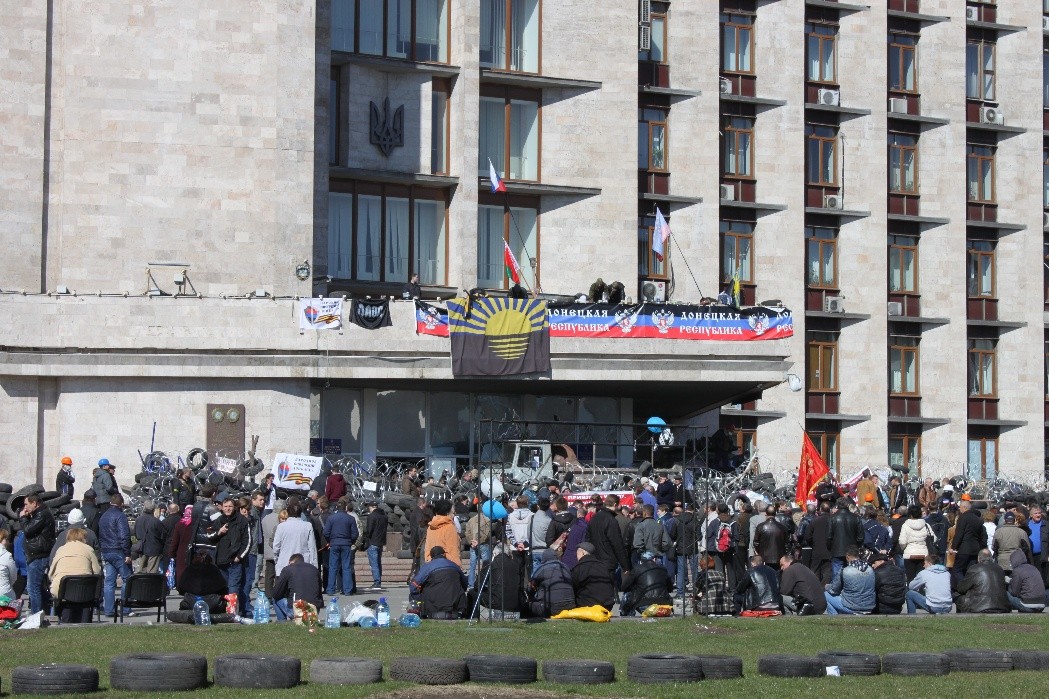
The building of the Donetsk Regional State Administration seized by participants of pro-Russian actions, Donetsk, April 8, 2014. Photo: Steffen Halling.
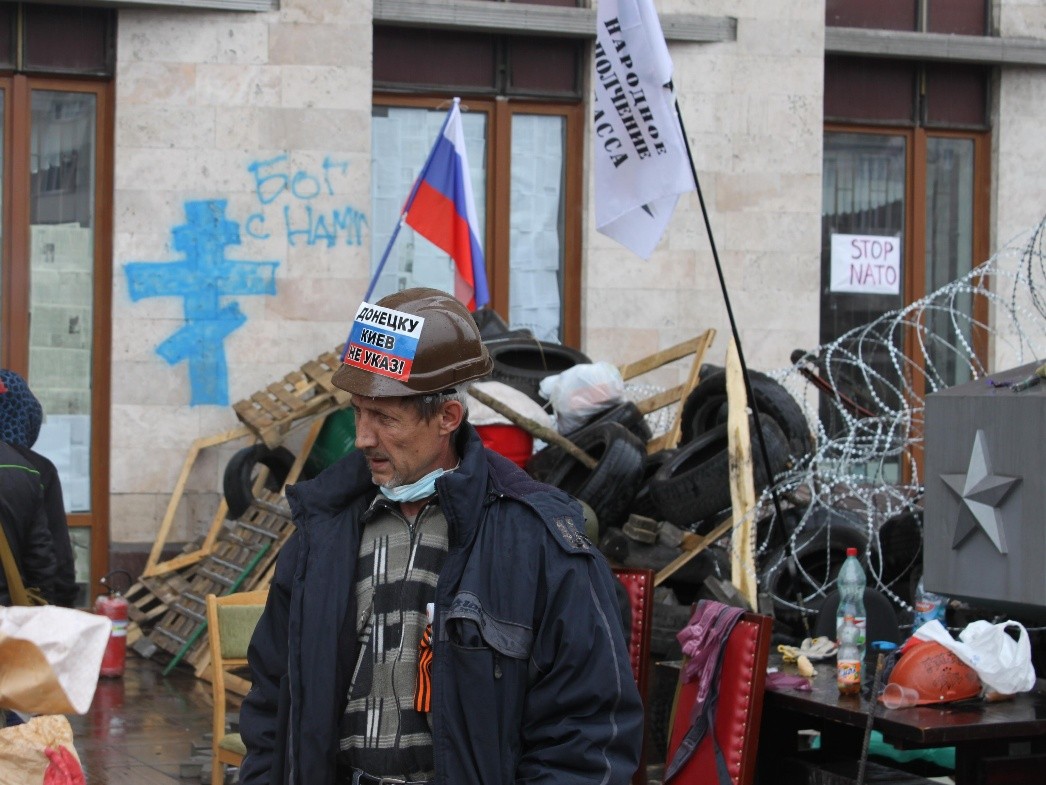
A pro-Russian participant in anti-government riots near the seized building of the Donetsk Regional State Administration, Donetsk, April 8, 2014. Photo: Steffen Halling.
The same was true of the SU building, which had a huge warehouse of weapons. In many other cases, the security forces simply laid down their arms in front of the “kharytonovs with shovel handles”. Of course, the notional “kharytonovs” were led by experienced Russian agents with weapons, instructions and money from Moscow, but the fall of seemingly powerful state and security structures in Donbas before these groups of boorish and stupid people looked pathetic. Many of the so-called law enforcement officers and officials who had been receiving privileged salaries and bonuses, benefits and pensions for years to protect this state, handed it over to the plebeian mob at the first and slightest sign of a real threat.
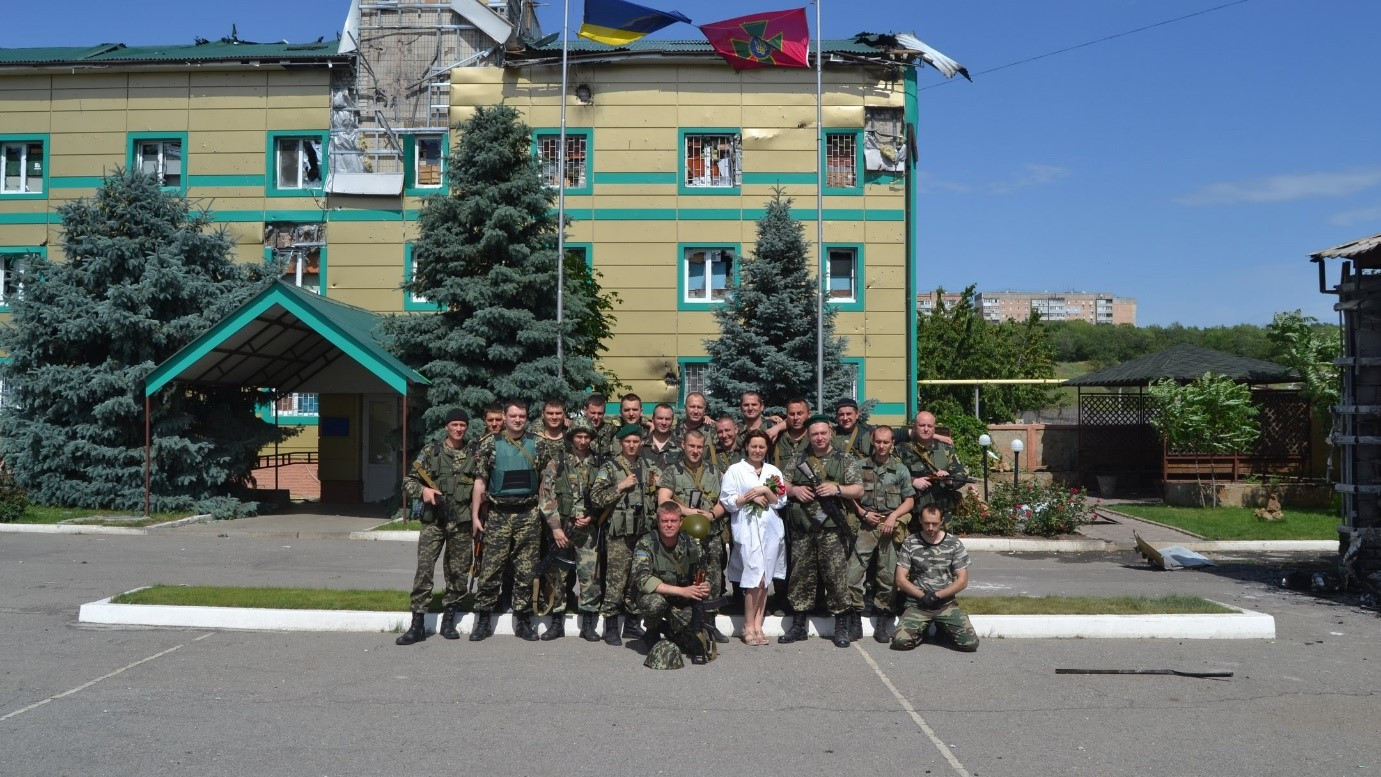
Luhansk Border Guard Detachment: those who heroically resisted the occupiers. Luhansk, June 2014.
Photo: Luhansk Border Guard Detachment, from the web-site of “Suspilne Movlennia”, https://tinyurl.com/26ae4waw.
Unfortunately, in 2022, the situation in Kherson and Sumy was much like Donetsk and Luhansk in 2014. Although this time the cities were captured by the regular Russian army, it was again the civilian self-defence forces and some of the military who put up real resistance to the occupiers. A significant number of security forces and high-ranking officials quickly left these regional centres.
If the authorities in Donbas were incapable of resistance, what was the position of the residents of the two eastern regions? Until 2014, approximately 6.5 million people lived in the Luhansk and Donetsk oblasts. As of the spring of 2024, over a million of these citizens refused to live under the occupation of the so-called “LPR” and “DPR” and moved to the government-controlled territory of Ukraine. They made an involuntary but conscious choice in favour of Ukraine. After all, residents of the occupied territories can leave for Russia and as well as many other countries around the world. There are no official statistics, but we know from our circle of friends that hundreds of thousands of Donbas residents with Ukrainian passports have emigrated to Europe and North America. All of them chose not to stay in Russia. For many of these people, fleeing their homeland has been accompanied by the deaths of their loved ones, huge financial losses, severed family ties, and irreparable physical and psychological damage.
Over a million people made a difficult choice when they realised that it was impossible for them to live under Russian occupation. But where was their civic stance in the first months of 2014?
At that time, a few demonstrations with thousands of participants under Ukrainian flags would have been enough to suppress the “Russian Spring”; local separatism would have been impossible, and not a single shot would have been fired. I do not want to sound like I’m accusing my fellow countrymen. There is no point in such accusations. In fact, at the time, many people did not take the threat of the “Russian Spring”, seriously, including me. It seemed like after a little more time, this circus performance would end.
I sometimes come back to my thought: “Was I radical enough to join in those days?”. Was my participation in public events, media interviews and organisation of new people who would join the civil society movement in the wake of Maidan enough? Or should I have joined my colleagues in a violent confrontation with the supporters of the “Russian Spring”, instead of trying to find a dialogue and nipped this Russian-inspired rebellion in the bud?
I know now that I was wrong, but at the time, violent confrontation seemed impossible and inappropriate. I didn’t like my political opponents, but I perceived them as fellow citizens with their right to freedom of thought and association. I left the right to violence to the state. I believed that in order to protect the constitutional order, we had law enforcement agencies that should preserve the very structure of the state as a basis for interaction between citizens of different political views.
There were people (I bow my head to their immediate reaction and public heroism) who, in the spring of 2014, moved on to intelligence and sabotage work, established contact with the special services and military intelligence, or formed volunteer battalions. My faith in the basic capacity of our local state institutions was a mistake. We will never know how the civilian violent confrontation in Donetsk and Luhansk would have ended (as it did in Odesa), if the supporters of state unity had attacked first. Would we have won, without the support of local law enforcement officers and with the hostile attitude of the majority of the local power elite, if our civil society sector had relied on force? We lost the limited violent confrontation that did take place, both in Luhansk and Donetsk oblasts.
The real key to a potential victory (and the antidote to the occupation) was in the tens of thousands of Ukrainian citizens of the east who did not see the threat as real. They did not consider it necessary; did not have time; did not want and were not used to defending their homeland and their rights in an active constitutional way. Unfortunately, these lessons are costing all of us (and eastern Ukraine residents in particular) very dearly. But it is never too late to learn, and I want to believe that we can do it.
We will do it
I am sure that those who want to, will have the opportunity to return to their home towns and villages after the reoccupation. Just as we once left our homes, so will the occupiers and the families they brought here will run back to Russia. It will not happen without ungrounded violence, but with a sense of justice and an understanding that in the 21st century, the long Russian tradition of preying on other people’s lands is coming to an end. Humanity is changing, and the world is becoming more just, even though it is happening not as quickly as we would like. Justice will come to our home, too.
I believe that I will again be sitting in a train carriage, the wheels will be chattering, and I will be looking out the window, searching for my native landscapes. My heart will clench with the feeling of approaching my home city. The train will pass the Alchevsk Iron and Steel Works, and I will know that only an hour is remaining to Luhansk. I will see steppes and piles of coal refuse, the Olkhovka River, the suburbs of Luhansk, where mostly workers live, and the old railway station... The Kyiv train will slow down and, like many years ago, slowly approach the first platform and the entrance to the city.
I will again be able to visit the graves of my ancestors, the first of whom came from today Zolochiv district in Kharkiv oblast to settle in Donbas back in 1793. I will show my grandchildren the houses and streets where their mother, I, and their great-grandparents lived. We will see the collection of “stone women” in the park of my alma mater, take a drive to the forest park at Hostra Mohyla, which we preserved in the early 2000s, and visit the Shevchenko monument, where people gathered in the Luhansk Maidan. We will walk slowly through the dusty streets of our native Verhunka village, founded by the Zaporozhian Cossacks, abundant with apricot trees, where apricots lie beneath our feet. It will be a peaceful summer evening. We will be standing in the street where I walked to the train station in 2014. The city upon Luhan River, like many years ago, will catch the last rays of the hot orange sun, as the light slowly disappears into the steppes of the Ukrainian Donbas.


