
I’m Still Needed Here, Just a Little
Uncle Vanya
The first page of the passport was dirty, stained with engine oil, with the corners curled up. Uncle Vanya held the document in his hands and was angry with me for not taking pictures fast enough, because they needed to get the people out before the shelling started.
At 6am that day the First Deputy of the Town Mayor phoned me and said:
“Find me a driver for the school bus!”
“Right, we already employ some, six of them”, I answered.
“No, you don’t get it. We need a driver to evacuate civilians to Kamianske….to drive through the shelling.”
He said his piece and hung up, not waiting for further arguments. I quickly went through the names of the drivers in my head. No one, except for Donchenko would agree to this… But he may not even pick up the phone, after receiving that last reprimand…
I phoned:
“Uncle Vanya, we need a driver for evacuation.”
“Got it. At what time and where?”
“Near the church at 7am. We’ll provide the fuel. Except, you know, there will be Russian checkpoints and shelling…”
“I said, I will be there!”
I put the phone down and try to collect my thoughts, so as not to forget anything in haste. We need to hang a white cloth on the bus, and make a sign which says “Dity” (“children” in Ukrainian), so that they don’t come under shelling. I find a snow-white sheet in the children’s cupboard, tear it into pieces and wonder at myself, where I found the strength. Previously, I could only have done this so efficiently with scissors. Then I print out the words “Deti,” yes, exactly, “Deti” (“children” in Russian), in the damned language of the occupiers!
The doors of the school bus closed, hiding people inside (whose names I didn’t know), a little Chihuahua in the arms of some child, and a German Shepherd with no muzzle or leash. I follow the convoy of cars with my eyes and remember the time Uncle Vanya had a fight with the boy from 11th Grade on the bus, I remember all the complaints from the grade school parents about the rudeness of the bus driver, and the number of requests to fire Donchenko. That very same Ivan Ivanovych, who now was rescuing them all from the war.
Strangers in town
The church square gradually quietened down, and the chatter of the local gawkers moved towards the market, leaving behind fragments of conversations about sugar at 100 UAH a kilo, about who was last in the queue for washing powder, and whether they would deliver more matches today… I stood on the white curb and didn’t move. My jacket was not warm enough for the cold spring, and I never wore a hat, not even when it was freezing. To the right of me, an elderly man stood silently, and to the left of me was the town Mayor, who as of today would come every day to see the evacuation convoys off. The town was teeming with Russian soldiers, it smelled of their dirty uniforms and it spoke a foreign language. The town was learning to live in a different way; it was resisting, like a child that doesn’t want to go to daycare or have an afternoon nap. Everything around was changing: the people, the faces, the buildings… and only the dvirnyks, the yard cleaners kept on sweeping the streets through habit.
Serhii Anatoliyevych came up to me, silently raised the hood of my jacket onto my head, as a mother would do to her disobedient child. He put his arm around my shoulders and together we went to the town council building. Before we entered, we stopped to take a selfie with the Ukrainian flag in the background (as of today, this would be our daily ritual).
Another ritual for me was touring the bomb shelters. We had quite a number of these shelters in our town; they were all different according to the amount of protection they gave, their location, and how they were equipped. We would get into the official car. It was me, a few of my colleagues and Gena the driver, who always used to sing along to “Russian Radio” and oddly enough shake hands with the occupiers, when he met them. We would drive along our regular route: Day-care no. 6, the lyceum and the city centre. The shelters were in order, not very many people there, they went home to fetch some duvets for the night. Closer to the highway there was a half-destroyed high-rise building, and not too far away, there was the building where the parents of my friend lived. Now this was not a planned stop. I just ran in to say hello and to check and see if all was there. I went down the familiar stairs.
Only the previous day this used to be storage for all sorts of old junk, which the grandmothers would carefully save for their grandchildren, just in case: the baby carriage with no wheels, a bundle of copper cables, a doll with blue hair and also, I think, missing the left eye…
This shelter was like dozens of others in my town. It remembered the taste of watermelons from Kherson, cherries from Melitopol and warm corn on the cob eaten on the beach in Kyrylivka… When it couldn’t stand listening to the arguments and whining of the teenagers because of the lack of internet service, the shelter would listen to the story of the missile, which would leave behind a rainbow in the sky.
The road of life
I got into the car, still following our plan. I felt tired, because the alarms at night and the early waking had become a normal routine. The time spent under occupation was measured for me in passports, suitcases, vehicles, and pies with cabbage. And also in kilometres, and in particular, by the 15 kilometre Road of Life. That is the distance between two Russian and Ukrainian checkpoints, the town of Vasylivka and the village of Kamianske. At the entrance to the town, the occupiers organized a filtration check point. That’s where the checks took place and often the tortures and the executions of civilians, who wanted to leave the occupied territories. Regardless of which season it was and of the outside temperature, the occupiers made people at the checkpoint undress down to their underwear. Young men, women, the elderly, children. They examined their tattoos, searching for Ukrainian service personnel, and for those that openly supported Ukraine.
This checkpoint was a place of humiliation for those who were living in their own land and speaking their own language. If the filtration check was successful and the occupiers gave permission to drive through, the refugees then started out on the only Road of Life in the direction of Zaporizhzhia, 15 kilometres away. The stretch of road between the two towns was constantly under enemy shelling, was mined and simply too dangerous. When heavy rains fell, part of the dirt road would turn into a muddy trap for cars and buses. So, people were faced with a difficult choice: to stay home and accept the new rules of the occupiers or to leave via the Road of Life towards free Zaporizhzhia. Most chose freedom..png)
The crisis
Many convoys from Kherson, Berdiansk, Melitopol, Enerhodar, and Mariupol started to travel through my town… but it was not for long. The Russians started to block civilian evacuations. There was a humanitarian crisis looming, the terrorizing of Ukrainians continued. The shelves in the stores were empty. The pharmacies were shut. Ordinary goods, which were essentials needed to satisfy basic needs, were unavailable. Humanitarian aid was not reaching the occupied territories; it was being confiscated by the occupiers or they would deny permission for it to enter the town. The community couldn’t supply enough groceries for the locals, let alone the thousands of refugees, who were waiting for a “green corridor” to evаcuate.
The farming enterprise run by Kaliman’s brother started to supply locals with fruits and vegetables for free. That enterprise also provided flour and bread, which had been baked in a local bakery. They would process some cereal wheat, bring in oil, and meat and dairy products. The local farmers and business people were a saving lifeline for all of us. They gave away their own agricultural products, their generators, fuel, machinery and vehicles for the essential needs of the people. In the kitchens and dining halls of various educational institutions, the teachers and admin staff would make tea, and bake cabbage and apple pies, and we would give these to the refugees waiting their turn for evacuation, if the Russian military allowed it. There were cases when approaching the convoys was forbidden. We had food and hot tea ready but couldn’t give it to them. When the occupiers turned the other way, the locals would throw bread and bottles with water into the crowd, at their own risk. The enemy showed no humanity and tried to sow anger among the hapless refugees, but without success. At that time we were all united by a common grief, and also by a common faith in Victory. In those convoys, friendships were born and mutual assistance was discovered. Total strangers would share medicines, blankets, clothing, fuel and food. Could the occupier imagine that an elderly diabetic woman would give away her last dose of insulin to a young mother, that men would go halves on their last cigarette, and that a little boy wearing brand new Ecco sneakers would make sure that there would be enough tea for everybody?
For the occupiers, the civilian convoys were just a live shield, that stopped the shelling from the Ukrainian military. People would wait for a “green corridor” for weeks. They would be weak from fatigue, from the cold and hunger. Babies would fall asleep on bus seats and wake up in the same place.
Kaliman
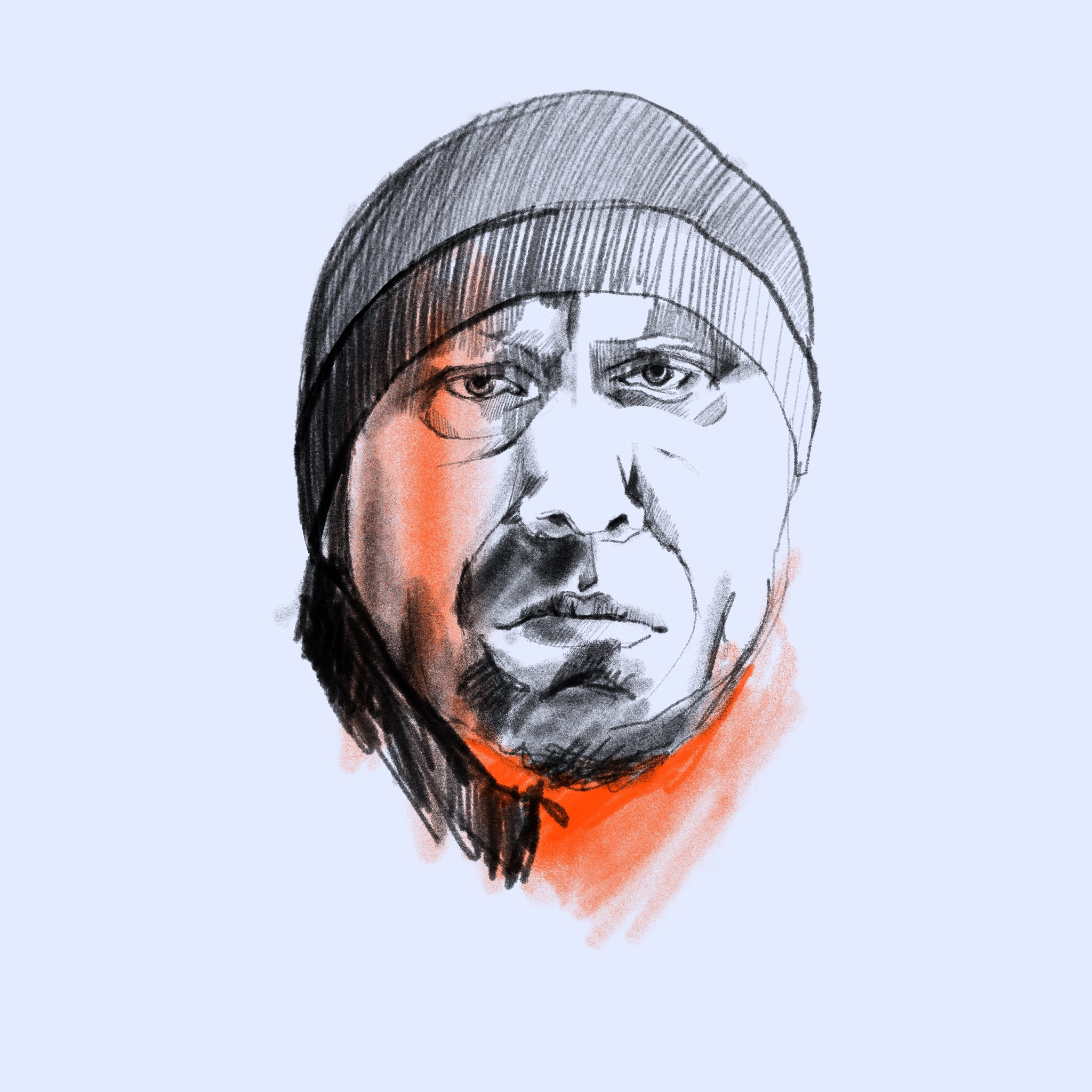 He would always begin his morning in the same way: he would check his Facebook page and do his inhalations, because of his lung disease. Rather, he had only one lung, because part of the other lung had been removed due to a tumour many years ago. Over a few weeks he had noticeably lost weight and had shrunk. He had let his beard grow and had let his normally perfectly-trimmed balding head get untidy. War had changed the pedantic Kaliman.
Today he was at a loss. He felt totally beaten down by the mock execution and the five-hour interrogation at the command headquarters. Before his eyes, humiliation and despair played out in slow motion: he remembered the conference room of the town council, the fresh smell of the recent renovations, of herbal tea and honey. From here they took him under guard to the place of execution. “Am I a criminal then?” He thought, when he was being taken under guard escort through the central town square. His lips were stubbornly pressed together, his cheekbones were moving, they left hollows in his cheeks. You could read silent resistance in each movement of his body. He didn’t know what was waiting for him on the other side of the Command HQ building, but he knew most definitely, that he would not be asking for mercy. He did not plead, he did not ask to be freed when they forced him on his knees, when they said that “He had been taking too many liberties, and he’s not here for long.” He was staring down the barrel of a gun, he heard the sound of the weapon reloading and thought about one thing, he wished that the soldier would have enough skill to shoot precisely on target. The gun fired a round into the fence behind Kaliman’s back, just slightly above his head… This was a mock execution.
Kaliman quickly took his telephone, his leather wrist band from Mount Athos and drove to the checkpoint. “Good God, they were leading me under guard like the worst criminal. What did I do wrong?” and in his thoughts he returned again and again to the town square…. “I thought that I was living a righteous and honest life, always… so that my children should never be ashamed of me.” In his phone he found a photo of his grandchild and trembled. “Yes, I am a criminal—to my family. I say good-bye to them every day, and possibly, it’s forever…”
The refugees from Mariupol
A 17-kilometre-long transport convoy…. The road was packed with buses and cars: school buses, city buses, long distance buses, some with broken windows, doors damaged by shrapnel, vehicles with flat tires, with white pieces of cloth, with signs saying “Deti”… At that time we counted almost five thousand refugees from Mariupol (among them 680 children). They asked for water, warm blankets and baby formula. One mother asked for a litre of petrol, just one litre to put in the car to save her young baby from the cold.
Serhii Anatoliyevych came up to the group of Russian militaries. The old scar under his sportswear reminded him of his brush with death many years ago. The whole convoy became quiet, from Hill you could hear explosions. A bunch of bearded little green men sometimes raised and sometimes lowered their rifles. They gesticulated, with grimacing smiles, and spat in anger through their teeth. Kaliman spoke about something very loudly, it seems he even interrupted the senior one. The bravest people got out of the overfilled buses to gawk. Everybody was waiting for a decision, the right decision, because there was no place to return to.
In an hour it will be curfew; I reach for my phone. My medical mask falls out of my pocket, a reminder of a previous life, when it was scary to die, not from missile shelling but from some unknown Chinese virus. Scrolling through the news feed, I catch myself thinking about the rapid disappearance of the coronavirus. I read: “Evacuation convoys from Mariupol, which were held hostage for several days by the occupiers at the checkpoint in Vasylivka, are now reaching Zaporizhzhia. The refugees are being provided with professional assistance.” The battery in my phone is almost gone. I switch it off and try to inhale deeply, and tears come to my eyes. I knew the price of this “successful” evacuation, the same as everybody, who despite the danger, remained working at their job. That time, together with the refugees from Mariupol, we succeeded in passing through the checkpoints some wounded Ukrainian soldiers, who had defended their country to the last and had hidden from the occupiers.
The work day had ended long ago, but nobody was going home. We wait there silently.
“Denis, take the girls home! Dmytrovych, you take Nastya and Svieta. That’s it, let’s go! Tomorrow will be a hard day again. More convoys are coming.”—he picked up his telephone and his bracelet from Mount Athos. “Let’s go!”
Today in his community there were no people dying.
The unbearable morning
During the night there were air raid alarms and in the morning everything was annoying. I was irritated by the artillery fire, the cold coffee, and the morning, which was repeating itself in the same way every day. I put on my usual jeans and the sneakers with the crack in the sole, and quickly ran to work. Today there were a lot of people in town. The farm women from the closest villages had come to town with milk and meat. People were selling candy and chewing gum and single-serve instant coffee packets out of car trunks. The Russian military were patrolling the town and making eyes at the young women. I instinctively pulled the hood of my sweater lower over my forehead and hid my telephone. I should walk calmly and slowly. But this square with its Russian tanks was just too large for me…
There was once again a crowd of locals near the church with their suitcases and backpacks, with their pet animals and a parrot…
“Tamara Serhiivna, you need to pay me a bonus. I have never evacuated feathered creatures before. Just kidding.” Uncle Vanya and his friend Sasha stood on the stairs in front of the Town council. Now there were two school buses that would evacuate Vasylivka residents.
“Everything OK?“ I asked uncertainly, already knowing the answer.
“We’re ready to go, just waiting for you to say.”
“And when will someone give me the OK to leave?” I catch myself thinking. In organizing the evacuation convoys, I had the opportunity to leave at any time. At the same time I also felt guilty before my own children and in my own eyes. What was keeping me so long in this town that stank of Orcs? What was driving me each day when I went to work on what could be my last day? Possibly, it was confidence in the people who surrounded me, and possibly, a lack of fear, because there was too much of that around for my liking.
What did I really want, standing on that same white curb in that same jacket which was still not warm enough? To get warm, to hide my hands in my pockets? To throw the weight of multifaceted human grief off my shoulders. To throw out all the candle stubs of trench candles from my memories. To tear out from my subconscious the steps of the heavy army boots of the Russian soldiers. To refresh my consciousness, to forget everything and everybody… Except for my memories of the sea, warm, always changeable and calm. Not that I was particularly fond of it, it was more that I loved the emotions that it would evoke.
I loved to watch the sea early in the morning. To breathe in the sun-rise, warm and at the same time so fresh. To sift sand through my fingers and to imagine myself as the creator of the eternal Egyptian pyramids. Did I realize then that I was seeing the sea for the last time, and that when I promised to return in a year, I would be deceiving and betraying the sea?
Time flies by. The innocent souls of refugees, wounded by the war, sift through my fingers like grains of sand, and are scattered by the winds to all corners of the world. Sometime I will join them. But not yet. I’m still needed here, just a little.
Today my Sea is black and deep.
