

Between Black and White
What do you associate with the colour grey? For me, personally, it’s ashes, sadness, and uncertainty. And my sweet home too… because I live in a “grey zone.” The “grey zone” is an area between light and darkness where you can’t be sure about anything. It’s a place where rules are broken, where boundaries are crossed, and a clear division between good and evil disappears. And it’s in the “grey zone” that all kinds of stories happen. One, such story, happened to me. It won’t be about heroism, rather—it’s about the abundance of life.
It happened in one of the villages in the Kharkiv region. Let’s call it village N. It’s located on the bank of an artificial lake, and to get to village N, one has to cross a forest and a bridge that was destroyed on the very first day of the full-scale Russian invasion of Ukraine. Village N is a place of contrasts. Here, bad roads and devastation are combined with splendid landscapes – endless fields, dense woods and a mirror-like river. When the war came, the contrast disappeared, having been replaced by greyness. The houses looked dirty and neglected, with chipped windows and tatty doors. The streets were covered with litter that had not been being picked up for quite a while. Small grocery stores, pharmacies, children’s playgrounds, and cosy cafes were closed. Life seemed to have hit the pause button. Local residents, who could be seen on the streets every now and then, moved fast and kept looking back. They were scared because danger could be anywhere. Fun and joy were long gone from this grey village. Despair and hopelessness were found at every corner, and there were no signs that this could ever change. That’s the “grey zone” for you.
Under the blanket of memories
Here is a multi-unit apartment building. Apartment number 18 on the ground floor, is located in the second section of the apartment building. This is where I live. In addition, all of us, who have the same mailing address, share the basement. This is what my neighbours and I have in common – a shared basement. In many buildings these basements serve as storage for old items, a pantry, parking space for bicycles and strollers, or even mini garages. And since February 2022, the basements have acquired yet another function – shelter.
My first night in the sub-apartment (don’t be surprised, that’s what I call the basement) was “unforgettable.” The air raid sirens kept going. There was chaos and panic in the residents’ online chat. There were rumours about a high probability of Russian shelling. Rumours… “Heard the song but got it wrong.” I’m not a fan of “word of mouth” and this: “someone said something, someone saw something.” I’m all about official data and verified information. However, I got scared that day. I wanted to run away from the whole world and hide somewhere no one would find me. The one who “brings me down to earth and brings me to my senses is my mom. Mom. I look at her with my frightened eyes and try to understand how she manages to keep her cool. Over the last few hours, since the beginning of the full-scale invasion, she seemed to have aged ten years. She copes well, trying not to show her fear but her eyes betray her. I spot desperation in those deep green eyes of hers. A grimace of pain, along with a forced, unnatural smile, are frozen on her face. Mom ordered me to quickly go down to the basement.
My mind was in a haze. I didn’t even notice how I got to the sub-apartment. It’s cold and smells of dampness. Time and time again the question pops up in my head: “What did we do? Why should we, Ukrainians, live like this? Why should we hide in a basement, because the eastern ‘neighbour’ decided to ‘liberate’ us?” A dusty basement, cobwebs everywhere, all kinds of junk? All that gave me an unstable sense of security, for the first time today.
A few minutes later, mom came down. She brought a mattress. Together, we set up our own space next to the big battered box where we stored our old things. I sat down on the mattress and looked around our sub-apartment. On the floor, right by our boxes, lay an old, abandoned children’s blanket. The little, soft-purple blanket with teddy bears on it looked painfully familiar to me. It stirred something deep within me, my heart skipped a beat. “Well, if it isn’t my… my favourite blanket!” I remember it, protecting me from cold nights and guarding my precious sleep, as a true friend would, when I was little. A wave of nostalgia washed over me. My whole childhood flashed before my eyes. I wished I could go back to those carefree days even for a moment. That blanket ensured happiness during the dark times. I actually fell asleep hugging it.
A crater in the heart
It’s sunny. I feel a warmth in my heart. A forest plantation is spread out before me, with a huge variety of trees. The thick branches of mighty oaks look like forked hands. The pines were tall, with trunks which stretched upwards for several meters. There’s a smell of pine branches and oak leaves in the air. Sun rays poke through the branches. The whole forest is filled with the sounds of nature – the bird songs, the rustle of leaves, the rapid stream of the river that flows nearby. Tranquillity. Harmony. Safety.
That’s how it used to be. In a past life, the forest plantation used to be a place of harmony, but now it has become a place of chaos. There is a crater in the centre of the plantation now. A crater created by an explosion of a Russian rocket. A radius of 10 meters, 6 meters deep. Abyss… The size and depth of the crater are striking, in a negative sense. Bushes and trees are scattered around the crater, within a radius of about 30 meters. They didn’t survive the shock wave. People survived though – fortunately, there were no casualties after the hit. There is a strong smell of smoke and burning near the place where the rocket hit the ground. To think about how many lives that rocket would have ended, had it struck say 300 meters to the right or left, is scary. How many tears would have been shed in this forest plantation?!
As weird as it may sound, the crater has become quite a popular spot among the village residents. A lot of people would flock to the crater with one goal in mind—to take pictures. To record our history. To document Russian crimes. To remember this moment and understand how much they have gone through already and how much more was yet to come. I myself have stood on the edge of that crater. I don’t know why I did, but that’s how I felt, at the time. It was creepy. Standing a step away from the “earthly abyss”, I felt vulnerable and helpless. I felt like a small, insignificant person in the middle of a war. I saw how much damage had been done by one rocket; and there were hundreds of them across Ukraine. Yes, of course, you can get the rocket out of the ground, cover up the crater, and it will be as if nothing ever happened. But it’s impossible to fill up the crater in the heart.
A story about bread and growing up
For the first time since the beginning of the full-scale Russian invasion of Ukraine, the day was relatively quiet. Fortunately, the air raid alert went off only once (though it would have been better if it didn’t go off at all). I decided to seize the opportunity and finally spend the night at home, in a cosy room, in a warm bed with my favourite stuffed toy. I was a little scared. Intrusive thoughts were creeping into my head. “What if shelling starts at night? What if I don’t make it to the basement in time?” And many more of those if’s. In the end, I did stay at home. I was lucky—the night was peaceful.
Around six o’clock in the morning I heard voices in the yard. Female, male, high, low, hoarse, gruff, twang, elderly, grumpy, whiny—there were different voices there. At first, I didn’t even understand what sort of meeting was going on under my apartment windows. It turned out all those people (and there were about 25-30 of them) came here with one purpose—to get in line at the store. It was a bread delivery day. Bread disappeared from the shelves of local grocery stores as far back as February 24. For about two weeks there were no resupplies at all in the village. One might think that bread is an ordinary food product that every Ukrainian has on their table. Not now, however. Not during the war when bread becomes a luxury. So, our local women started to bake bread themselves, to somehow meet the demand. Naturally, there wasn’t much of it, but it was available. And that’s already something.
Some people came to the store at six in the morning for a loaf of fragrant bread with a crispy crust, although the store doesn’t open until eleven. I understand them because we are in the same situation. We are all surviving on humanitarian aid and food stocks were purchased on the first day of the invasion. Grandma’s preserves and pickles helped, too. “Grandma, why do you keep canning those jars. It’s so much trouble… It’s easier to buy them in a store,” I used to always say. However, my grandma was adamant: for her, canning was a special kind of meditation. Over the years, it finally dawned on me as well that one should not rely solely on stores, it’s good to have some food stocks at home. Well, I’m growing up fast!
Pilaf under fire
There were 12 of us in the sub-apartment in the basement, back then, on that first horrible day of the full-scale invasion. Days passed, and many neighbours managed to evacuate. There are three routes to get out of the village: two of them through the occupied territories, and the last one was through the city where the fighting was going on. The village was literally surrounded on three sides, isolated from the region. People still took risks. People fled. People were afraid of Russians coming to the village. They were afraid of occupation.
Within a month of the full-scale invasion, our basement crowd had dwindled down to 4 people: an elderly couple, my mom and me. Lubov Pavlivna and Anatolii Petrovych are my neighbours from the apartment across the hall who don’t like it when I address them so formally. That’s why they are simply grandma Liuba and grandpa Tolia. They have been living in perfect harmony for 45 years now. I think that grandpa Tolia and grandma Liuba are incredibly similar to Mr. and Mrs. Fredricksen from the cartoon “Up”. Grandpa Tolia is 70 and he is a bit of a grump. He is not too fond of people but he loves birds. Therefore, it’s not surprising that he devotes most of his time to pigeon breeding. And he is helped by his wife—a super-positive grandma, Liuba, who melts the heart of her grumpy husband every day. The full-scale invasion destroyed that paradise.
These neighbours flatly refused to leave the village. “Where we were born is where we will die”, they repeated those words like a mantra. We were together during all the air raids. My mom always loved to cook. That’s why I wasn’t surprised when I saw her bringing a pressure cooker to the basement one day. To my mom cooking was what canning was to my grandmother—a special kind of meditation. It runs in the family. “Now we are going to cook my signature dish—pilaf!”, mom said cheerfully and assigned a task to everyone. Grandpa Tolia handled carrots and onions, while grandma Liuba chopped meat. I got the most important mission – to peel garlic, a lot of garlic. Alerts, shelling, missiles, bombs – we forgot about all that while we were cooking pilaf. We talked, laughed, shared real-life stories. We were happy, we were in the moment. I hope that in the near future grandpa Tolia will release one of his pigeons into the sky over free Ukraine!
Behind the scenes of the Palace of Culture
It’s the morning of April 11, 2022. In the Village N, I’m approaching the local Palace of Culture. It has always brought me warm memories. I remember my first performance on the palace stage. I remember how nervous I was. I was a member of the dance team called Inspiration. Back then, in 2010, the thing I was afraid of the most was forgetting my choreography, making a mistake.
Backstage, the air is filled with anxiety. I’m wearing a short but such a cute light pink dress. My mom braided my hair into tight pigtails so that it wouldn’t get in the way during the performance. Literally 10 minutes ago she gave me a Little Fairy perfume and told me that I was the best and that I would be fine. I was beyond happy but my nervousness didn’t go away. I could feel my heart beating fast with anxiety, my hands shaking. I didn’t notice how I adjusted my pigtails, tapping my foot nervously on the floor. When the presenter announced our dance team’s name, I felt my heart stop for a moment.
I fondly remembered my first stage performance, which seemed like a global catastrophe; my innocent time when I didn’t know what war was. Right now I’m standing in line in front of the Palace of Culture, a place so close to my heart and so alien at the same time, to get humanitarian aid. Humanitarian aid for people affected by the war and I came here for sugar. We ran out of our pre-war stocks of the so-called “white death” a week ago. The shops are empty. And I would kill for some sweet tea…
There was an explosive sound. My heart was pounding, hoping that it’s not an air raid. It came from different directions all at once, it seemed. There were screams, panic, and chaos. Frightened people were rushing to the Palace of Culture. Someone was sick. Someone was silently crying. Someone was praying. Someone clutched at their chest. And someone fainted. I was frantically searching my purse for some medicines to help those who didn’t feel well. Amidst all that commotion, I noticed a small boy, about seven years old, sitting on the floor of the Palace of Culture, with his arms wrapped around his knees. He was very slowly and carefully swaying from side to side. His face was contorted with tension and fear, and his breathing was deep and uneven. The room got stuffy. When the boy took off his jacket, his hands were shaking, and his eyes seemed to be looking for someone but not finding them. It turned out that the boy’s name was Denis. His house was a five-minute walk from the Palace of Culture. He said he came with his mother to get humanitarian aid. A few minutes before the shelling began, Denis’ mom ran home to check on his little sister. The boy stayed in the line alone. When the shelling started, he was very scared. I hoped his mom comes back, soon. In the meantime, I am trying to calm the child down and cheer him up somehow. The shelling doesn’t seem that loud anymore. People are starting to leave the Palace of Culture. Amidst the crowd at the door, a woman going against the flow stands out—she is trying to get inside the building, rather than getting out. Denis’ happy eyes tell me that it’s his mom. A joyful moment of family reunion. I feel incredibly relieved, as my little “palace companion” is in safe hands.
The shelling has stopped. I am walking home along the street, surrounded by dead silence, as if everyone has died. I can’t even hear any dogs or cats. Only the sound of my own footsteps on the asphalt breaks the silence. Just two months ago, this street was bustling with life, alas it seems neglected and abandoned now. That felt scary and creepy.
It’s never going to be “as it used to”
April 11, 2022. Village N. It’s lunchtime, and I’m on my way home after a shelling. The premonition that something bad is about to happen never leaves me. I am worried. And rightly so, as it turns out.
My apartment greets me with a mess. All the cabinets and drawers are turned upside down, my things are scattered all over the apartment, and there is a pile of suitcases on the floor. “No way.” I thought. My mom came out of the room, worried, and said the words I wish I could forget, forever. “Russians are in the village. We are occupied. We’ve got to run.” My heart was pounding incessantly, my hands were shaking. My mind went blank. My heart sank. To stay and live under occupation? Or to leave everything behind and run away into the blue? “Living under occupation” sounds absurd. Because one doesn’t live under occupation, one survives, that’s if they stay alive in the first place. I realised that the move was inevitable. Although a protest was raging in my heart. I absolutely didn’t want to leave my own home. And it’s not even about the apartment being of a material value. Not at all. First of all, my small apartment is a place of memories and happy moments in my life. That’s why, leaving my apartment, I lost a piece of my soul. I buried it in the village of N.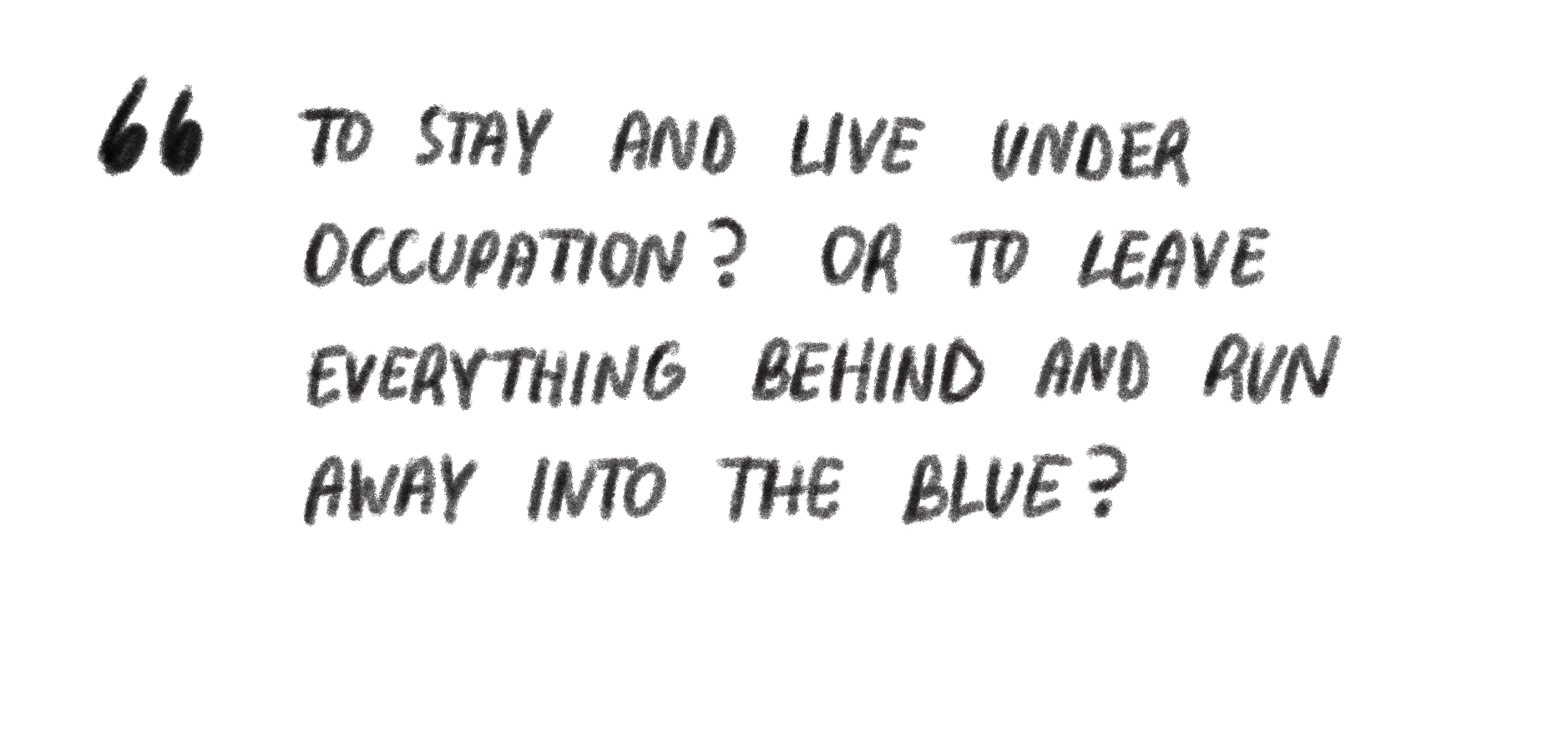
Relocation is a ten-letter word and implies hundreds of kilometres at the same time. Relocation is a period of uncertainty and tension. I was riding in the back seat of the car and looking out the window. A grey, faceless village, but so dear to my heart, nevertheless. It’s mine. My childhood passed here, here I learned to love, hate and just live. I didn’t know if I would ever be back here again. I didn’t know whether my apartment would be hit. I didn’t know if I would make it to a new place of residence at all. I didn’t know if I’d survive. I was scared of the future… But what I knew for sure was that it would never be “as it used to.”
The sun set below the horizon, leaving behind a bright red streak in the sky. A regular sunset on my street. There’s one difference though: my street is not mine anymore. Had I not evacuated the occupied village, I might have stood on this street, watching the sunset and listening to the battle sounds. I might have seen the Russians ruining my apartment. I might have witnessed my fellow villagers die at the hands of the Russians. I might have died myself.
Now, looking back, I realize how timely my evacuation was. A new stage has begun in my life, but I still don’t know what to do with myself. There is still hope in my heart that the war will be over soon, and I will finally come out of the “grey zone” into the light, into the sun. One fine day, I’ll return home!
