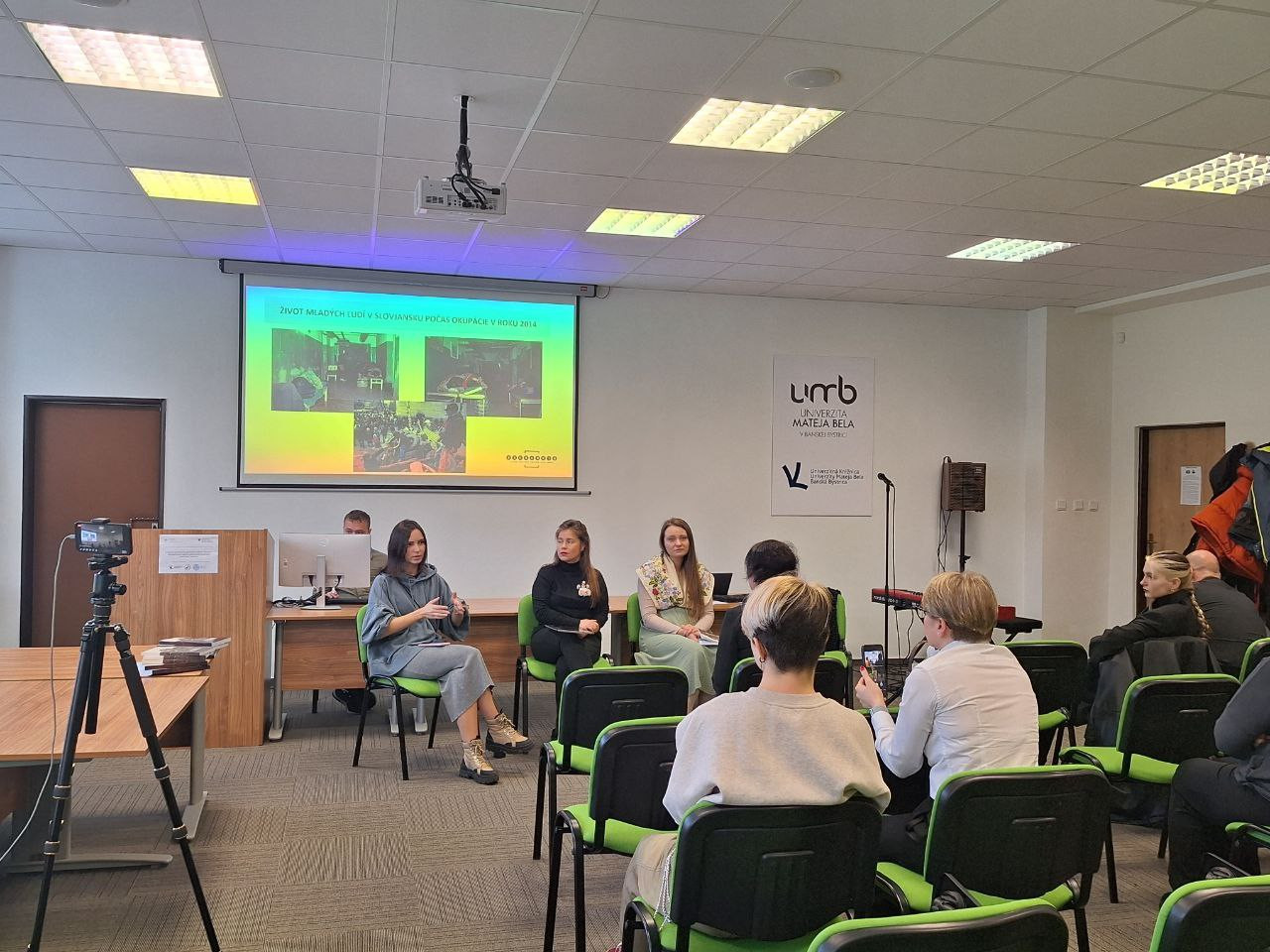
On 21–22 November, human rights activists of the “Eastern Ukrainian Center for Civic Initiative” presented the book ‘The City Where the War Began’ and discussed the Russian-Ukrainian war in Slovakia. The events were held at the Educational Centre of the Matej Bel University in Banská Bystrica and for high school students at the Bilingual Secondary School Evangelical United School in Martin.
The book ‘The City Where the War Began’ describes the occupation of Sloviansk in 2014, after which the Ukrainian government announced the start of an anti-terrorist operation. Almost a decade has passed since then, while hundreds of other Ukrainian cities are experiencing the tragic fate of Sloviansk.
“The book consists of 10 chapters that cover various aspects of life under occupation. Separate chapters are devoted to Russian propaganda, the creation of illegal detention facilities, the reaction of local authorities to the occupation, problems of access to medical care, religious discrimination, and the involvement of teenagers in illegal armed groups,” said Alina Serha, EUCCI’s project manager.
Kapitalina Pasikova, an eyewitness to the events and a representative of the Civil Society Center “Drukarnia” shared her memories of the occupation of Sloviansk. She described how pro-Russian rallies gradually began to appear in the city, and she and her friends decided to show that they had a different opinion:
“These people didn’t want to hear us. They didn’t like what we were saying, and they tried to kick us out. The next week, we gathered more like-minded people and held a big rally of those who were in favour of European values. People of the opposite opinion, who were older, gathered on the opposite side. They told us how good life was in Russia and that we were provocateurs, that we were not from Sloviansk at all and that we had been paid for. They were aggressive, and the police did not react... They did not allow us to express our position.”
Later, the city was seized by armed men. Kapitalina’s parents realised that those people were not Ukrainians, but Russians, in particular, by the specific word “poriebrik” they heard [transl. note: “poriebrik” (порєбрік) is Russian for curb, used particularly in Russia]. Ukrainians have never called a curb like that.
The participants of the events discussed the tools for influence used by Russia to implement the occupation. In particular, the issue of distortion of historical and current events.
Complaints that the Slovak media space lacks positive information about Ukraine and Ukrainians were also voiced during the discussion. At the same time, the dominance of Russian propaganda is felt.
“I have lived in a peaceful country for 35 years and knew what war was only from stories. When they said that Russia might attack, I realised that that country was not entirely friendly, but the war seemed like something impossible. Now, we are in peaceful Slovakia. I don’t want to threaten you with our presentations, but you need to realise that war comes very unexpectedly and in peaceful life you need to do everything to preserve this peace,” said Volodymyr Shcherbachenko, head of the EUCCI.
The book has been presented in various communities of Ukraine since 2019. In 2023, human rights defenders obtained the opportunity to hold presentations abroad to bring the truth about Russia’s aggression to people from other countries. Similar events have already taken place in Poland.
The presentation of the book in Banská Bystrica was supported by the NGO Mareena.sk and Matej Bel University.
The book was presented in Martin with the assistance of the Evangelical United School in Martin and the support of the Ukrainian Community Centre in Martin.


The book ‘The City Where the War Began’ was prepared by the NGO “Eastern Ukrainian Center for Civic Initiative” together with partner organisations (Vostok SOS, Human Rights Centre for Public Research, the “Moloda Prosvita Prykarpattia” NGO, NGO “Public Committee for Protection of Citizen’s Constitutional Rights and Freedoms”, which are members of the Coalition “Justice for Peace in Donbas”), with the support of Kurve Wustrow — Centre for Training and Networking in Nonviolent Action as part of the Civil Peace Service (CPS) programme funded by the Federal Government of Germany.
